
The New Guard: Why the Vanguard Pro 96 Matters
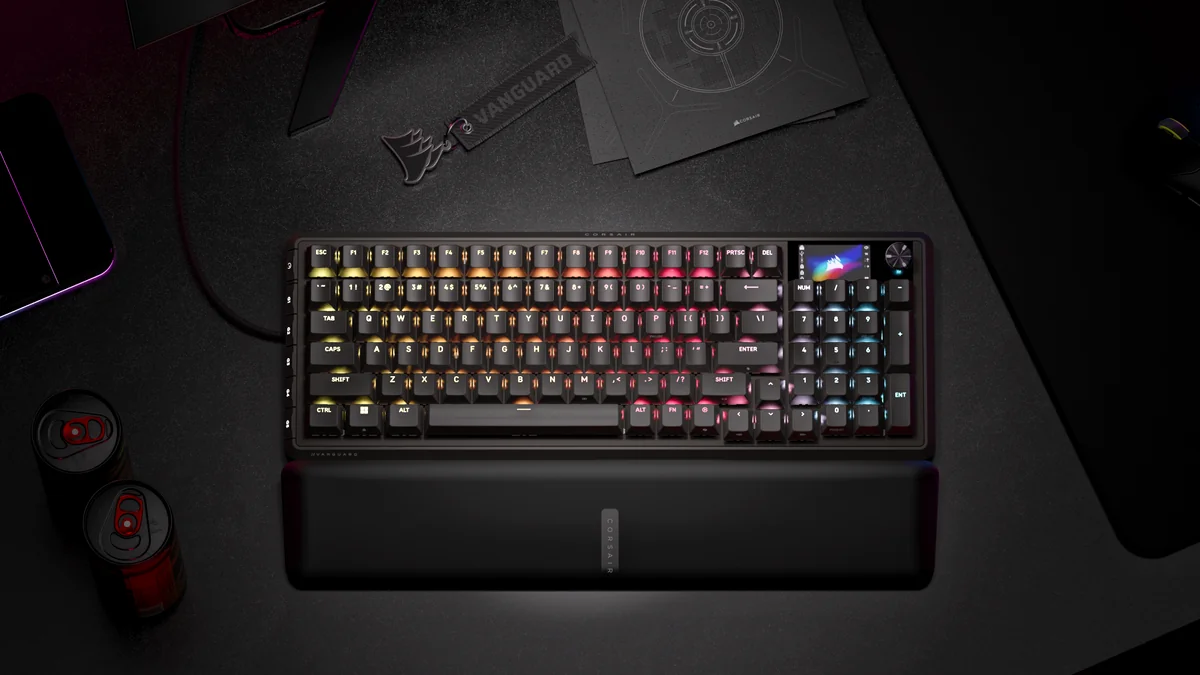
The Vanguard Pro 96 arrives as a dense, 96% layout powerhouse designed to reclaim Corsair’s territory in the enthusiast space. Retaining the numpad while slimming down the footprint to save precious desk real estate, it enters the fray with a premium $240 price tag. Its primary weapon is the inclusion of MGX Hall Effect switches—a magnetic leap forward that signals a major shift in how the brand approaches high-performance input, moving away from traditional mechanical contacts toward a future defined by magnetic flux.
Key Takeaways
- 0.1mm actuation precision for hyper-responsive competitive inputs.
- A pivot to the lightweight, web-based Corsair Web Hub software over the legacy iCUE suite.
- Blistering 8,000Hz polling rate for industry-leading input latency.
- A controversial plastic-heavy frame that challenges its premium price positioning.

Magnetic Mastery: The MGX Hall Effect Advantage
The MGX Hyperdrive switches represent a fundamental departure from traditional mechanical contact points. By utilizing Hall Effect sensors to measure magnetic flux, the Vanguard Pro 96 can detect exactly how far a key is pressed with surgical accuracy. This allows for granular actuation adjustments ranging from a hair-trigger 0.1mm to a deep 4.0mm. More importantly, this physics-based approach enables Rapid Trigger—resetting the key the instant you lift your finger—and Flash Tap (SOCD). For competitive shooters, this means jiggle-strafing and counter-strafing are executed with a level of precision that traditional switches simply cannot match.
The Software Schism: Leaving iCUE Behind
“The fact that it doesn’t integrate with iCUE was a deal breaker… part of the reason I purchased this was because it would all be controllable in one program.”
Corsair is making a bold, if polarizing, move with the Corsair Web Hub. This browser-based utility is a breath of fresh air for those tired of bloated background processes, offering a lightweight, no-install way to tune actuation and lighting. However, for the Corsair faithful who have spent years building a unified ecosystem of fans, RAM, and peripherals, the lack of iCUE integration creates a frustrating schism. You gain performance efficiency, but you lose the ‘one-stop-shop’ convenience that has been a cornerstone of the brand’s identity for a decade.
| Model | Price | Switch Type | Software | Build | Connectivity |
|---|---|---|---|---|---|
| Corsair Vanguard Pro 96 | $240 | MGX Hall Effect | Web-Based Hub | Plastic/Alum | Wired (8kHz) |
| Wooting 80HE | $199+ | Lekker Hall Effect | Wootility (Web) | Plastic/Zinc | Wired (8kHz) |
| Keychron Q6 Max | $210 | Gateron Jupiter | VIA/QMK | Full Aluminum | Wireless/Wired |
Built for Speed, Not for Weight
- Integrated 1.9-inch LCD screen acting as a heads-up display for real-time setting control and logo customization.
- Five dedicated G-keys for macros, fully compatible with Elgato Stream Deck software for creator-focused utility.
- Textured aluminum rotary dial for precise volume control and application switching.
- Magnetically attaching padded wrist rest designed for ergonomic comfort during long competitive sessions.
Watch our detailed hands-on review to hear the acoustics of the pre-lubed MGX switches and see the 8,000Hz polling rate in action.
Pros
- Elite 0.1mm actuation precision for competitive play
- Lightweight, no-bloat web software utility
- Exceptional 8kHz polling rate for sub-1ms latency
Cons
- High price point for a predominantly plastic construction
- No wireless connectivity options
- Fragmented software ecosystem for existing Corsair users
Review Score
9.5/10
7/10
8/10
6.5/10
Final Verdict
The Vanguard Pro 96 is undeniably Corsair’s best-feeling keyboard to date, pushing the boundaries of raw input performance with its MGX switches. However, its high price and the sudden move away from the iCUE ecosystem make it a specialist tool for performance purists rather than a mandatory upgrade for the Corsair faithful. If you crave 0.1mm precision and 8kHz speed, it’s a titan; if you want a premium aluminum ‘thock’ and unified software, the trade-offs may be too steep.