
The AI Invasion: Which Coding Agents Will Redefine Game Development?
The very fabric of software development is undergoing a seismic transformation, with artificial intelligence evolving far beyond the realm of predictive text and basic autocomplete. We are witnessing the dawn of truly agentic AI systems, capable of understanding complex project structures, planning multi-step implementations, and even generating entire applications from high-level prompts. For game developers, this paradigm shift presents both exhilarating opportunities and formidable challenges. The ability to offload repetitive coding, automate testing, and rapidly prototype game mechanics could unlock unprecedented creative freedom and accelerate development cycles. However, it also demands a new level of ‘AI literacy’ – a precise understanding of which agents are robust enough for the intricate demands of game logic, and how to effectively integrate them without compromising creative vision or code integrity. At LoadSyn, our scientific approach demands empirical validation: which of these intelligent assistants are truly ready to be co-pilots in the high-stakes world of game creation?

Key Takeaways
- OpenAI Codex demonstrated superior capabilities in generating a functional and feature-rich web-based Minesweeper clone, including advanced gameplay elements.
- Claude Code offers robust agentic features, comprehensive context understanding, and powerful automation tools that extend beyond simple code generation.
- Not all AI coding agents are created equal: while some excel in specific tasks, others (like Google Gemini CLI in this test) still show significant limitations.
- The integration of AI into development workflows requires understanding unique features like CLAUDE.md for project context and ‘Plan Mode’ for complex tasks.
- The broader landscape sees competition from tools like GitHub Copilot and Cursor, each with distinct strengths for different development needs.
- Despite advancements, human oversight, strategic prompting, and continuous learning remain crucial for maximizing AI’s potential and addressing concerns about job security.
Contenders in the Code Arena: OpenAI Codex, Claude Code, Mistral, and Gemini
To conduct a truly definitive analysis, it’s imperative to first establish a baseline understanding of our chosen contenders. We meticulously selected four prominent AI coding agents, each representing a distinct philosophy or market position, to undergo a rigorous, real-world game development challenge. Our aim was to move beyond theoretical benchmarks and observe their practical efficacy in a scenario directly relevant to our audience.
- OpenAI Codex: The foundation behind many generative AI coding tools, known for its strong general-purpose code generation capabilities.
- Claude Code (Anthropic): An agentic AI assistant focused on deep code understanding, multi-step reasoning, and ethical AI principles.
- Mistral Vibe: Often praised for its efficiency and ability to produce functional, albeit sometimes basic, code with fewer resources.
- Google Gemini CLI: Google’s command-line interface for its Gemini model, aiming to provide a direct coding assistant experience.
The Minesweeper Gauntlet: A Practical Test of Skill
To empirically validate the capabilities of these AI coding agents, we devised a practical test: the creation of a web-based Minesweeper clone. While seemingly straightforward, Minesweeper is a deceptively complex game that demands sophisticated logic for fundamental elements such as dynamic grid generation, intelligent cell revelation, accurate flag placement, and precise win/loss condition management. Beyond core functionality, we pushed for advanced features like ‘chording’ (revealing adjacent cells with a single click) and integrated sound effects, which test an AI’s ability to handle nuanced requirements and integrate external assets. Our rigorous evaluation criteria encompassed overall functionality, the successful implementation of advanced features, aesthetic quality and user interface (UI) design, and critically, the resulting playability and underlying code structure. This gauntlet was designed to expose the true strengths and weaknesses of each agent in a tangible game development context.
| AI Agent | Functionality | Advanced Features | Aesthetics/UI | Playability |
|---|---|---|---|---|
| OpenAI Codex | Fully functional game with core logic implemented correctly. | Superior, included advanced features like ‘chording’ and sound effects. | Clean and intuitive, highly polished. | Excellent, smooth and responsive gameplay. |
| Claude Code | Functional core gameplay, but some inconsistencies. | Limited, primarily focused on core mechanics, lacking advanced features. | Aesthetically appealing, but some UI elements were less practical. | Good, but some gameplay features were missing or buggy. |
| Mistral Vibe | Basic but functional game, core logic present. | Minimal, no advanced features beyond essential gameplay. | Simple and unrefined. | Basic, but the game was playable. |
| Google Gemini CLI | Failed to generate a playable game. | N/A | N/A | Failed to launch or operate correctly. |
Claude Code Unpacked: The Developer’s Agentic Powerhouse
While our targeted Minesweeper challenge offered an illuminating snapshot of raw code generation, it only scratched the surface of what an advanced agentic system like Anthropic’s Claude Code truly offers. Unlike many AI tools that function primarily as intelligent autocompletion or snippet generators, Claude Code is engineered to be a comprehensive coding companion. Its true strength lies in its agentic capabilities: the profound ability to ingest and understand entire codebases, meticulously plan complex multi-step implementations, and rigorously adhere to established coding standards and architectural patterns, all facilitated by a suite of unique, developer-centric features.
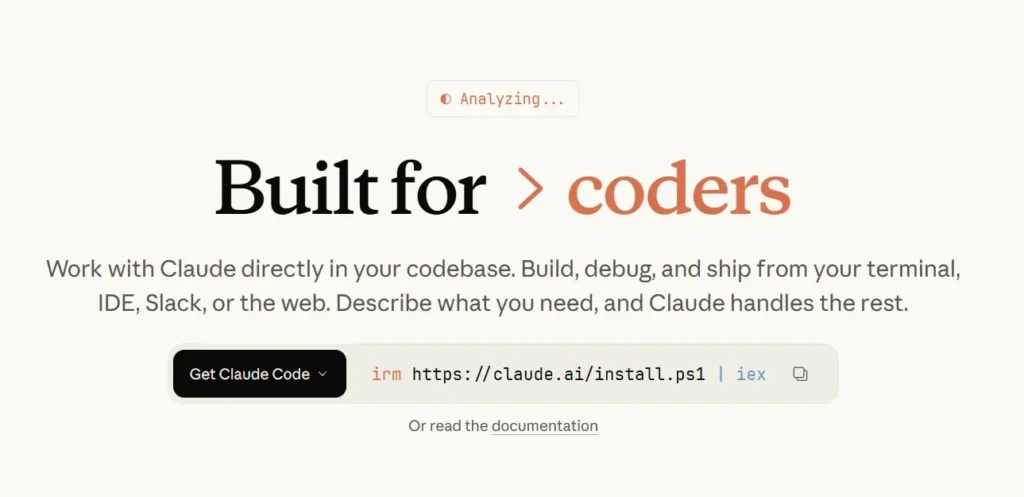
- Installation & Setup: Claude Code is typically installed via npm, integrating directly into your terminal. It requires an Anthropic API key for access, offering CLI, desktop, and cloud interfaces.
- CLAUDE.md File: This Markdown file at your project’s root acts as Claude’s onboarding guide. It defines tech stack, project structure, coding standards, and workflow rules.
- Plan Mode: A critical feature allowing Claude to ‘think before it codes.’ In this mode, Claude can read, search, and ask clarifying questions but cannot execute changes.
- 200,000-Token Context Window: Enables it to ‘remember’ and reason across vast codebases, a significant advantage for complex projects.
Pro Tip: Master Your CLAUDE.md
Treat your CLAUDE.md as a living document. Commit it to version control and continuously refine it with your team’s evolving coding standards and architectural decisions. This ensures Claude consistently aligns with your project’s unique requirements, saving hours of corrective prompting.
An introductory tutorial to Claude Code, covering essential functionalities for new users.
Claude 3.5 Sonnet: Key Technical Specifications
Pros
- Best-in-Class Coding: Excels in complex tasks and debugging.
- Massive Context Window: Maintains context across many files.
- Agentic Capabilities: Autonomous planning and execution.
- CLAUDE.md Customization: Project-specific standards.
- Cost-Effective: High intelligence at competitive pricing.
Cons
- Slower Response Times: Compared to rapid short-form competitors.
- Mathematical Gaps: Weakness in formal proofs.
- Knowledge Cutoff: Training data ends April 2024.
- Partial Autonomy: Still requires oversight for complex tasks.
- Infrastructure Limits: Potential traffic limits on AWS Bedrock.
OpenAI’s Canvas and the Broader AI Landscape
While Anthropic has made significant strides in championing deep agentic workflows with Claude Code, OpenAI has strategically countered with ‘Canvas,’ a new interface for ChatGPT. This innovative feature is explicitly designed to foster more natural and fluid collaboration on both writing and coding projects. Canvas introduces a dedicated, editable workspace that operates in tandem with the traditional chat window, directly addressing the need for iterative development and offering a compelling alternative to features like Claude’s Artifacts.
- Editable Workspace: A dedicated window beside the chat for direct editing.
- In-Line Edits: Highlight sections and prompt ChatGPT to make specific changes.
- Coding Shortcuts: Buttons for comments, reviews, or troubleshooting.
- Iterative Development: Fixing parts of output without regenerating everything.
- Model-Driven Activation: GPT-4o automatically launches Canvas for complex tasks.
| Feature | Claude Code | GitHub Copilot | ChatGPT/Codex | Cursor |
|---|---|---|---|---|
| Interface | Terminal (CLI) | IDE Plugin | Web/API (Canvas) | Full IDE |
| Context | 200,000 tokens | ~8,000 tokens | 128,000 tokens | Project-aware |
| Approach | Agentic | Autocomplete | Conversational | Refactoring |
| Best For | Architecture | Boilerplate | Brainstorming | Large Refactors |
The Human Element: Impact on Game Developers
The rapid, almost relentless, advancement of AI coding agents inevitably sparks critical questions within the game development community. From our empirical observations, the consensus firmly leans towards augmentation. AI, particularly agentic models like Claude Code, excels at automating mundane, repetitive tasks, generating boilerplate code with impressive speed, and providing robust initial drafts.
The sentiment from the community is clear: ‘Kya hum game bhi bana sakte haines’ (Can we even make games?) and ‘Engineer ki job khatre mai hai’ (Engineer’s job is in danger) reflect both the curiosity and anxiety surrounding AI’s role. It’s a journey of discovery for many.
Final Verdict & Essential FAQs
The landscape of AI coding agents is rapidly evolving. While OpenAI Codex demonstrated impressive out-of-the-box performance for game generation like Minesweeper, Anthropic’s Claude Code stands out for its deep agentic capabilities and extensive context understanding. The future isn’t about choosing one tool but strategically integrating the strengths of each into a fluid, human-augmented workflow. Developers must become adept ‘AI conductors,’ orchestrating these powerful agents to build the games of tomorrow.
Is AI coding going to replace game developers?
Highly unlikely. AI coding agents are tools for automation and debugging designed to augment human developers, freeing them to focus on creative design and higher-level problem-solving.
Which AI coding agent is best for game development?
OpenAI Codex excelled in direct generation, while Claude Code is superior for complex project management and multi-step reasoning.
How important is ‘prompt engineering’?
Extremely important. The quality of your prompts directly dictates the quality and relevance of the AI’s output.
Can these AI tools create entire games from scratch?
While they can generate functional prototypes, human creativity and nuanced problem-solving remain indispensable for full-scale development.