

Key Takeaways
- The Evnia 27M2N5901A is a 27-inch Fast IPS ‘Unicorn’ contender, combining 4K fidelity with a specialized high-speed 1080p mode.
- True Dual Mode functionality allows an instant toggle between 4K UHD at 160Hz and a blistering 320Hz at 1080p for competitive frame-chasing.
- Built for the hybrid professional-gamer, it features a 65W USB-C Power Delivery port, an integrated KVM switch, and surprisingly beefy 2x5W stereo speakers.
- The Evnia Precision Center introduces specialized AI tools like Smart Sniper and Stark ShadowBoost, while 3-sided Ambiglow provides high-end bias lighting.
- At a disruptive £329.00 MSRP, it challenges the market by offering premium productivity and esports specs without the standard ‘OLED tax’ or budget-tier compromises.
The Dual-Mode Strategy: Why 4K/160Hz Isn’t Enough Anymore
The display landscape has been fractured by a central conflict: gamers demand cinematic 4K fidelity for single-player epics, yet achieving ultra-high frame rates (300Hz+) remains mandatory for peak competitive performance. Philips’ Evnia 27M2N5901A is engineered as the definitive answer to this hybrid challenge. This 27-inch Fast IPS panel doesn’t force a compromise; it offers a true Dual Mode solution, a technical feat that’s rapidly gaining traction in the market, with competitors like MSI and Asus also exploring similar ‘dual-mode’ LCD technologies. Users can enjoy the crisp 4K (3840×2160) resolution at a fluid 160Hz refresh rate for graphical showcases, benefiting from the IPS panel’s superior color accuracy (95% DCI-P3, 130% sRGB, 90% Adobe RGB coverage) and wide 178°/178° viewing angles. However, when milliseconds matter in esports titles, the monitor dynamically drops the resolution to 1080p (1920×1080), effectively doubling the refresh rate to a blazing 320Hz. This technical feat is achieved by intelligently re-allocating the display bandwidth and processing power, delivering the speed needed without relying on interpolation or frame doubling. With VESA Adaptive-Sync support, it’s compatible with both Nvidia ‘G-SYNC Compatible’ and AMD FreeSync, ensuring tear-free gaming across its impressive 48-160Hz (4K) and 48-320Hz (FHD) VRR ranges, complemented by Low Framerate Compensation (LFC).
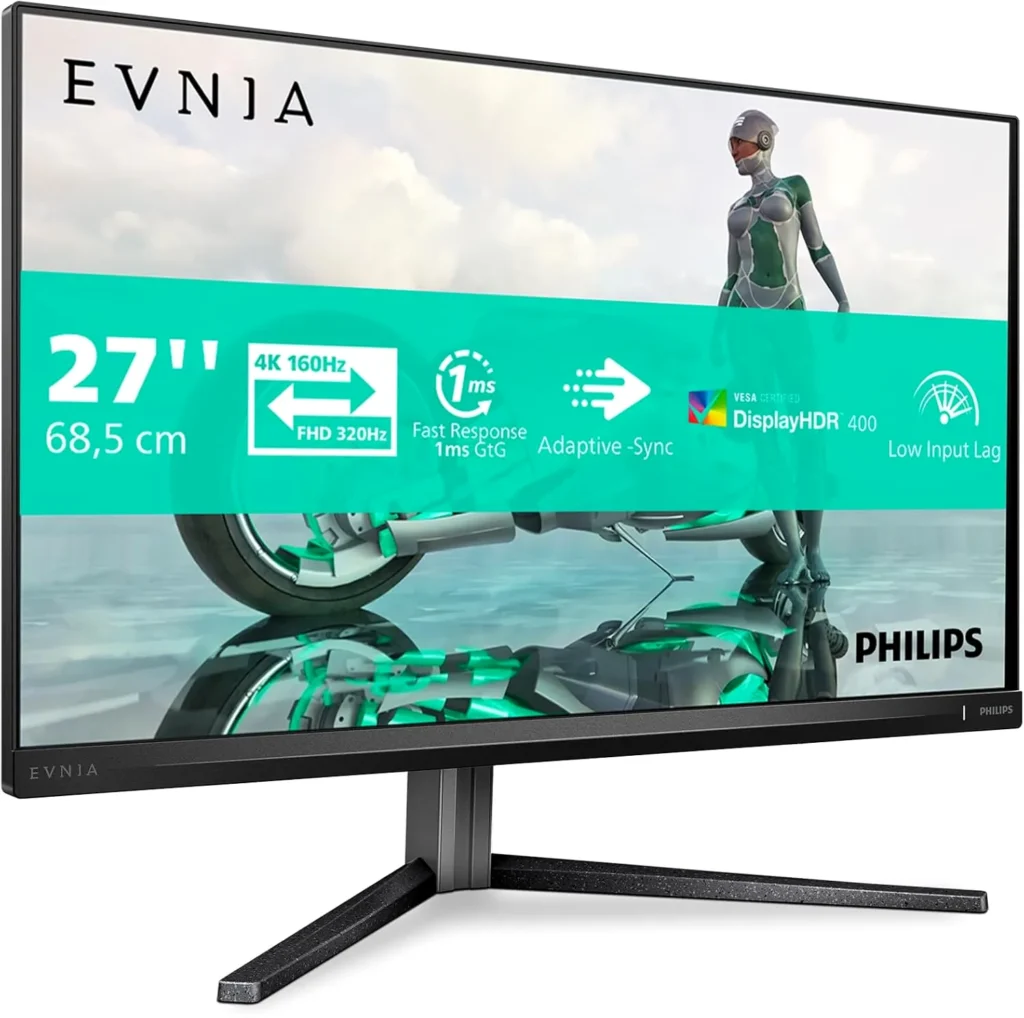
Philips Evnia 27M2N5901A Key Specifications
| Panel Type | 27-inch Fast IPS (Matte Anti-Glare, 3H Hardness) |
| Native Resolution / Refresh Rate | 4K UHD (3840 x 2160) @ 160Hz |
| Dual Mode Resolution / Refresh Rate | FHD (1920 x 1080) @ 320Hz |
| Response Time | 1ms GtG / 0.5ms MPRT (via Smart MBR Sync) |
| VRR Support | VESA Adaptive-Sync (Nvidia G-SYNC Compatible, AMD FreeSync) |
| VRR Range | 4K: 48-160Hz; FHD: 48-320Hz (with LFC support) |
| HDR Certification | VESA DisplayHDR 400 (450 cd/m² HDR Peak) |
| Typical Brightness | 350 cd/m² |
| Static Contrast Ratio | 1000:1 |
| Color Gamut | 95% DCI-P3, 130% sRGB, 90% Adobe RGB |
| Connectivity | 2x HDMI 2.1, 1x DisplayPort 1.4, 1x USB-C (65W PD, DP Alt Mode) |
| USB Hub | USB 3.2 Gen 1 (2x Downstream, 1x Type-B Upstream) |
| Audio | 2x 5W Integrated Speakers, 3.5mm Audio Out |
| Ambient Lighting | 3-sided AI-enhanced Ambiglow RGB LEDs |
| Ergonomics | Height (130mm), Pivot (±90°), Swivel (±30°), Tilt (-5/20°) |
The Community Demands: KVM and USB-C Are Now Non-Negotiable
“The community is vocal that essential productivity features like KVM switches and high-power USB-C are no longer optional extras but non-negotiable requirements for high-end monitors, reflecting the hybrid work/play reality.”
— LoadSyn Fandom Pulse Report
In today’s hybrid reality, a monitor must perform as well during the workday as it does during a gaming session. The Evnia 27M2N5901A understands this mandate perfectly, integrating features that streamline the desktop experience. The built-in KVM switch is arguably the most critical productivity feature, allowing users to seamlessly toggle control between a connected work laptop (perhaps via the USB-C port) and the main gaming rig, all using one keyboard and mouse. Furthermore, the USB-C port provides a robust 65W Power Delivery (PD). This capability is crucial, enabling a single-cable docking solution for laptops while simultaneously charging them, drastically simplifying cable management and reducing desktop clutter. Beyond these core productivity tools, Philips has layered in quality-of-life enhancements, including the AI-enhanced Ambiglow ambient lighting system for heightened immersion and reduced eye strain, and the comprehensive Evnia Precision Center software. This suite offers proprietary gaming aids like Smart Crosshair (auto-adjusting color for optimal visibility), Smart Sniper (on-screen zoom for precision targeting), and Stark ShadowBoost (improving visibility in dark scenes without overexposing bright areas). Complementing these are eye-care technologies such as Flicker-Free operation and LowBlue Mode, designed to reduce eye strain during extended gaming or work sessions.
Performance Deep Dive: Unpacking Response Times and Motion Clarity
While the raw, empirical measurements that LoadSyn readers demand, such as precise GtG overshoot at ‘Fastest’ overdrive settings or sub-pixel layout analysis for text clarity, await our in-depth lab review, the stated specifications for the Evnia 27M2N5901A offer a strong foundation. Philips touts a 1ms GtG (Grey-to-Grey) response time, further enhanced by a 0.5ms MPRT (Moving Picture Response Time) achieved through ‘Smart MBR Sync’. Critically, this strobe backlight feature is designed to operate concurrently with Variable Refresh Rate (VRR) technologies, a significant advantage for competitive players seeking both smooth, tear-free visuals and exceptional motion clarity. The effectiveness of ‘Smart MBR Sync’ and its impact on total system latency at 320Hz will be a key focus of our full performance analysis. LoadSyn recognizes that perceived input latency, especially when switching between 4K and 1080p modes, is a paramount concern for our audience. Understanding the system overhead and driver-level latency introduced by the ‘Evnia Precision Center’ features is also crucial for competitive gaming. The IPS panel, while generally excellent for color and viewing angles, can sometimes exhibit minor glow or variations in black levels compared to VA or OLED. However, its ‘Fast IPS’ designation promises quick pixel transitions essential for high refresh rates. Our commitment to LoadSyn’s Constitution (Category 27: Display Tech & Monitors, Category 24: Low-Level Tuning & Latency) means we will rigorously test these aspects to provide verifiable data.
Value Proposition: How £329 Disrupts the High-End Market
The £329.00 MSRP of the Philips Evnia 27M2N5901A positions it as a genuine market disruptor, directly addressing the ‘Unicorn’ anxiety surrounding high-performance monitors. To put this in perspective, many 27-inch 1440p 240Hz+ IPS panels often retail for similar or higher prices, while 4K 160Hz+ IPS monitors with robust productivity suites typically command significantly more. For instance, competing 27-inch 4K panels with USB-C and KVM functionality can easily exceed £400-£500, with high-refresh OLED options like the Evnia 27M2N6501L sitting at £399 (albeit with different panel tech). Even entry-level 27-inch FHD 280Hz VA monitors can be found around £130, but lack the resolution, panel quality, and comprehensive features of the Evnia. The inclusion of HDMI 2.1, robust 65W USB-C PD, and the KVM switch at this price point makes it an unparalleled offering for hybrid work-and-play setups, offering a premium feature set without the ‘OLED tax’ or the typical budget compromises. This aggressive pricing strategy validates the reader’s hope that a truly versatile ‘budget champion’ has finally arrived.
Evnia 27M2N5901A vs. Market Context
| Feature | Evnia 27M2N5901A (Dual Mode) | Evnia 27M2N6501L (QD-OLED) | Typical 4K/160Hz IPS (w/ KVM) | Typical 1440p/240Hz OLED |
|---|---|---|---|---|
| Panel Tech | Fast IPS | QD-OLED | IPS | WOLED/QD-OLED |
| Max Res/Refresh | 4K@160Hz / 1080p@320Hz | 1440p @ 240Hz | 4K @ 160Hz | 1440p @ 240Hz+ |
| MSRP (UK) | £329.00 | £399.00 | £450 – £650 | £600 – £850 |
| Burn-in Warranty | N/A (IPS) | 3-Year Coverage | N/A (IPS) | 3-Year Coverage |
| Productivity | KVM + USB-C (65W PD) | Basic USB Hub | KVM + USB-C (65W+ PD) | Variable |
| HDR Peak | 450 cd/m² | ~1000 cd/m² | 400 – 600 cd/m² | ~1000 cd/m² |
Pros
- Unbeatable Value: At £329, it offers 4K/160Hz with KVM and USB-C PD.
- Dual Mode Versatility: Perfect for cinematic single-player and 320Hz esports.
- Productivity Ready: 65W USB-C and KVM for single-cable work laptop docking.
- Wide Color Gamut: 95% DCI-P3 ensuring vibrant, accurate production.
- Motion Clarity: 0.5ms Smart MBR Sync allows simultaneous backlight strobing and VRR.
- Full Ergonomics: Includes 130mm height adjustment and 90-degree pivot.
Cons
- Resolution Trade-off: 320Hz refresh rate requires dropping to 1080p.
- Limited HDR: DisplayHDR 400 lacks local dimming and high peak brightness.
- IPS Contrast: Cannot compete with the infinite black levels of OLED.
- Verification Pending: Empirical GtG overshoot and input lag metrics still pending lab review.
Philips Evnia 27M2N5901A Gaming Monitor
£329.00 MSRP
Release Date: Early October 2025 (UK)
Landing just in time for the 2025 holiday season, the 27M2N5901A is the monitor to beat for under £350. Its aggressive pricing and hybrid feature set make it a top recommendation for anyone avoiding the OLED tax while demanding high-speed versatility.