

Key Takeaways
- Project Orion (Cyberpunk 2) has entered full development with a target release window not before 2028, led by a newly formed CDPR North America team.
- CDPR has officially abandoned the proprietary REDengine in favor of Unreal Engine 5 (UE5) for Project Orion, aiming for faster development and greater stability.
- The core technical challenge is solving known UE5 issues—specifically micro-stuttering, frame-time consistency, and heavy reliance on aggressive upscaling—which the community views with intense skepticism.
- Hiring for a Network Engineer role strongly suggests a dedicated online multiplayer component will be featured in the sequel.
Project Orion: The New Night City Blueprint Takes Shape
The sequel to Cyberpunk 2077, codenamed Project Orion, is officially out of pre-production and gaining significant momentum. This development is being spearheaded by the newly established CD PROJEKT RED North America, operating out of Boston and Vancouver. The team is not only composed of veterans from the original game and the highly successful Phantom Liberty expansion, but has been massively bolstered by high-profile external hires, signaling a serious commitment to avoiding the technical and organizational pitfalls of the 2020 launch. This restructuring, coupled with the strategic decision to abandon last-generation hardware compatibility, positions Project Orion to be a genuinely next-generation experience.
- Executive Leadership: Dan Hernberg (former Head of Production at Amazon Games) joins as Executive Producer.
- Design & Engineering: Ryan Barnard (former Game Director at Massive Entertainment) as Design Director, and Alan Villani (former VP of Technology at WB Games) as Engineering Director.
- Narrative Strength: Anna Megill (writer on Control) as Lead Writer and Alexander Freed (former Lead Writer at BioWare) bolstering the writing team.
- Core Direction: Gabriel Amatangelo remains Game Director, with Paweł Sasko as Associate Game Director, ensuring continuity from the successful Phantom Liberty era.
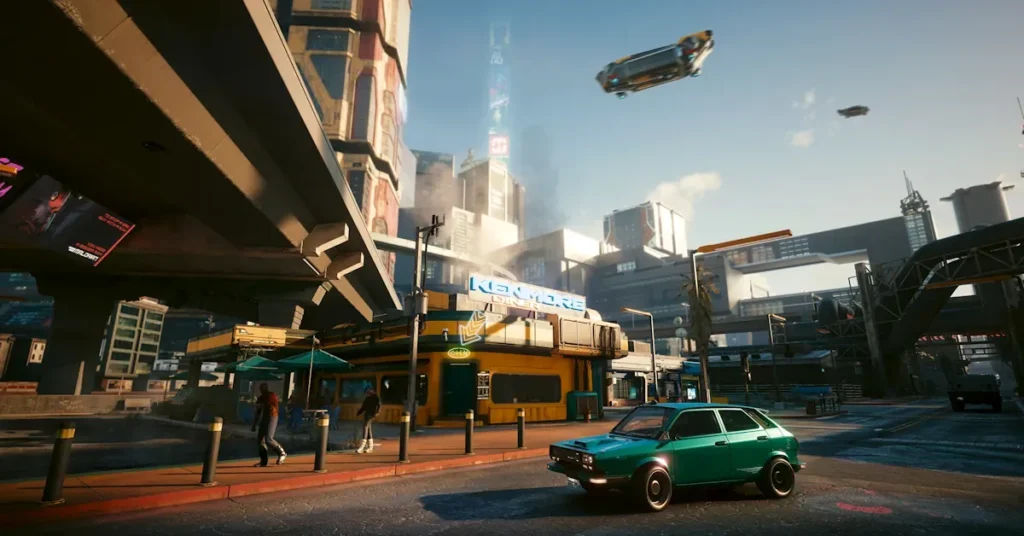
The Engine Paradox: Trading REDengine for Unreal Engine 5’s Hidden Costs
The most significant technological decision for Project Orion is the shift away from CDPR’s proprietary REDengine to Epic Games’ Unreal Engine 5 (UE5). This move is strategically sound, promising streamlined workflows, simplified patching, and faster content integration—allowing CDPR to focus on game design rather than engine maintenance. However, the community and industry experts are intensely focused on the technical baggage that comes with UE5—a baggage CDPR is now responsible for solving. The primary concerns revolve around fundamental issues that plague nearly all large-scale UE5 titles: persistent micro-stuttering tied to shader compilation, poor frame-time consistency that degrades performance proportionally to world complexity, and optimization that often relies too heavily on aggressive Temporal Super Resolution (TSR) upscaling techniques. For a dense, open-world title like Cyberpunk 2, these are not minor annoyances; they are existential threats to a smooth 60 FPS experience.
“Upscaled from 800p-1080p with freaking TSR (forced TAA) with DoF and Motion Blur… oh my… I’m not looking forward to this. This will be a blurry, smeary mess on console. 60 fps is pointless if microfreefreezing/stuttering/hitching is not fixed.”
UE5 Adoption for Project Orion: The Technical Trade-Offs
The Road to 60 FPS: CDPR’s Technical Deep Dive
The good news is that CDPR is not ignoring these issues. The studio has publicly acknowledged the frame-time degradation and stuttering that plagues UE5, even dedicating a presentation at Unreal Fest by Jarosław Rudzki to their findings on improving CPU utilization—specifically noting that performance worsens with increased world size and actor count. Their work on The Witcher 4’s tech demo—achieving a smooth 60 FPS on standard PS5 hardware using hardware-based Ray Tracing—demonstrates their capacity for deep engine optimization. Industry experts confirm CDPR is working on fundamental changes to UE5’s streaming methodology, a crucial fix for massive open worlds. If these solutions are successfully integrated into Project Orion, they could not only save the sequel from performance controversy but also provide vital, foundational fixes for the entire Unreal Engine ecosystem, validating the community’s ‘Hope’ that CDPR’s competence will force Epic to improve the core engine architecture itself.
Final Verdict
CD Projekt Red is placing a massive bet on Unreal Engine 5 for Cyberpunk 2, a decision that promises a faster, more stable development cycle but introduces significant technical risk associated with UE5’s known frame-time and upscaling issues. The success of Project Orion hinges entirely on CDPR’s ability to not just build a new world, but fundamentally fix the engine it’s built on. Given the studio’s proven ability to turn around the original Cyberpunk 2077 and the deep optimization work shown in the Witcher 4 demo, the outlook is cautiously optimistic. If anyone can force UE5 to deliver a flawless, high-fidelity 60 FPS open-world experience without relying on a ‘blurry mess’ of aggressive upscaling, it is this newly restructured, technically focused CDPR team.