
For decades, our relationship with audio has been defined by rigid enclosures and visible drivers. From towering floor-standing speakers to the ubiquitous gaming headset, sound has always emanated from a distinct, often imposing, source. But a profound paradigm shift is underway, one that promises to dissolve these physical boundaries and integrate sound seamlessly into the very fabric of our environments. Imagine a world where audio isn’t heard from a speaker, but from a wall tapestry, your clothing, or even your gaming chair, delivering unseen, ubiquitous sound that enhances immersion in ways previously unimaginable. This revolution, driven by advancements in flexible electronics, is set to redefine gaming, smart homes, and wearable technology. In this cornerstone guide, we will meticulously dissect the underlying technology, evaluate its current state through pioneering products, and forecast its transformative impact on our digital lives.
Key Takeaways
- Fabric speakers innovate by emitting sound across their entire flexible surface, a stark contrast to traditional cone-based designs.
- The breakthrough is enabled by flexible electronics, specifically conductive fibers woven into fabric and thin dielectric films forming electrostatic structures.
- Sensia Technology’s ‘Fabric Speaker Portable’ exemplifies this with its thin, light, and discreet audio capabilities.
- Applications are vast, spanning smart homes, wearables, automotive interiors, and offering transformative potential for gaming immersion.
- Current challenges include optimizing audio fidelity and ensuring durability, but the long-term potential for pervasive, integrated sound is immense.
Introducing the Fabric Speaker: Sound Woven into the Environment
At its core, a fabric speaker represents a radical departure from conventional audio transducers. Unlike the familiar cone-and-coil mechanism that pushes air from a localized point, these innovative devices emit sound uniformly across their entire flexible surface. This fundamental difference is rooted in electrostatic principles. Instead of a vibrating diaphragm, fabric speakers utilize conductive fibers woven into the textile, creating a capacitor-like structure. A thin dielectric film separates these conductive layers, and when an audio signal modulates the electric field between them, the entire fabric vibrates, directly pushing and pulling air to produce sound waves. This ingenious approach, pioneered by institutions like AIST Japan, allows for sound to emanate from an otherwise inert material.
- Thin and Light Design: Their inherent material properties allow for extremely slender and lightweight form factors, making them virtually imperceptible.
- Exceptional Flexibility: The fabric construction means these speakers can bend, fold, and conform to irregular surfaces, opening up new integration possibilities.
- Uniform Sound Emission: Eliminating traditional cone drivers means no ‘dead spots’; sound emanates evenly across the entire surface, creating a more consistent listening experience.
- Discreet Integration: They can be seamlessly integrated into walls as tapestries, upholstered furniture, or even clothing, disappearing into the environment while delivering audio.
Flexible Electronics: The Engineering Behind the Acoustic Weave
The magic behind fabric speakers lies squarely in the realm of flexible electronics. This burgeoning field replaces rigid printed circuit boards with circuits printed onto flexible substrates, allowing for unprecedented design freedom. In the context of fabric speakers, this means conductive fibers, often exceedingly thin, are precisely woven into textile sheets. These fibers form the electrodes of a capacitor, with a thin dielectric film serving as the insulating layer between them. When an audio signal is applied, it generates an oscillating electric field across this capacitive structure. This field, in turn, causes the flexible fabric to vibrate, pushing and pulling air to generate audible sound. This foundational technology, initially developed at Japan’s National Institute of Advanced Industrial Science and Technology (AIST) in 2018, represents a critical step towards truly pervasive computing and sensing.
To understand the broader context of how flexible electronics are shaping our auditory landscape, consider this insightful look into the future of audio technology. It highlights the disruptive potential that integrated solutions like fabric speakers represent.
Pros
- Unparalleled Design Freedom: Enables entirely new form factors for devices, moving beyond traditional rigid enclosures.
- Space-Saving Integration: Circuits can be integrated directly into materials, freeing up valuable internal volume and reducing device thickness.
- Novel Product Categories: Facilitates the creation of smart textiles, bendable displays, and integrated sensors that were previously impossible.
- Enhanced Durability (in specific applications): Can be more resistant to impact and bending stresses than brittle rigid PCBs, though specific material durability varies.
Cons
- Manufacturing Complexity and Cost: Production processes for flexible electronics are often more intricate and expensive than traditional rigid circuit manufacturing.
- Performance Limitations: Current flexible materials may present challenges in achieving the same power delivery, signal integrity, or thermal management as rigid counterparts.
- Long-Term Reliability in Dynamic States: Sustained flexing and environmental exposure can impact the longevity and electrical stability of flexible circuits.
- Repairability: Integrated flexible components can be difficult or impossible to repair, leading to higher replacement costs.
Sensia Technology’s ‘Fabric Speaker Portable’: A Tangible Breakthrough
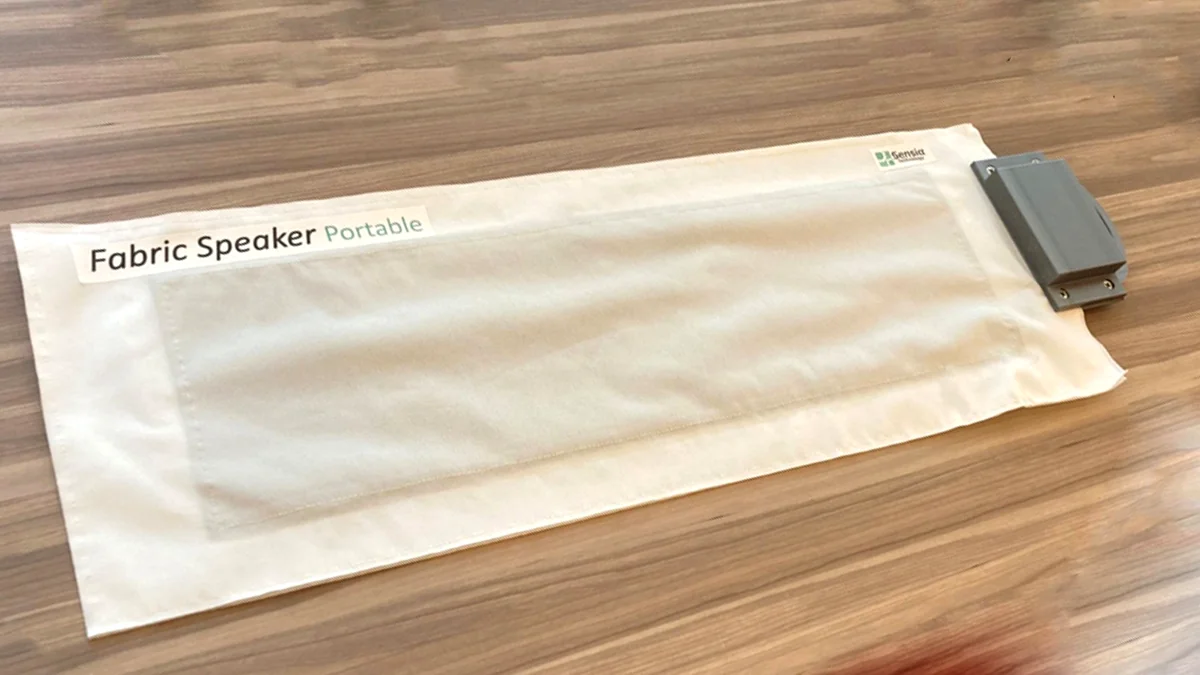
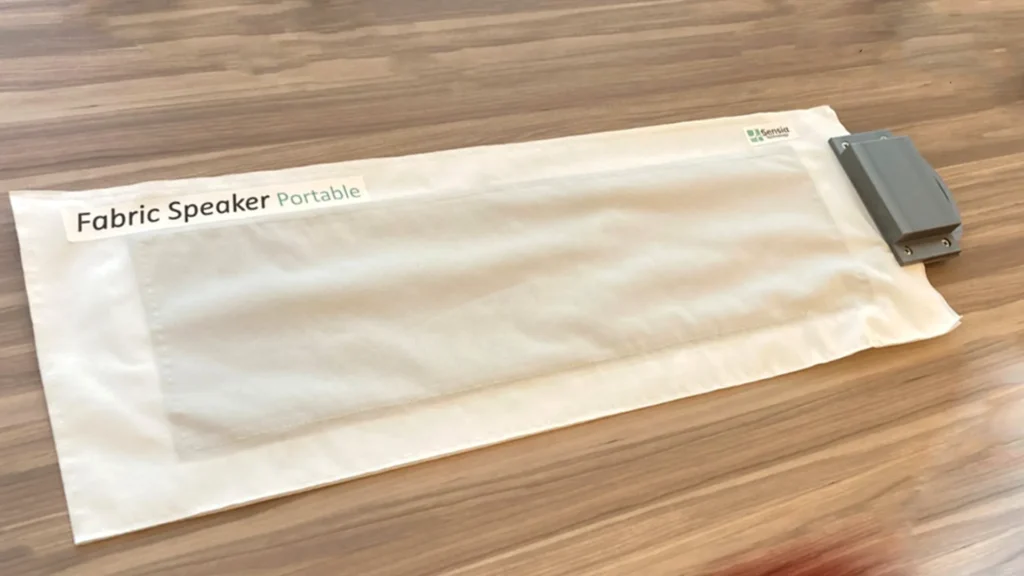
Bringing this advanced theory into practical application, Sensia Technology has unveiled its ‘Fabric Speaker Portable’—a compelling demonstration of flexible electronics in action. This product distinguishes itself through its remarkably thin, soft, and pliable form factor, allowing sound to emanate from its entire fabric surface. Crucially, it integrates a compact drive circuit with wireless Bluetooth connectivity into a small plastic module attached to one edge, maintaining the fabric’s inherent flexibility. This design fundamentally differs from older ‘hidden speakers’ that merely conceal traditional, rigid cone drivers within soft materials, often resulting in noticeable lumps and ‘dead spots’ in the sound field. Sensia’s innovation provides consistent audio dispersion, transforming the fabric itself into an active sound source.
Technical Specifications
| Sound Level (Single) | 68dB |
|---|---|
| Sound Level (Paired) | 71dB |
| Mechanism | Electrostatic (Conductive Fibers, Dielectric Film) |
| Form Factor | Thin, Light, Flexible Fabric |
| Connectivity | Wireless (Bluetooth) |
| Drive Circuit | Compact, Integrated plastic module |
| Note: Critical specifications such as frequency response, impedance, and detailed audio quality assessments are not yet publicly available, which is common for early-stage disruptive technologies. | |
Beyond the Box: Diverse Applications of Fabric Speakers and Flexible Electronics
The potential applications of fabric speakers and the underlying flexible electronics technology extend far beyond portable audio. This is a technology poised to fundamentally alter how we interact with sound in virtually every environment. In smart homes, imagine walls adorned with tapestries that double as invisible sound systems, or furniture that provides immersive audio without a single visible speaker. Wearables could evolve to include audio-emitting clothing, allowing for personalized soundscapes or discreet communication. Automotive interiors could integrate sound directly into seats, headliners, or dashboard fabrics, revolutionizing in-car entertainment and communication. Even public spaces could benefit from discreet, integrated audio for announcements or ambient sound, truly moving audio beyond cumbersome ‘boxes’ and into the very fabric of our surroundings.
- Contextual Audio for Smart Environments: Soundscapes that dynamically adapt to room activity, user presence, or time of day, enhancing ambiance and functionality.
- Personalized Sound Zones: Creation of individual audio bubbles in multi-person settings, allowing each user to experience their preferred audio without disturbing others.
- Integrated Health Monitoring: Wearable fabric speakers could combine with biometric sensors for discreet audio feedback or communication in health monitoring applications.
- Seamless Communication Interfaces: Fabric surfaces in offices or public spaces could become intuitive, invisible interfaces for voice commands, notifications, or hands-free calling.
Revolutionizing Gaming Immersion: The Fabric Audio Advantage
For gamers, the advent of fabric speakers and flexible electronics promises a revolution in immersion. Traditional gaming headsets, while offering directional audio, can cause fatigue over long sessions and isolate players from their physical surroundings. Conversely, conventional speakers require optimal placement and often clutter the gaming space. Fabric-integrated audio, however, enables truly spatial sound, emanating from the environment itself, creating seamless and natural soundscapes that pull players deeper into virtual worlds. Imagine sound cues coming directly from the virtual wall in your game, rendered physically from your actual room’s wall. Furthermore, this technology opens the door to integrating advanced haptic feedback directly into gaming chairs or even specialized clothing, allowing players to not just hear but also feel explosions or enemy footsteps, creating an unprecedented level of sensory engagement. This move toward invisible, room-scale gaming audio setups represents a significant leap beyond the current limitations.
| Feature | Traditional Gaming Audio (Headsets/Speakers) | Fabric-Integrated Gaming Audio |
|---|---|---|
| Immersion | Directional audio, often limited to ear-level or virtual surround. Can feel ‘external’. | True 3D spatial audio, sound emanating from environment, creating seamless, natural soundscapes. |
| Aesthetics | Visible, often bulky peripherals (headsets, large speakers). Can clutter gaming space. | Invisible, integrated into furniture, walls, clothing. Blends seamlessly into environment, minimalist design. |
| Comfort | Headsets can cause fatigue over long sessions. Speakers require optimal placement for best effect. | No physical contact required for room audio. Wearables are designed for comfort and flexibility. |
| Portability | Headsets are portable, speakers are less so for room audio. | Highly portable and adaptable, as the ‘speaker’ is the fabric itself, easily moved or integrated. |
| Setup Complexity | Wiring, calibration, spatial arrangement often required. | Minimal setup for integrated systems, ‘set-and-forget’ for environmental audio. |
Addressing the Skepticism: Quality, Durability, and Practical Concerns
While the promise of fabric speakers is compelling, it’s crucial to address the inherent skepticism that often accompanies radical new audio form factors, a sentiment frequently echoed across community forums and technical reviews. The primary concern, as always, revolves around audio quality. When compared to the meticulously engineered acoustics of traditional audiophile-grade speakers, the lack of detailed specifications, such as frequency response or distortion measurements, for products like Sensia’s ‘Fabric Speaker Portable’ naturally raises questions. Can a thin sheet of fabric truly deliver the rich bass and crisp highs that enthusiasts demand? Furthermore, practical considerations like durability, resistance to wear and tear, and even washability for fabric-integrated electronics remain significant hurdles. The very flexibility that makes them innovative could also compromise longevity, and as sources suggest, simply placing a fabric speaker under a pillow can diminish perceived audio quality, highlighting the challenge of environmental interference.
“One big thing missing is any kind of description of the audio quality users can expect. However, even if these are as good as the best speakers we have tested, or even offer audiophile quality, that perception will certainly be diminished if you shove the Fabric Speaker Portable under a pillow, or in a hooded jacket, etc.”
The current trade-off for fabric speakers prioritizes seamless integration and discreet design. While revolutionary in concept, early iterations may not meet peak audiophile fidelity standards. This is a rapidly evolving technology where performance is expected to improve significantly with further R&D.
The Road Ahead: Future Developments and Engineering Challenges
The path forward for fabric speakers and flexible electronics is one of continuous innovation and overcoming significant engineering challenges. Scaling manufacturing processes to meet demand while reducing costs remains a critical hurdle. Achieving higher fidelity, particularly in bass reproduction and dynamic range, will require advances in material science and drive circuit design. Standardizing integration into diverse ecosystems is also paramount; this includes ensuring compatibility with smart home platforms like OpenAudio, integrating seamlessly into complex automotive E/E architectures as envisioned by Porsche, and developing professional audio solutions akin to those from DirectOut and Cirrus Logic. Ongoing R&D efforts are focused on improving the acoustic performance of these materials, enhancing their durability for everyday use, and optimizing power efficiency for battery-powered flexible devices, pushing the boundaries of what’s possible.
- Enhancing Acoustic Performance: Significant research is dedicated to broadening frequency response, deepening bass, and improving overall sound clarity to meet discerning user expectations.
- Improving Durability and Material Science: Developing flexible materials that are resistant to wear, moisture, and environmental factors for greater longevity and practical application.
- Scalable, Cost-Effective Manufacturing: Innovations in production techniques are needed to bring down manufacturing costs and enable mass adoption.
- Broadening Ecosystem Integration: Establishing robust standards and partnerships for seamless integration into smart home, automotive, and gaming platforms (e.g., OpenAudio, Porsche, Cirrus Logic).
- Addressing Power Efficiency: Optimizing energy consumption for battery-powered flexible devices, crucial for wearables and portable applications.
Final Verdict
Fabric speakers and flexible electronics are undoubtedly in their nascent stages, yet their disruptive potential to fundamentally alter our relationship with audio is undeniable. This technology promises to transform sound from a confined output of a ‘box’ into an omnipresent, integrated element of our environments. For gaming, this means truly immersive, spatial audio that transcends headphones, combined with haptic feedback woven into our physical world. For smart living, it envisions intelligent soundscapes that adapt to our needs, seamlessly blending into our decor. While engineering challenges in fidelity, durability, and cost remain, the trajectory of this quiet revolution is clear. LoadSyn will continue to dissect these advancements, providing the technical depth and analysis our readers expect as this exciting future unfolds.
Frequently Asked Questions
What is the main advantage of fabric speakers?
The primary advantage is their ability to seamlessly integrate into environments due to their thin, flexible form factor and uniform sound emission. They offer discreet audio without visible speakers, enhancing aesthetics and spatial immersion.
How do fabric speakers work?
Fabric speakers operate on electrostatic principles. Conductive fibers woven into the fabric act as electrodes, separated by a thin dielectric film. An audio signal modulates the electric field between these layers, causing the entire fabric surface to vibrate and produce sound.
Are they suitable for gaming?
Yes, they hold immense potential for gaming. They can deliver truly spatial, room-scale audio without the need for headphones, and can be integrated into gaming furniture or clothing to provide synchronized haptic feedback for unprecedented immersion.
What about audio quality compared to traditional speakers?
Currently, fabric speakers are in early stages, and their primary value proposition is discreet integration. While evolving, they may not yet match the peak audiophile fidelity of high-end traditional speakers, especially in terms of bass depth and frequency response. Detailed audio specifications are often still emerging.
Can I wash fabric speakers?
Generally, no. Fabric speakers, especially those with integrated electronics, are not inherently water-resistant or washable. Cleaning typically requires gentle methods like lint rollers or slightly damp cloths, avoiding harsh chemicals. Always check manufacturer guidelines.