
Key Takeaways: The Redstone Divide
- AMD’s new FSR ‘Redstone’ suite introduces four core Machine Learning (ML)-based rendering features, including Ray Regeneration and Frame Generation, specifically designed to close the long-standing performance and quality gap with NVIDIA DLSS.
- The advanced ML components of FSR Redstone are fundamentally exclusive to the new RDNA 4 architecture (RX 9000 series) due to the necessity of dedicated, high-throughput AI hardware units for real-time processing.
- While older RDNA 3 (RX 7000) cards will receive FSR Redstone Upscaling and Frame Generation, they must utilize generalized shader-based fallbacks, meaning they will inherently lack the performance efficiency and superior visual quality benefits of the RDNA 4 ML implementation.
- Community anxiety is currently high, driven by the RDNA 4 exclusivity and the confusing, official driver bifurcation that places RDNA 3 into a separate, albeit ‘stable,’ development branch, raising concerns about long-term feature support.
FSR Redstone Deconstructed: The Four Pillars of AMD’s AI Future
AMD FSR ‘Redstone’ Core Feature Matrix
| Feature | Technology Base | Function | RDNA 4 Requirement |
|---|---|---|---|
| FSR Upscaling (ML) | Neural Networks | Reconstructs visuals to match or exceed native quality using trained models. | ML-optimized (RDNA 4) or Shader Fallback (RDNA 3) |
| FSR Frame Generation (ML) | Neural Networks + Motion Vectors | Interpolates entirely new frames for smoother motion and dramatically higher FPS. | ML-optimized (RDNA 4) or Shader Fallback (RDNA 3) |
| FSR Ray Regeneration | ML Denoiser | Replaces traditional denoisers for high-quality, efficient ray tracing cleanup. | ML-optimized (RDNA 4) – Highly Recommended |
| FSR Radiance Caching | Trained Neural Network | Predicts light propagation to replace expensive secondary ray bounces in path tracing. | ML-optimized (RDNA 4) – Required for full benefit |
The Architecture Divide: Why RDNA 4 Needs Dedicated AI Hardware
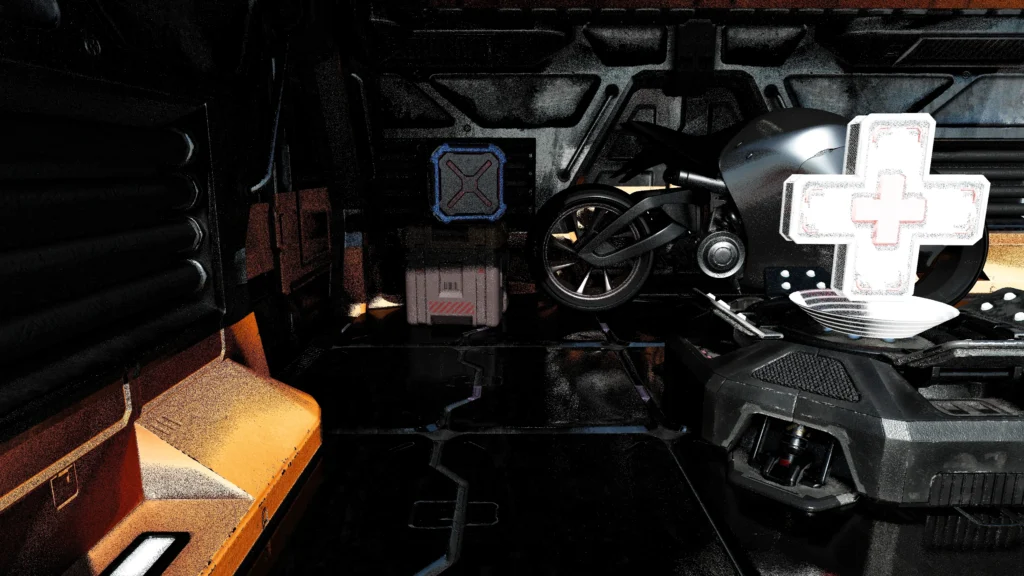
The introduction of features like Ray Regeneration and Radiance Caching signals a fundamental shift in AMD’s rendering strategy, moving away from purely analytical algorithms toward heavy Machine Learning (ML) inference. This change necessarily dictates new hardware requirements. While RDNA 3 introduced basic AI acceleration capabilities, RDNA 4 features dedicated, high-throughput AI units—functionally analogous to the Tensor Cores in NVIDIA’s architecture—that are required to run the Redstone neural networks efficiently in real-time. The computational load of these trained models, especially for advanced denoising and light prediction, is immense. The analytical fallbacks provided for RDNA 3, while functional, must rely on generalized shader units. Our analysis confirms that this leads to significantly lower performance scaling and potentially reduced visual fidelity compared to the dedicated, optimized ML path on RDNA 4 silicon. This architectural leap is the unavoidable technical reason behind the feature wall, mirroring the exclusivity steps taken by competitors to maximize the performance potential of their latest silicon.
FSR Redstone vs. NVIDIA DLSS: Feature Parity Check
The Fandom Pulse: Anxiety Over Driver Longevity
“And then there’s now another consideration …. how long will it receive driver support before ‘ Maintenance Mode ‘, thanks AMD for now adding that to the mix.”
Critical Driver Split Warning
AMD’s official driver bifurcation—creating a ‘dedicated, stable branch’ for RDNA 1 and RDNA 2, and a separate, accelerated branch for RDNA 3/4—raises immediate long-term questions among users. While AMD promises simultaneous game optimizations across both branches, skepticism persists regarding feature parity. RDNA 3 owners must monitor this split closely, as there is no guarantee that the older branch will receive crucial future low-level API updates (like new DirectX shader models) necessary for implementing the full feature set of future FSR iterations. This strategic divergence increases the risk of feature stagnation for the RX 7000 series.
The Community Workaround: Reliance on OptiScaler
The slow pace of native FSR Redstone integration into existing game titles has created a vacuum, forcing many RDNA 3 and even RDNA 4 owners to rely on third-party middleware like OptiScaler. This sophisticated tool acts as an advanced layer, dynamically forcing FSR 4 compatibility and its advanced ML upscaling into games that only natively support older FSR 2 or 3 versions. Crucially, OptiScaler’s utility extends beyond simple resolution manipulation; it provides essential frame pacing and latency correction, especially when paired with the inherent latency of Frame Generation technologies. The fact that many high-end users consider OptiScaler essential to ensure a smooth, artifact-free experience highlights a persistent gap between AMD’s rapid cadence of hardware releases and the significantly slower pace of developer adoption for their latest, most complex software features.
The RDNA 3 Longevity Outlook
Pros (Staying Power)
- Continued simultaneous game optimizations are promised via the new stable driver branch.
- FSR 3.1 shader-based fallbacks ensure basic frame generation and upscaling functionality remains available.
- The strong performance baseline of RDNA 3 remains excellent for current-generation titles at high resolutions.
- Driver-level FSR 4 overrides are now available for many DirectX 12 titles, easing implementation.
Cons (Architectural Gaps)
- Exclusion from the dedicated, high-performance ML-based Redstone features (Ray Regeneration, Radiance Caching).
- Uncertainty regarding long-term support for new low-level API features within the RDNA 3 driver branch.
- Reliance on third-party tools like OptiScaler to force full feature compatibility and manage frame pacing.
- Potential for faster obsolescence compared to previous generations due to the rapid industry shift toward dedicated AI hardware.
Frequently Asked Questions (FAQ)
Will FSR Redstone work on my RDNA 3 (RX 7000) GPU?
Yes, but only the upscaling and frame generation components will function via analytical, shader-based fallbacks. The core ML-based features like Ray Regeneration and Radiance Caching are fundamentally optimized for, and effectively exclusive to, the dedicated AI hardware in RDNA 4, meaning RDNA 3 will not see the optimal performance or quality gains.
Is AMD ‘ending support’ for RDNA 2 (RX 6000)?
AMD clarified that RDNA 1 and RDNA 2 are moving to a ‘dedicated, stable driver branch,’ not ending support. This branch will still receive essential security updates and game optimizations. However, new architectural features and rapid development iterations will be prioritized exclusively for the RDNA 3/4 branch.
How does FSR Ray Regeneration compare to NVIDIA’s Ray Reconstruction?
FSR Ray Regeneration is AMD’s direct competitive answer. Both are ML-powered denoisers designed to clean up highly noisy, low-sampled ray-traced images with significantly reduced computational cost. Both aim for parity in visual quality and performance gains, though FSR’s ML performance advantage is strictly dependent on RDNA 4 hardware.
Final Verdict: The Cost of Competing
AMD’s introduction of FSR Redstone is a necessary, if painful, strategic move in the GPU wars. To genuinely compete with NVIDIA’s advanced DLSS suite—specifically Ray Reconstruction and DLSS Frame Generation—AMD had to integrate dedicated AI hardware into RDNA 4, creating a sharp technological divide that previous generations could not cross. While RDNA 3 owners can still utilize shader-based fallbacks, the long-term value proposition of the RX 7000 series is now complicated by feature exclusivity and the driver bifurcation. For the first time in its history of broad compatibility, AMD is asking its loyal users to trade that openness for cutting-edge performance. This forces a difficult choice: accept the feature limitations inherent to the RDNA 3 architecture, or rely on community ingenuity and middleware like OptiScaler to bridge the growing architectural gap.