
Key Takeaways: The G923’s Current Standing
- The G923 remains a premium-built wheel with excellent features (TrueForce, progressive brake, dual clutch) but is fundamentally limited by its gear-driven mechanism.
- At its $400 MSRP, the G923 is now considered functionally obsolete by the sim racing community due to the emergence of entry-level Direct Drive (DD) systems (e.g., Moza R5, Fanatec CSL DD) at a comparable price point.
- The primary drawback is the low torque output (a verified 2.3Nm) and the ‘notchy’ feeling inherent to gear drive, which compromises realism and high-fidelity detail compared to Direct Drive’s 1:1 force feedback ratio.
- RECOMMENDATION: Only purchase the Logitech G923 if you find it heavily discounted (under $300) or if you prioritize broad console compatibility (PS/Xbox) over superior force feedback realism.
Dissecting the G923: A Feature-Set Ahead of its Core Technology
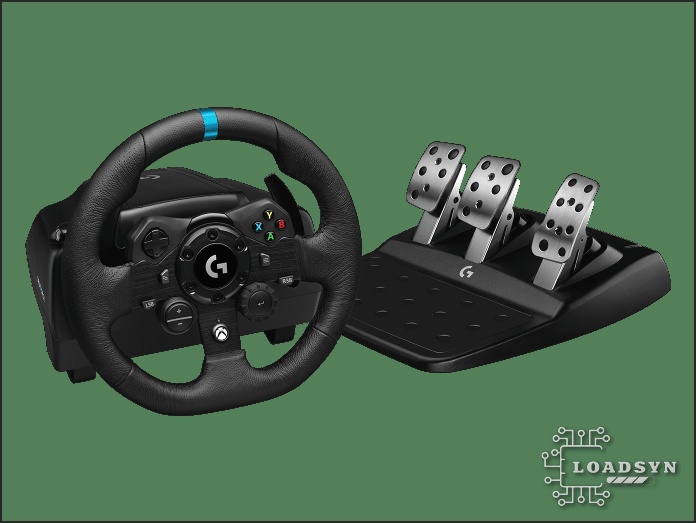
When the Logitech G923 launched, it was positioned as the next evolution of the world’s best-selling racing wheel, succeeding the venerable G29/G920. Logitech equipped this new flagship with several impressive next-generation features, most notably the proprietary TRUEFORCE high-definition force feedback system. This technology samples game physics and audio 4,000 times per second, promising unprecedented sensory realism by translating engine vibrations and road texture directly into the wheel. However, four years later, the G923—still priced near its $400 MSRP—is caught in a market revolution. Sim racers must now question if its advanced software features can possibly overcome a core engineering drawback: its legacy gear-driven architecture.
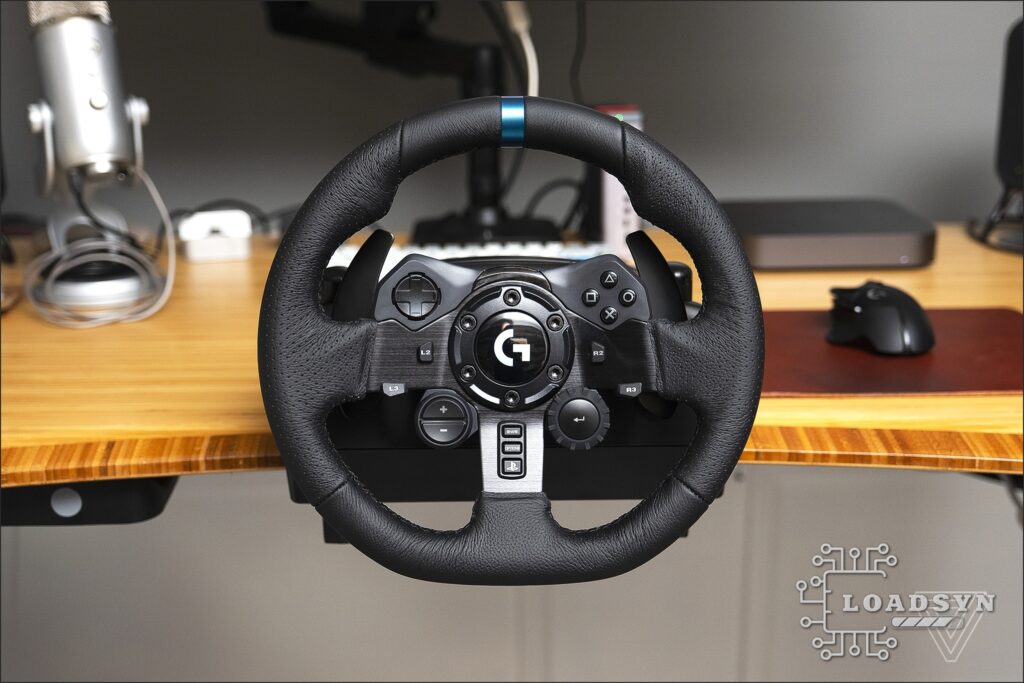
Logitech G923 TrueForce Racing Wheel & Pedals Technical Specifications
- Force Feedback Type
- Gear-Driven with Dual-Motor FFB
- Max Torque Output
- Approx. 2.3 Nm
- FFB Update Rate
- 4000 times/second (via TRUEFORCE)
- Rotation
- 900 degrees lock-to-lock
- Pedals
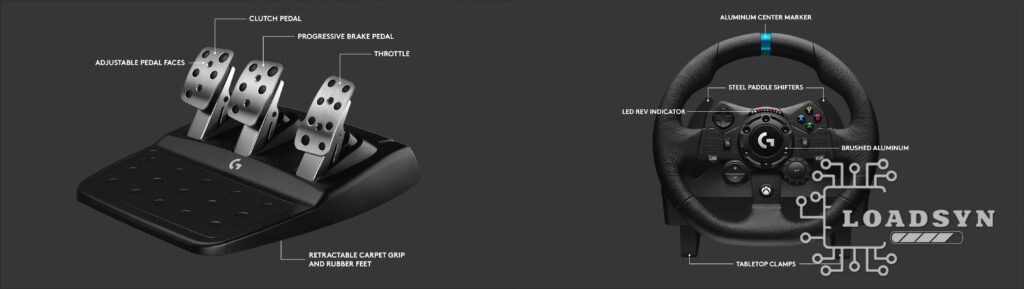
- Progressive Brake Pedal (nonlinear spring), Repositionable Faces
- Materials
- Hand-stitched leather, anodized aluminum spokes, steel shaft
- Key Feature
- Programmable Dual Clutch Launch Controls, RPM Indicator LEDs
The Market Reckoning: Gear Drive vs. Direct Drive
The true challenge for the G923 isn’t its own advanced feature set; it is the seismic shift that has redefined the entry-level sim racing hardware market. For decades, gear-driven wheels like the G27, G29, and G923 were the undisputed gateway. They were cheap, durable, and functional—a perfect starting point. However, this foundational technology relies on internal cogs to amplify the motor’s force, which inherently introduces friction, mechanical noise, and the infamous ‘notchy’ feeling. This gear mesh compromises high-fidelity detail, resulting in a loss of subtle road texture and precise slip cues. The recent rise of affordable Direct Drive (DD) systems—which offer a 1:1 force feedback ratio—has completely changed the value equation, forcing consumers to look past the G923’s advanced software and focus instead on the fundamental physics of force feedback generation.
Force Feedback Showdown: Entry-Level Gear vs. Modern Direct Drive
| Criteria | Logitech G923 (Gear) | Thrustmaster T300 (Belt) | Moza R5 Bundle (Direct Drive) |
|---|---|---|---|
| Mechanism | Cog Wheels | Belt/Pulley | Direct Motor Shaft |
| Peak Torque (Nm) | 2.3 Nm | 4.2 Nm | 5.5 Nm |
| FFB Fidelity/Detail | Low (Notchy, Loss of Detail) | Medium (Smooth, Belt Absorption) | Highest (1:1 Fidelity) |
| Price Point (Bundle) | ~$400 | ~$500-$600 | ~$600 |
| Noise/Vibration | High (Loud, Grinding) | Medium-Low | Low |
| LoadSyn Verdict | Outdated Value | Decent Mid-Range | Best Entry-Level Value |
“T300, hands down. Nearly 2x the torque (4.2nm v 2.3nm), smoother FFB due to the belt drive design (vs the gear driven logitech), and swappable wheels. Very much in 2 different categories. I might just look into Moza Racing for wheels from now and forget about Thrustmaster and Logitech.”
The Sim Racer’s Decision: When Should You Still Buy the G923?
Your Definitive 2025 Sim Racing Purchase Path
Condition: You MUST have a wheel for PS5/Xbox AND your budget is strictly under $350.
Recommendation: Buy the G923 (Only if on sale). It’s the best console-compatible option at this low price point, offering reliability and the unique TRUEFORCE feature.
Caveat: Accept the low 2.3Nm torque and the inherent gear noise. The experience is functional, not high-fidelity.
Condition: You are a PC-only racer and your budget is $400 – $600.
Recommendation: Avoid the G923 entirely. Purchase an entry-level Direct Drive bundle (e.g., Moza R5, Fanatec CSL DD).
Caveat: The fidelity and torque increase (5.5Nm+) is a foundational upgrade worth the marginal price difference. Do not compromise on FFB quality.
Condition: You need a high-end, future-proof console/PC setup.
Recommendation: Invest in the new Logitech G RS Series (Direct Drive, 8Nm) or high-end Fanatec/Moza systems.
Caveat: This path requires a budget exceeding $1,000 for the base and wheel alone, but provides unparalleled realism and modularity.
The $400 Price Point is the New DD Entry Barrier
The single most important factor determining the G923’s viability is its price. The $400 MSRP was defensible five years ago, but today, that money puts you within striking distance of the Direct Drive ecosystem. If you pay full price for the G923, you are fundamentally investing in outdated technology. The measurable performance difference between 2.3Nm (G923) and 5.5Nm (Moza R5) is too significant to ignore. Wait for a deep discount (below $300) or save slightly more for a vastly superior, future-proof experience.
Final Verdict
The Logitech G923 is a tragic piece of hardware. It is built with premium materials—hand-stitched leather, anodized aluminum—and features genuinely innovative software like TRUEFORCE and the Dual Clutch Launch Controls that should have made it a world-beater. But its foundation—the low-torque, gear-driven mechanism—is a relic of the past. In a world where Direct Drive has democratized, offering 2x the torque and 1:1 force feedback fidelity for a marginal price increase, the G923 is only viable as a budget console option found on deep sale. For the vast majority of PC sim racers, it is no longer the recommended gateway wheel. Logitech itself has acknowledged this market shift with the launch of its new, high-end RS Direct Drive series, leaving the G923 as the final, outdated flagship of a bygone era.
Frequently Asked Questions
Is the Logitech G923 compatible with the new Logitech G RS Direct Drive pedals and shifters?
The G923 is compatible with the older Logitech Driving Force Shifter (G29/G920 accessory). The new modular Logitech G RS pedals and shifters are part of a separate, high-end ecosystem. While Logitech has designed some components to integrate via the Logitech G Racing Adapter, full compatibility and functionality should be checked against the latest G HUB software updates, as the RS components are optimized for the RS Direct Drive bases.
Does the TRUEFORCE feature make up for the gear drive noise?
No. While TRUEFORCE provides excellent high-frequency feedback (like engine vibration and road texture), the fundamental ‘clunkiness,’ grinding, and ‘notchy’ feel of the gear mechanism, particularly during rapid or heavy steering input, remains. TRUEFORCE enhances the detail of the signal, but it cannot eliminate the mechanical limitations and inherent noise of the dual-motor gear drive system.
Is the G923 the same as the G29/G920?
The G923 uses the same core gear-driven mechanism and motor as its predecessors. However, it includes key internal upgrades: the mandatory TRUEFORCE FFB firmware, a refined progressive brake pedal spring, and standardized button layouts (including RPM Indicator LEDs) across both PS and Xbox versions. It is an evolution, not a revolutionary redesign.
Source Attribution: This analysis was compiled using 15 comprehensive intelligence briefs, technical specifications from Logitech G, and real-time community sentiment analysis from sim racing forums and subreddits. Hardware performance characteristics (torque, FFB fidelity) are based on verified industry benchmarks and engineering principles established in the LoadSyn.com gear lab.