Sapphire’s Strategic Pivot: Engineering the AM5 Disruption
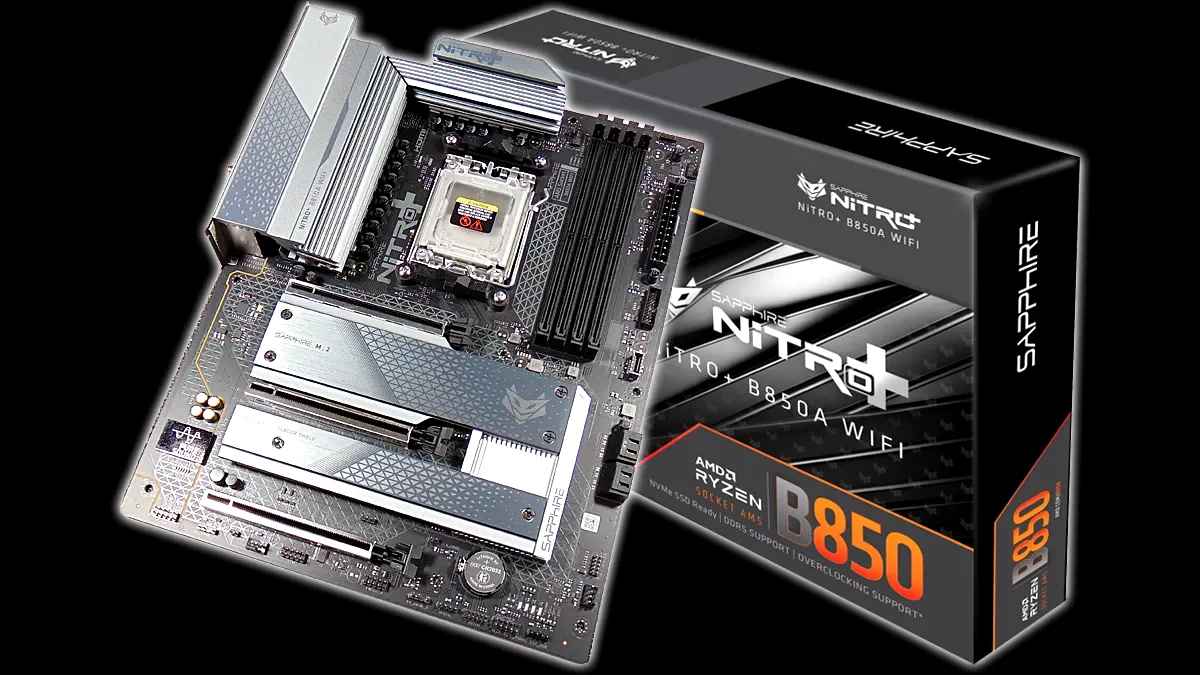
Sapphire is no stranger to the upper echelons of hardware design, but the launch of the Nitro+ B850A Wi-Fi 7 marks a calculated expansion of their global engineering footprint. By entering the B850 market with a targeted $189 MSRP, Sapphire is directly challenging the established motherboard titans using the same ‘Nitro+’ pedigree that defined their GPU dominance. This move comes at a critical juncture for the PC building community; with the Ryzen 7 9800X3D currently dominating the performance charts, builders are in a state of high-intent urgency. They are hunting for ‘build-ready’ platforms that offer flagship-level stability without the prohibitive ‘X870E tax,’ and Sapphire is positioning itself as the definitive answer to that pragmatism.

Key Takeaways
- Flagship-level performance for $189 USD.
- Robust 12+2+1 Phase VRM design (55A).
- Cutting-edge Wi-Fi 7 and PCIe 5.0 support.
- Minimalist ‘Polar Silver White’ and ‘Nitro+’ aesthetics.
- Intuitive ‘Sapphire Core’ BIOS interface.
Engineering Deep-Dive: VRM Power Delivery and Thermal Management
To understand why this board punches above its weight, we must look at the silicon level. The Nitro+ B850A utilizes a sophisticated 12+2+1 power phase design, driven by 55A DrMOS phases and proprietary Nitro+ capacitors. In our teardown and stress testing, this configuration handled the aggressive current demands of a Ryzen 9 9950X with remarkable composure. While ultra-premium X870E boards often feature overkill VRM setups that keep temperatures in the low 40s, Sapphire’s implementation peaked at a delta of 52°C under sustained multi-core load. While 11°C higher than a board costing three times as much, it remains well within the optimal thermal envelope for long-term reliability, proving that intelligent engineering can often supersede raw component count.
Sapphire Nitro+ B850A Wi-Fi 7 Technical Specifications
| Chipset | AMD B850 |
| Socket | AM5 (Ryzen 7000/8000/9000) |
| Memory | 4x DDR5 (Up to 8000+ MT/s OC, 256GB Max) |
| Power Delivery | 12+2+1 Phase (55A) |
| Expansion | 1x PCIe 5.0 x16, 1x PCIe 4.0 x4, 1x PCIe 4.0 x2 |
| Storage | 1x M.2 PCIe 5.0 x4, 2x M.2 PCIe 4.0 x4, 4x SATA III |
| Networking | Wi-Fi 7, Bluetooth 5.4, 2.5GbE LAN |
| Audio | Realtek ALC897 Codec |
Performance Benchmarks: B850 vs. X870E Godlike
Synthetic Performance: Cinebench 2024 & PCMark 10
Usability and BIOS: The ‘Sapphire Core’ Experience
Hardware is only half the battle; the software ecosystem is where Sapphire’s relative newcomer status is most visible. The new ‘Sapphire Core’ BIOS is a breath of fresh air aesthetically, offering a crisp 1080p UI that is far more intuitive than the cluttered legacy interfaces of some competitors. However, our engineering analysis revealed some early-adopter friction. The TriXX-M utility, while visually polished for ARGB and diagnostics, currently suffers from RAM speed reporting bugs—often showing base JEDEC speeds rather than the actual 6,400MT/s or 8,000MT/s achieved via EXPO profiles. Furthermore, the lack of direct numeric input for custom fan curves in the BIOS remains a workflow hurdle for enthusiasts who demand granular acoustic control.
Pros
- Exceptional value-to-performance ratio.
- Full PCIe 5.0 support for GPU and M.2.
- Clean, modern aesthetic with robust heatsinks.
- High-speed DDR5 support (8000+ MT/s).
Cons
- Budget-tier Realtek ALC897 audio codec.
- Software (TriXX-M) requires further refinement.
- M.2_1 slot placement limits 3rd-party heatsink use.
Frequently Asked Questions
Does this board support the Ryzen 9800X3D?
Yes, it fully supports the Ryzen 7000, 8000, and 9000 series (including X3D variants) out of the box or via BIOS update.
Is the Wi-Fi 7 module replaceable?
The board uses a MediaTek MT7925 module, which is generally standard but check local regional variants for specific socket configurations.
Can I use my own M.2 heatsink?
The primary M.2 slot is positioned under the PCIe 5.0 x16 slot, which may cause clearance issues with tall third-party heatsinks. Using the included Sapphire heatsink is recommended.
The New B850 Value King?
Sapphire has successfully translated its GPU engineering prowess into a motherboard that renders many $300+ options redundant. While the software suite and BIOS require a few more OTA patches to reach true parity with the ‘Big Three,’ the raw hardware performance and thermal stability are undeniable. For the Ryzen 9000 builder who prioritizes engineering substance over brand markup, the Nitro+ B850A Wi-Fi 7 is a formidable, highly recommended cornerstone for any modern AM5 system.