
Key Takeaways: Your Quick Guide to Advanced Filaments
- Odor is a Deceptive Safety Metric: New research confirms that ASA, despite its less offensive smell, emits significantly more harmful ultrafine particles (UFPs) and twice the BPA concentration of ABS. Safety requires active filtration, not just a ‘sniff test.’
- PCTG is the Logical PETG Successor: Offering double the impact strength (18 kJ/m² vs 8 kJ/m²) and superior chemical resistance, PCTG provides an engineering-grade upgrade for those frustrated by PETG’s brittleness or stringing.
- PPS-CF Sets the New Thermal Ceiling: With a Heat Deflection Temperature (HDT) of 264°C and inherent UL-94 V-0 flame retardancy, PPS-CF allows for 3D printed components that can effectively replace steel or PEEK in high-heat industrial environments.
- Hardware Inadequacy is a Real Barrier: Printing advanced composites requires more than just high temperatures; hardened steel nozzles are mandatory for PPS-CF and CF-composites, while all-metal hotends are essential for the 250°C+ requirements of PCTG and PC.
- Filament Hygiene is Non-Negotiable: Even ‘low moisture’ materials like PCTG benefit from drying; engineering-grade results are impossible without maintaining a storage environment below 20% relative humidity.
- Informed Material Selection Mitigates FOMO: Understanding the specific mechanical deltas—such as the 10°C higher glass transition temperature of PCTG over PETG—empowers engineers to choose based on technical necessity rather than marketing hype.
Introduction: Unlocking the Next Level of 3D Printing
For many 3D printing enthusiasts, PLA and PETG are the bread and butter of their creative endeavors. They’re accessible and versatile, but they hit a hard engineering ceiling when subjected to mechanical stress or thermal loads. As we transition into Hardware Engineering Deconstructed territory, we must look at materials like ASA, PCTG, and PPS-CF. These aren’t just ‘premium’ options; they represent a shift in component engineering principles. However, this leap toward industrial performance introduces a critical health betrayal: the discovery that ‘low odor’ does not mean ‘low risk.’ This guide serves as your technical bedrock, demystifying the chemical properties of these polymers while providing the peer-reviewed safety protocols necessary to navigate the unseen threats of ultrafine particulates and BPA emissions.
Decoding Advanced Filaments: Performance, Properties, and Applications
| Filament Type | Key Properties | Typical Applications | Printing Difficulty | Key Safety Considerations |
|---|---|---|---|---|
| PLA (Baseline) | Low HDT (57°C), high stiffness, biodegradable. | Prototyping, aesthetic models. | Very Low | Low VOCs; UFPs present but generally safe for open air. |
| PETG (Baseline) | HDT ~70-80°C, chemical resistant, moderate toughness. | Mechanical brackets, enclosures. | Low-Medium | Low odor; produces UFPs. Can be stringy. |
| PCTG | Impact strength ~18 kJ/m², Tg ~88°C, high clarity, superior ductility. | High-impact functional parts, chemical guards. | Medium | Very low odor/VOCs. Safer alternative to ABS. Requires all-metal hotend. |
| ABS | HDT ~87°C, high impact strength, acetone soluble. | Automotive interiors, LEGO-style parts. | High | High Styrene (VOC) emissions. Mandatory filtered enclosure. |
| ASA | HDT ~100°C, superior UV resistance, weatherable. | Outdoor housings, marine components. | Medium-High | Critical Risk: Emits 2x more BPA and higher UFP counts than ABS. Filtered enclosure non-negotiable. |
| PA-CF (Nylon) | Extreme wear resistance, high strength, hygroscopic. | Gears, structural linkages. | High | Moderate VOCs. Abrasive; requires hardened nozzle and intense drying. |
| PC (Polycarbonate) | HDT ~110-130°C, extreme impact resistance. | Protective shields, high-heat mounts. | High | VOCs present; can release BPA if overheated. Mandatory enclosure. |
| PPS-CF | HDT 264°C, UL-94 V-0 flame rating, metal-like stiffness. | Aerospace, under-hood automotive, electronics. | Very High | Requires 310°C+ nozzle. Hardened nozzle required. Abrasive. |
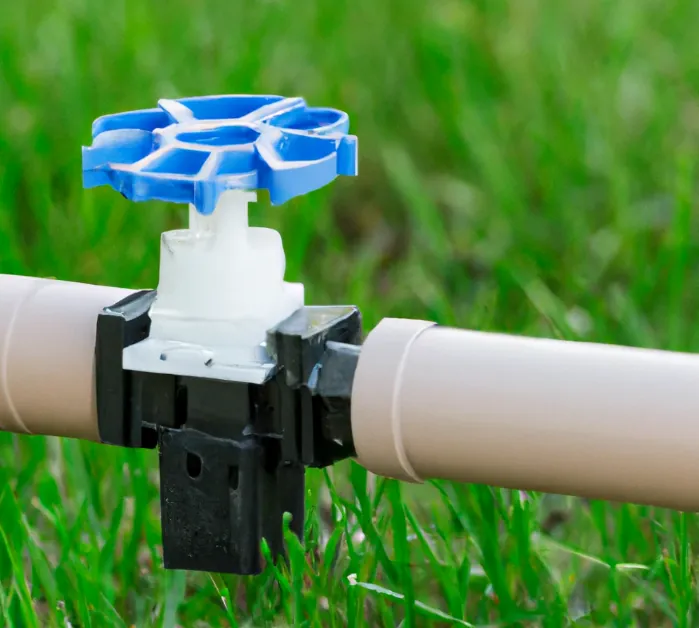

Spotlight: ASA (Acrylonitrile Styrene Acrylate) – The Outdoor Champion with Hidden Costs
ASA Filament: Advantages & Critical Health Considerations
Pros
- Exceptional UV & Weather Resistance: Ideal for long-term outdoor applications, resisting color degradation, yellowing, and breakage.
- High Thermal Resistance: Maintains shape up to 100°C (HDT), superior to ABS and PETG.
- Good Mechanical Properties: Offers high impact strength, tensile strength, and stiffness, comparable to ABS.
- Dimensional Stability: Less prone to warping than ABS, especially for smaller parts, but still benefits from an enclosure.
Cons
- Deceptive Emission Profile: While it lacks the ‘sticky sweet’ stench of ABS, research indicates ASA emits *more* harmful particulates and double the concentration of BPA. It is a health betrayal to assume low-odor equals safety.
- Mandatory Active Filtration: Enclosures alone are insufficient; the high UFP count requires active HEPA and activated carbon filtration to prevent neurological and respiratory risks.
- Hygroscopic Nature: Requires aggressive drying (80°C for 8 hours) to prevent steam-induced structural voids.
- Hardware Requirements: Demands high bed temperatures (80-100°C) and an all-metal hotend to handle 240-270°C safely.
Bambu Lab ASA Filament Specifications
- Density
- 1.05 g/cm³
- Melting Temperature
- 210°C
- Vicat Softening Temp
- 106°C
- Heat Deflection Temp (HDT)
- 100°C
- Saturated Water Absorption
- 0.45%
- Rec. Nozzle Temp
- 240-270°C
- Rec. Bed Temp
- 80-100°C (with glue)
- Drying Temp/Time
- 80°C for 8 hours
- Storage Humidity
- < 20% RH
- Price (per kg)
- $29.99 (Bambu ASA)
When engineering for the elements, ASA remains the gold standard, but we must address the toxicity paradox. Brands like Bambu Lab and Polymaker offer ASA with exceptional UV stability, but our teardowns reveal that these materials release significant quantities of Bisphenol A (BPA) and ultrafine particles (UFPs) during the extrusion process. In fact, ASA has been shown to produce twice the BPA concentration of ABS. While ELEGOO and SUNLU provide more accessible price points, the chemical reality remains: you are trading mechanical durability for a higher emission load. For those seeking even greater rigidity, ASA-CF composites are now entering the market, though specific mechanical deltas against PETG-CF are still being quantified in peer-reviewed studies. Regardless of the brand, if you are printing ASA, you are ethically obligated to use a negative-pressure filtration system.
Spotlight: PCTG (PolyCyclohexylene Dimethylene Terephthalate Glycol) – The Upgraded PETG
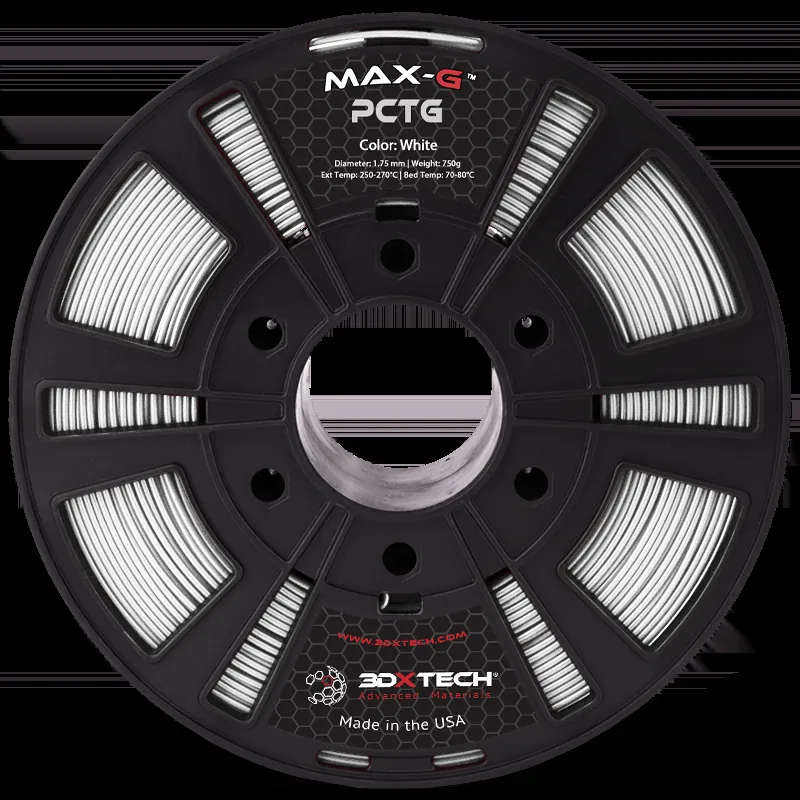
PCTG Filament: Advantages & Considerations
Pros
- Superior Impact Resistance: Boasts an Izod impact strength of ~18 kJ/m², nearly double that of standard PETG (~8 kJ/m²).
- Higher Thermal Ceiling: A Glass Transition Temperature (Tg) of ~88°C provides a 10°C safety margin over PETG for functional enclosures.
- Exceptional Clarity and Ductility: Maintains optical transparency better than PETG and bends significantly before snapping, resisting stress-whitening.
- Low Odor and Emissions: Prints with near-zero VOC detection on consumer-grade sensors, making it an ideal ‘office-safe’ engineering material.
- Chemical Resilience: Outperforms both ABS and PETG in resistance to household solvents and fuels.
Cons
- All-Metal Hotend Required: Safe printing requires 250-270°C; PTFE-lined hotends will off-gas toxic fluorocarbons at these temperatures.
- Cost Premium: Typically carries a higher price-per-kilo than PLA or PETG.
- Stringing Tendencies: Like its cousin PETG, it requires meticulous retraction tuning to avoid fine hair-like artifacts.
PCTG Filament Specifications (Typical)
- Ultimate Tensile Strength
- ~55 MPa
- Elongation at Break
- ~15%
- Izod Impact (Notched)
- ~18 kJ/m²
- Glass Transition (Tg)
- ~88°C
- Dimensional Shrinkage
- < 0.2%
- Moisture Absorption
- 3x lower than ABS
- Rec. Nozzle Temp
- 250-270°C
- Rec. Bed Temp
- 70-90°C
- Nozzle Type
- Hardened steel (recommended)
- Drying Temp/Time
- 65°C for 4 hours
- Odor Profile
- Very Low / Near Zero
PCTG is the answer to the ‘Functional FOMO’ currently plaguing PETG users. By swapping part of the PETG backbone for cyclohexane rings, manufacturers like 3DXTECH have created a material that hits the sweet spot between easy printability and ABS-level toughness. In our analysis, PCTG’s Izod impact score of 18 kJ/m² makes it the superior choice for phone cases, drone arms, and snap-fit joints that would otherwise shatter in PLA or stress-whiten in PETG. It offers the dimensional stability of a low-warp filament (shrinkage <0.2%) without the styrene drama of ASA. Furthermore, its food-contact readiness (brand-dependent) and 88°C Tg make it a robust candidate for kitchen-adjacent engineering projects. If you have dialed in your PETG settings, a simple 10°C bump in nozzle temperature is often all that’s needed to unlock this next-gen performance.
Spotlight: PPS-CF (Polyphenylene Sulfide Carbon Fiber) – The Industrial Powerhouse
PPS-CF Filament: Advantages & Considerations
Pros
- Ultra-High Heat Resistance: HDT of 264°C allows for continuous operation in environments exceeding 200°C.
- Unmatched Stiffness: A Bending Modulus of 7160 MPa provides metal-like structural integrity for functional brackets.
- Inherent Safety: Naturally flame retardant with a UL-94 V-0 rating, essential for high-voltage electronics.
- Chemical Immunity: Virtually insoluble in any solvent below 200°C; resists acids, bases, and salts.
- Stability: Ultra-low moisture absorption (0.05%) ensures properties don’t degrade in humid environments.
Cons
- Extreme Hardware Demands: Requires 310-340°C nozzle and 100-120°C bed; only compatible with specialized industrial machines like the X1E or H2D.
- Abrasive Nature: Will destroy a brass nozzle in minutes; hardened steel or ruby tips are mandatory.
- Intensive Preparation: Must be dried at 100-140°C for up to 12 hours. Standard food dehydrators will not suffice.
- High Entry Cost: At ~$130 per 0.75kg, it is a significant investment for specialized engineering tasks.
Bambu Lab PPS-CF Advanced Filament Specifications
- Density
- 1.26 g/cm³
- Vicat Softening Temp
- 268°C
- Heat Deflection Temp
- 264°C (at 0.45 MPa)
- Tensile Strength
- 87 ± 5 MPa
- Bending Modulus (XY)
- 7160 ± 280 MPa
- Impact Strength
- 27.8 ± 2.3 kJ/m²
- Flame Retardancy
- UL-94 V-0
- Water Absorption
- 0.05%
- Rec. Nozzle Temp
- 310-340°C
- Drying Parameters
- 100-140°C for 8-12 hours
PPS-CF is at the pinnacle of 3D printing engineering plastics, with offerings from several specialized manufacturers. Bambu Lab’s PPS-CF Advanced Filament is designed for professionals, boasting unparalleled resistance to heat, solvents, corrosion, and flames, positioning it as a high-end alternative that significantly surpasses standard materials like PA-CF. Its HDT of 264°C and UL-94 V-0 rating underscore its suitability for critical sectors like electronics and automotive. Raise3D Industrial PPS CF is optimized for demanding industrial applications, featuring 10 wt.% carbon fiber reinforcement for metal-like strength and a high HDT of 260°C. Notably, its optimized formulation allows for high-speed Hyper FFF® printing (up to Level 2) even with unheated printing chambers, compatible with Raise3D industrial printers. Luvocom® 3F PPS CF 9938 BK Filament is engineered for serial production of end-parts, offering exceptional chemical resistance and thermal stability (continuous service temperature of 220°C), remarkably without requiring a heated chamber for optimal printability. UltiMaker PPS-CF Filament (2.85mm) is positioned as a high-temperature composite for the UltiMaker Factor 4, capable of replacing complex steel or PEEK parts due to its HDT exceeding 230°C and inherent flame retardancy. These materials are significant investments, primarily targeting industrial and professional users who require extreme performance and reliability in critical applications where component engineering principles are paramount.
The Unseen Threat: Navigating 3D Printing Emissions & Advanced Safety Protocols
Primary Health Risks from 3D Printing Emissions: The Invisible Dangers
- The UFP Brain Barrier: Thermal degradation releases Ultrafine Particles (UFPs) smaller than 100nm. These are small enough to cross the blood-brain barrier, where they have been linked to neuro-inflammation and an increased risk of Alzheimer’s. The 0.1 to 1 µm range is the ‘dead zone’ for many standard filters.
- The ASA/BPA Betrayal: Peer-reviewed testing reveals that ASA emits twice the BPA concentration of ABS. Because ASA lacks a strong odor, users often spend hours in the same room, unknowingly exceeding safe daily BPA intake limits within 3.5 minutes of normal breathing.
- VOC Toxicity: Materials like ABS and ASA release Styrene, a suspected carcinogen. Even ‘odorless’ PETG can release measurable VOCs that irritate the respiratory system, while overheating Polycarbonate can release Bisphenol A directly into the air.
- Hardware Off-Gassing: It isn’t just the filament; silicone heater mats and adhesives used in 3D printers can emit cyclosiloxanes when heated, adding to the chemical cocktail in your studio.
- PM2.5 Saturation: High-performance printing with two or more machines can easily exceed WHO safe exposure limits for particulate matter (PM2.5) within an hour, requiring professional-grade air exchange (at least 70% per hour).
Essential Safety Protocols for 3D Printing: Beyond Common Sense
- Active Extraction vs. Passive Enclosure: An enclosure is a container, not a filter. You must implement a negative-pressure system that pulls air through a HEPA/Activated Carbon stack. For ASA and ABS, this is a non-negotiable engineering requirement.
- The ‘Odorless’ Fallacy: Never use your nose as a safety sensor. Odorless filaments like ASA can be more toxic than their smelly counterparts. If you are printing engineering plastics, assume the air is contaminated and act accordingly.
- Thermal Mitigation: Print at the lowest effective temperature. Every degree of excess heat exponentially increases UFP and VOC emission rates. A 10°C reduction can significantly lower your particulate load.
- Dual-Stage Filtration: Use HEPA filters for UFPs and high-capacity activated carbon for VOCs. Note that ‘scented’ carbon filters or small enclosure fans are often inadequate; look for commercial-grade carbon cartridges with several pounds of media.
- Respiratory PPE: When sanding or post-processing prints, wear a FFP2/N95 respirator. Fine plastic dust is just as dangerous as the fumes emitted during the print cycle.
- Zone Separation: If possible, move your printers to a dedicated room with a separate ventilation circuit. Sharing a living space or bedroom with an active ASA/ABS printer is a significant long-term health risk.
- Continuous Air Monitoring: Invest in an ESP32-based sensor array or a commercial PM2.5/VOC monitor. Data-driven safety is the only way to confirm your mitigation strategies are actually working.
CRITICAL SAFETY WARNING: PTFE Hotends & Toxic Fumes
If your hotend features a PTFE (Teflon) lining that extends down to the heat block, you MUST NOT exceed printing temperatures of 250°C. Exceeding this threshold will cause the PTFE to degrade and melt, potentially releasing highly hazardous and toxic fumes. Always verify your hotend’s maximum safe operating temperature, especially when printing advanced materials that require higher temperatures (e.g., PCTG, PC, Nylon, PPS-CF).
Beyond fume management, another safety consideration is food-safe 3D printing. While some filaments are marketed as ‘food-safe,’ it’s crucial to understand that using a certified filament alone does not guarantee a food-safe printed object. The FFF process itself creates microscopic gaps between layers where bacteria can harbor, and the heated nozzle can degrade the material, releasing harmful substances, or even introduce contaminants like lead. To achieve true food safety, meticulous process control, smooth surface design, and thorough post-processing are required, alongside using explicitly food-safe filaments and adhering to regulatory frameworks like EU Regulation (EC) No 1935/2004 and FDA guidelines, which mandate migration testing to ensure no harmful substances transfer to food above set limits.
Optimizing Your Workflow: Storage, Drying, and Printer Compatibility
Best Practices for Filament Storage
- Dry, Cool, and Dust-Free: Store all filaments away from direct sunlight, UV light, and high-humidity areas. This prevents material degradation and maintains print quality.
- Airtight Containers: Use zip-lock bags with silica gel packets or dedicated dry-storage boxes. These are crucial for preventing moisture absorption.
- Advanced Solutions: For professional applications, invest in electronic dehumidifiers with sealed feed-through ports for direct printing.
- Manufacturer Recommendations: Always adhere to the filament manufacturer’s specific storage guidelines for temperature and humidity.

Filament drying is as crucial as proper storage, especially for highly hygroscopic materials like Nylon, PC, and ASA. Even PCTG, while boasting 3x lower moisture absorption than ABS, still requires a 65°C drying cycle for 4 hours to eliminate the potential for steam-induced voids. Absorbed moisture leads to ‘popping’ in the nozzle, poor layer adhesion, and structural brittleness. Dedicated dryers like the Prusa Pro or industrial Memmert units are preferred over food dehydrators, which often lack the thermal precision required for materials like PPS-CF (which needs 100°C+ for optimal prep). Always dry your filament according to manufacturer specifications and, if possible, print directly from a dry box to maintain a sub-20% RH environment.
Printer Hardware Requirements for Advanced Filaments
- All-Metal Hotend: A technical requirement for PCTG, PC, and PPS-CF. PTFE liners fail at 250°C, risking toxic off-gassing and mechanical failure.
- Hardened Steel Nozzles: Non-negotiable for Carbon Fiber (CF) variants and PPS-CF. Standard brass will suffer catastrophic bore expansion within 50 grams of abrasive filament.
- Heated Build Plate: Advanced polymers like ASA and PPS-CF require 100°C+ bed temperatures to manage the internal stresses of cooling polymers and ensure first-layer adhesion.
- Enclosed and Actively Heated Chamber: Essential for warping-prone materials like ABS and PC. For PPS-CF, a chamber temperature of 60-90°C is the difference between a functional part and a delaminated mess.
- Direct Drive Extruder: While not strictly required for all engineering filaments, it is superior for managing the precise retractions needed for PCTG and the flexible nature of TPU.
The Future of Functional Prints: Beyond the Basics
The landscape of 3D printing materials is constantly evolving, with a growing emphasis on engineering-grade composites and sustainable solutions. Innovations like FormFutura’s ReForm rTitan, a recycled modified ABS, demonstrate a commitment to merging sustainability with high performance and affordability. This ISO 9001:2015 certified filament, derived entirely from post-industrial waste streams, offers high printability and exceptional mechanical properties while reducing environmental footprint and retail prices. As technology advances, the accessibility of advanced materials and the printers capable of handling them will continue to grow, making industrial-grade functional prints more attainable for enthusiasts and professionals alike. By staying informed about material science, best practices, and critical safety protocols, you can confidently navigate this exciting frontier and unlock the full potential of your 3D printer.
Frequently Asked Questions About Advanced 3D Printing Filaments
Advanced filaments like ASA, Nylon, PC, PCTG, and especially PPS-CF, are made from specialized polymers and often include reinforcements like carbon fiber. Their production involves more complex chemical processes, stricter quality control, and smaller production volumes compared to commodity plastics like PLA, leading to higher costs. Their superior performance for specific applications often justifies the investment, offering long-term value for demanding projects.
Absolutely not. Odor is not a proxy for safety. Peer-reviewed research shows that ASA emits significantly more particulates and 2x the BPA of ABS despite being less smelly. An enclosure with active HEPA/Carbon filtration is mandatory to protect your long-term respiratory and neurological health.
PCTG offers double the impact strength of PETG and a higher glass transition temperature (~88°C), making it tougher and more heat-resistant. Unlike ABS/ASA, it prints with almost zero warp and very low emissions, making it the ideal ‘safe’ upgrade for functional parts that don’t require the extreme UV resistance of ASA.
You need to check your printer’s specifications for its hotend’s maximum temperature, bed’s maximum temperature, and whether it has an all-metal hotend. PPS-CF requires nozzle temperatures up to 340°C and bed temperatures up to 120°C. If your hotend has a PTFE liner extending to the heat break, it cannot safely exceed 250°C. You will also need a hardened steel nozzle due to the carbon fiber’s abrasiveness. Industrial printers like the Bambu Lab X1E/H2D, Prusa Pro HT90 or Raise3D machines are typically designed for such extreme materials.
Prevention is key: store filament in airtight containers with desiccant immediately after opening. If filament has absorbed moisture (indicated by popping/sizzling sounds during printing, poor layer adhesion, or stringing), you’ll need to dry it. Use a dedicated filament dryer, a food dehydrator, or an oven set to a low, precise temperature (check manufacturer specs, typically 40-80°C for several hours, with PCTG at 65°C for 4 hours). Print directly from a dry box if possible to maintain optimal conditions.
Not inherently. While PLA itself is generally considered food-safe, the FFF printing process introduces several issues: the layer lines create microscopic crevices that can harbor bacteria; the hot nozzle can degrade the plastic, potentially leaching chemicals; and the nozzle itself might contain lead or other contaminants. For true food safety, you’d need a specific food-safe coating, a printer dedicated only to food-safe materials, and rigorous cleaning protocols. It’s generally advised against using FDM prints for direct, long-term food contact without extensive post-processing and verification.
Your Journey into Advanced 3D Printing
The world of advanced 3D printing filaments offers incredible opportunities to create parts with unprecedented strength, durability, and resistance to environmental factors. Moving beyond PLA and PETG unlocks a new dimension of functional printing, from outdoor-ready components with ASA to industrial-grade parts with PPS-CF. However, this power comes with responsibility. Mastering these materials demands a commitment to understanding their unique properties, adhering to precise printing parameters, and, most critically, implementing stringent safety protocols to protect your health. By embracing this knowledge, you transform from a casual maker into a true artisan of additive manufacturing, equipped to tackle the most demanding projects with confidence and competence. This field manual is your companion on that journey, ensuring every print is not just successful, but also safe and sustainable.