
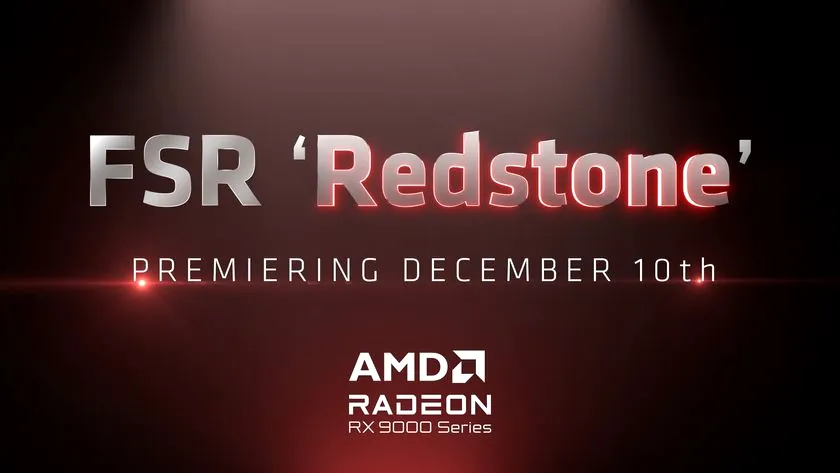
- AMD FSR 4 ‘Redstone’ marks a pivotal shift to Machine Learning (ML)-based upscaling, frame generation, Ray Regeneration, and Radiance Caching, aiming for parity with NVIDIA DLSS 4.
- Full ML-based Redstone features are exclusive to upcoming RDNA 4 GPUs (RX 9000-series) due to dedicated AI accelerators, while RDNA 3 (RX 7000-series) will rely on FSR 3.1’s shader-based fallbacks for most features.
- The RDNA 3 community feels ‘betrayed’ by AMD, perceiving a deliberate feature lockout on capable hardware, leading to widespread distrust and consideration of switching to NVIDIA.
- Technical justifications for RDNA 4 exclusivity lie in the efficiency of dedicated AI hardware (NPUs) compared to RDNA 3’s general-purpose shaders for complex ML workloads.
- Initial tests of Redstone’s ML Frame Generation show significant image quality improvements over FSR 3.1, but persistent issues with frame-pacing and smoothness remain in some titles.
- AMD’s long-term strategy, including collaboration with Sony on Project Amethyst for PS5 Pro, indicates a strong commitment to AI-driven graphics across future RDNA 4 and RDNA 5 architectures.
The Redstone Reckoning: AMD’s AI Leap and the RDNA 3 Divide
AMD’s FSR (FidelityFX Super Resolution) has long been celebrated for its open-source nature and broad hardware compatibility, offering a crucial alternative to NVIDIA’s proprietary DLSS. However, the announcement of FSR 4, codenamed ‘Redstone,’ marks a seismic shift for Team Red. With a pivot towards machine learning (ML)-based upscaling, frame generation, Ray Regeneration, and Radiance Caching, Redstone promises a new era of visual fidelity and performance. Yet, this technological leap has been met with a significant divide within the AMD community, particularly among owners of current-generation RDNA 3 GPUs. Many feel a profound sense of abandonment, questioning whether their hardware is being prematurely rendered obsolete or if legitimate technical barriers truly dictate Redstone’s RDNA 4 exclusivity. This definitive analysis unpacks the technical nuances, the community’s outcry, and the strategic implications of AMD’s most ambitious FSR iteration to date.
FSR Redstone Deconstructed: A New Era of AI Upscaling
FSR Redstone isn’t just an incremental update; it’s a fundamental architectural shift. The working title ‘Redstone’ encompasses FSR 4’s new AI Machine Learning-based super resolution algorithm, designed for superior accuracy and image quality. More significantly, it introduces three new, ML-driven features: Neural Radiance Caching, AI ML-based Ray Regeneration, and a new AI ML-based Frame Generation. These features aim to achieve technological parity with NVIDIA’s DLSS 3.5 and the upcoming DLSS 4, particularly for ray-traced AAA titles. Neural Radiance Caching learns light bounces to predict and store indirect lighting, reducing ray tracing costs. Ray Regeneration, similar to DLSS 3.5’s Ray Reconstruction, uses neural networks to refine path-traced pixels for crisper reflections. The most anticipated change is the replacement of FSR 3’s interpolation-based frame generation with a sophisticated ML model that incorporates temporal and spatial awareness for vastly improved accuracy and image quality. AMD plans to launch Redstone in the second half of 2025.
FSR Evolution: From Shader-Based to AI-Driven
| FSR Version | Core Technology | AI Integration | RDNA 3 Support (Current) | RDNA 4/Future Support (Planned) |
|---|---|---|---|---|
| FSR 1.0 | Spatial Upscaling | None | Full | Full |
| FSR 2.0 | Temporal Upscaling (Motion Vectors) | None | Full | Full |
| FSR 3.0 | Temporal Upscaling + Frame Generation | None | Full | Full |
| FSR 4.0 (Redstone) | AI-based Frame Generation & Interpolation | High (Neural Networks) | Unconfirmed/Likely Limited | Dedicated hardware acceleration expected |
Closing the Gap: FSR Redstone vs. NVIDIA DLSS 4
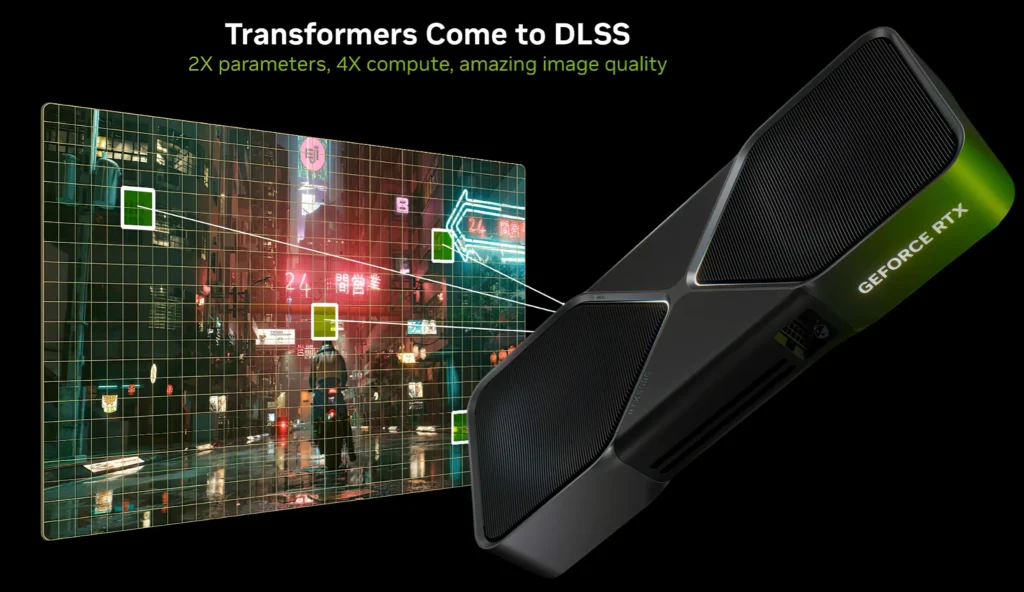
With Redstone, AMD is conceptually aligning FSR with the principles that have underpinned NVIDIA’s DLSS for years. Both now leverage machine learning and neural networks to reconstruct high-resolution images from lower-resolution inputs, depth buffers, and motion vectors. While DLSS traditionally emphasizes temporal history buffers and game-specific training, FSR Redstone aims for a more generic, universal approach, albeit now with a trained model. The core difference has historically been hardware: NVIDIA’s early adoption of dedicated Tensor Cores for AI inference versus AMD’s reliance on shader-based methods. Redstone changes this dynamic, introducing dedicated AI blocks in RDNA 4, signaling a direct architectural counterpoint to NVIDIA’s approach. This convergence means that FSR Redstone’s ML upscaling can achieve image sharpness in static scenes comparable to current DLSS versions, and its integrated pipeline for upscaling, ray regeneration, and frame generation is designed for similar stability and high-frequency output.
The RDNA 3 Divide: Betrayal or Technical Necessity?
The most contentious aspect of FSR Redstone’s rollout is its perceived exclusivity to RDNA 4 GPUs, leaving current RDNA 3 owners feeling abandoned. With high-end RX 7000 series cards still relatively new, the community’s outcry is palpable. Phrases like ‘betrayal’ and ‘obsolescence’ frequently appear in forums and social media. Many RDNA 3 users believe their hardware possesses sufficient computational capabilities, even without dedicated NPUs, to handle FSR Redstone’s AI workloads, making AMD’s stance appear as a deliberate feature lockout to drive sales of new hardware. This sentiment is amplified by the existence of community-made mods that reportedly enable some advanced features on older GPUs, fueling the frustration that official support is being withheld.
“As a 7900XTX user they SCREWED us MAJORLY”
“If they deliberately don’t let their previous customer use the feature going forward, what’s to say they won’t gatekeep FSR5 features from RDNA4 in order to sell more RDNA5? 😢”
The frustration among RDNA 3 owners is underscored by the fact that independent modders are already attempting to force FSR Redstone features onto older hardware. AMD Chief Software Officer Andrej Zdravkovic, while acknowledging these efforts with a ‘all the power to them,’ reiterated that official support hinges on delivering a consistent, quality experience across a wide range of systems. This gap between community innovation and official caution remains a major point of contention.
Under the Hood: Why RDNA 4 is Crucial for Redstone’s Full Potential
While RDNA 3 GPUs do possess matrix operation capabilities within their compute units, they crucially lack the dedicated, power-efficient Neural Processing Units (NPUs) or specialized AI cores found in newer architectures like the Ryzen AI 300 series and anticipated in RDNA 4/5. Running complex AI models for features like Frame Generation or Ray Regeneration on general-purpose shaders, while technically possible, is highly inefficient, slow, and can consume excessive power. This inefficiency leads to suboptimal user experiences—degraded performance, increased latency, or visible artifacts—which AMD aims to avoid associating with its FSR 4 branding. Andrej Zdravkovic emphasized that ML workloads must complete within a single frame budget; failure to do so can be counterproductive, undermining the feature’s purpose. The architectural leap in RDNA 4 provides the necessary hardware basis for optimal ML inference performance, allowing Redstone to function economically and effectively, similar to how NVIDIA’s Tensor Cores empower DLSS.
Performance & Fidelity: Early Impressions of Redstone Frame Generation
Initial analyses of FSR Redstone’s Machine Learning Frame Generation (MLFG) indicate a significant leap in image quality compared to FSR 3.1. Improvements are particularly noticeable in tracking objects without motion vector data, such as shadows, which no longer suffer from lag or warped perspectives. Fast-moving particles also exhibit clearer, ghosting-free movement, bringing MLFG’s visual fidelity closer to NVIDIA’s DLSS and Intel’s XeSS. However, despite these visual enhancements, a critical issue persists: spiky frame-times. Digital Foundry reports that while MLFG provides clearer images on RDNA 4 hardware, frame-pacing can remain problematic, especially during camera turns, leading to an inconsistent ‘shaky’ feel. This issue undermines the very purpose of frame generation—to increase apparent smoothness—and suggests that while the generated frames look better, the overall experience still requires refinement.
- Significant leap in image quality for Frame Generation via Machine Learning.
- Ray Regeneration and Neural Radiance Caching enhance ray tracing fidelity.
- Conceptual parity with NVIDIA DLSS 4.
- Dedicated AI hardware in RDNA 4 promises efficient performance.
- Open-source nature maintains broad long-term appeal.
- Full features exclusive to RDNA 4, alienating RDNA 3 owners.
- Persistent issues with ‘spiky frame-times’ impacting smoothness.
- Lack of clear communication on potential RDNA 3 support levels.
- Requires developer integration, not yet universal.
- Long-term brand loyalty at risk due to feature gating.
The Road Ahead: AMD’s AI Vision and Future Architectures
AMD’s strategic pivot with FSR Redstone is not an isolated event but a clear indicator of its long-term vision for AI integration across its hardware roadmap. The collaboration with Sony’s Mark Cerny on ‘Project Amethyst’ for the PS5 Pro, which has already co-developed a super-resolution algorithm used in FSR 4 on PC, underscores this commitment. Cerny’s revelation that ‘Big chunks of RDNA 5… are coming out of engineering I am doing on the project,’ explicitly designed for machine learning workloads, confirms that dedicated AI accelerators will be a cornerstone of future RDNA architectures. While this promises significant advancements in gaming performance and visual fidelity, it also reinforces the growing hardware segmentation. For AMD, Redstone is a necessary step to remain competitive in an AI-driven graphics landscape, but managing customer expectations and loyalty for prior generations will be a critical challenge in the years to come.
Your Burning Questions About FSR Redstone Answered
FSR Redstone represents a monumental and necessary leap for AMD, positioning them as a serious contender in the AI-driven graphics arms race. The technical advancements in image quality and ray tracing capabilities, powered by dedicated RDNA 4 hardware, are undeniable and crucial for future competitiveness against NVIDIA. However, the decision to limit these transformative ML features to upcoming generations has undeniably alienated a significant portion of AMD’s loyal RDNA 3 customer base. While the technical justifications are sound—dedicated AI hardware is demonstrably more efficient for these workloads—the communication and strategic handling of this transition have fostered widespread feelings of betrayal. For LoadSyn, the data is clear: FSR Redstone is a powerful, forward-looking technology that will define AMD’s future. Yet, the cost to current customer loyalty is a tangible concern. AMD must find a way to bridge this divide, perhaps through clearer roadmaps or experimental backports, to ensure that their pursuit of technological parity doesn’t come at the expense of their most ardent supporters. The Redstone Reckoning is here, and it demands more than just technical brilliance; it demands trust.