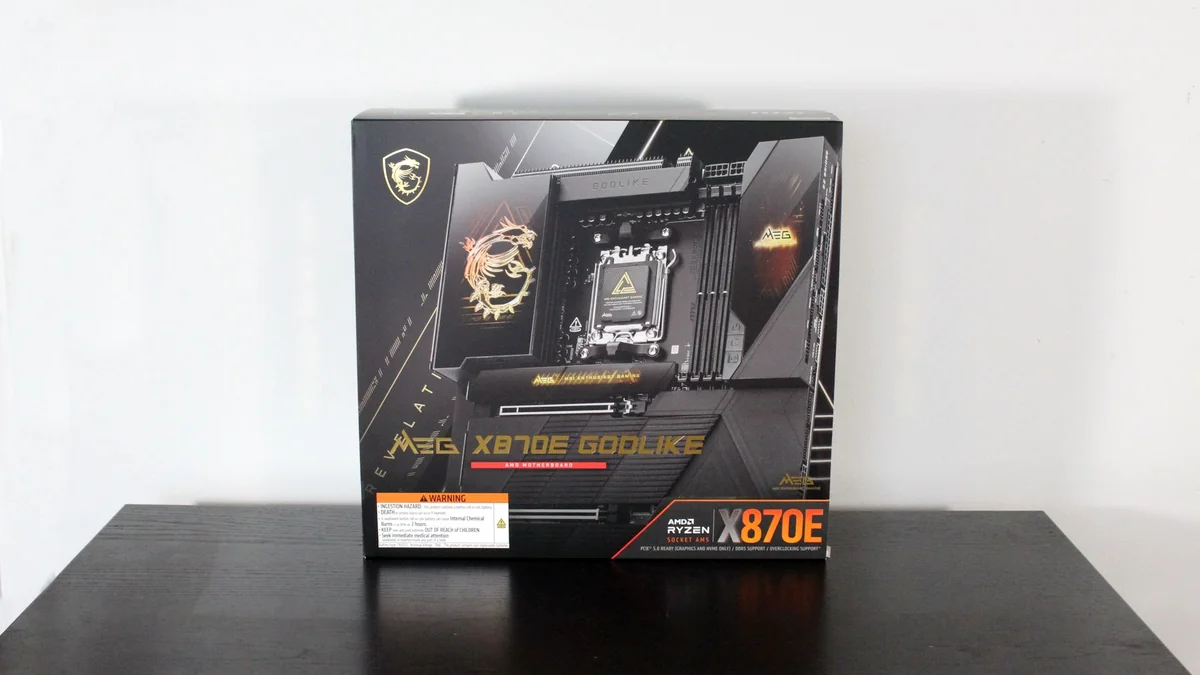

Key Takeaways: The Godlike X Edition in a Nutshell
- MSI’s MEG X870E Godlike X Edition is an ultra-premium, limited-edition motherboard priced at ~$1300, celebrating the series’ 10th anniversary.
- It boasts exceptional connectivity (15 rear USB, 7 M.2 slots), but PCIe lane limitations can compromise USB4 and M.2 Gen5 speeds.
- Despite massive heatsinks, thermal performance for the primary M.2 slot (76°C) and VRMs is surprisingly average, even sub-par in some tests.
- Real-world gaming and CPU performance show no significant advantage over X870E boards costing a fraction of the price.
- The ‘X Edition’ offers minimal functional upgrades over the standard Godlike, primarily aesthetic changes and a collectible plushie, making its premium price questionable.
- In a market plagued by component price inflation, its luxury-over-value proposition starkly contrasts with community anxieties.
Unveiling the MSI MEG X870E Godlike X Edition: A Glimpse into PC Royalty
In the realm of PC hardware, few names command as much attention and aspiration as MSI’s ‘Godlike’ series. For a decade, these motherboards have pushed the boundaries of engineering and aesthetics, culminating in the limited-edition MEG X870E Godlike X Edition. Priced at an eye-watering $1299.99 and restricted to just 1,000 units worldwide, it promises the pinnacle of AMD AM5 performance. But does this anniversary behemoth truly deliver a ‘godlike’ experience, or is it merely an opulent spectacle in a market increasingly focused on value?
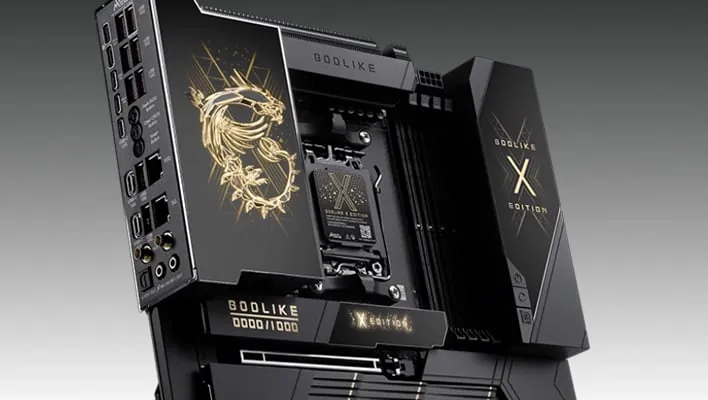
Beneath the Bling: Core Specifications & Design Philosophy
The X870E Godlike X Edition is built upon AMD’s X870E chipset, offering full support for Ryzen 7000, 8000, and future 9000 series processors on the AM5 platform. MSI has spared no expense in its construction, featuring a 24+2+1 duet rail power system with 110A Smart Power Stages, a 10-layer optimized PCB, and dual PCIe 5.0 slots. It aims to provide an uncompromised foundation for extreme overclocking and next-generation components. The integration of features like the Dynamic Dashboard III and EZ Link cable management system also speaks to a focus on user experience and aesthetics.
MSI MEG X870E Godlike X Edition: Key Specifications
| Socket | AMD AM5 (LGA 1718) |
|---|---|
| Chipset | AMD X870E |
| Form Factor | E-ATX |
| VRM Design | 24+2+1 Phase, 110A SPS |
| Memory Support | 4x DDR5 DIMM slots, up to 256GB, up to DDR5-9000+(OC) |
| PCIe Slots | 2x PCIe 5.0 x16 (x16/x0 or x8/x8), 1x PCIe 4.0 x4 |
| M.2 Slots (Onboard) | 2x PCIe 5.0 x4, 3x PCIe 4.0 x4 (1x x2/x4 limited) |
| M.2 Slots (with Xpander-Z) | 2x PCIe 5.0 x4 (hot-swappable) |
| Rear USB Ports | 2x USB4 Type-C (40 Gbps, DP), 5x USB 3.2 Gen2 Type-C, 8x USB 3.2 Gen2 Type-A |
| LAN | 1x Marvell 10GbE, 1x Realtek 5GbE |
| Wireless | Wi-Fi 7, Bluetooth 5.4 |
| Audio | Realtek ALC4082 Codec + ESS9219Q Combo DAC/HPA |
| Display | Dynamic Dashboard III (3.99-inch LCD) |
| Unique Features | EZ Link, EZ Bridge, M.2 Xpander-Z Slider Gen5, EZ PCIe Release |
Visual Tour: Engineering & Aesthetics
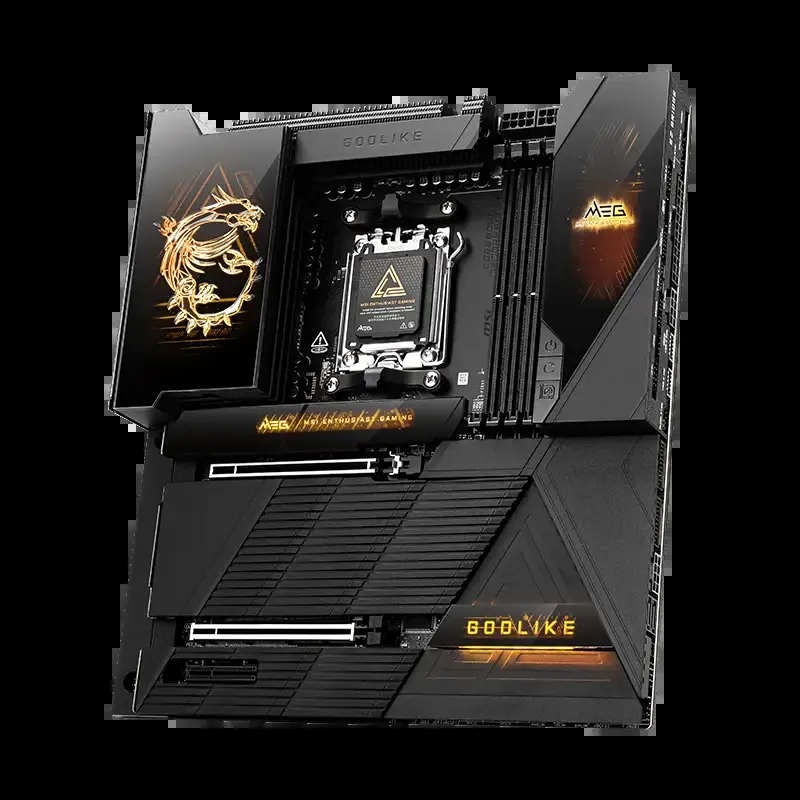
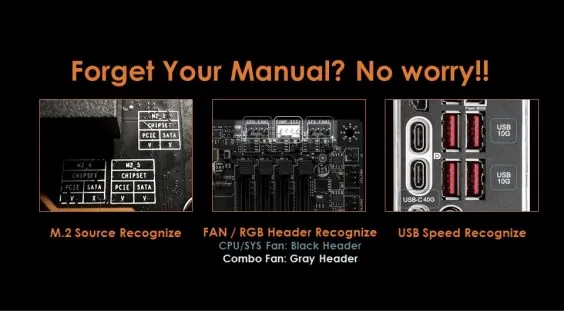
Connectivity King or PCIe Compromise?
One of the Godlike’s standout features is its unparalleled connectivity. With a staggering 15 rear USB ports (including two USB4 Type-C at 40 Gbps and five USB 3.2 Gen2 Type-C at 10 Gbps) and up to seven M.2 slots (two Gen5, five Gen4), it seems like a dream for peripheral and storage enthusiasts. However, this abundance comes with a caveat: shared PCIe lanes. Populating the second M.2 slot can reduce USB4 ports to 20 Gbps and the M.2 drive from x4 to x2. Similarly, the bottom PCIe x4 slot can be limited to x2 if M.2_4 is populated. These compromises, while common on AM5, are particularly noticeable on a board this expensive, suggesting that even ‘Godlike’ designs are constrained by platform limitations.
MEG X870E Godlike vs. MEG X670E Godlike: Generational Leaps?
| Feature | MEG X870E Godlike | MEG X670E Godlike |
|---|---|---|
| VRM Design | 24+2+1, 110A | 24+2+1, 105A |
| Max RAM Speed | 9,000+MT/s | 8,000+MT/s |
| Onboard Graphics Output | Type-C DisplayPort (x2) | N/A |
| PCIe 5.0 x16 Slots | 2 (x16/x0 or x8/x8) | 3 (x16/x0/x0, x8/x8/x0, x8/x4/x4) |
| Total M.2 Slots | 7 total | 5 total |
| Rear USB Type-C | 2x 40Gb/s, 5x 10Gb/s | 2x 20Gb/s |
| LAN | 1x 10Gb/s, 1x 5Gb/s | 1x 10Gb/s, 1x 2.5Gb/s |
| Wireless | Wi-Fi 7, BT 5.4 | Wi-Fi 6E, BT 5.3 |
Thermal Performance: Large Heatsinks, Mixed Results
MSI has adorned the Godlike X Edition with an imposing array of heatsinks, including a massive VRM cooler and dense M.2 Shield Frozr plates. The expectation is flawless thermal management, even under extreme loads. However, testing reveals a surprising reality. Despite its size, the VRM heatsink’s performance is only average, running hotter than some competitors. More critically, the primary M.2 slot, cooled by a slim heatsink featuring an embedded display, reached a peak temperature of 76°C. While not catastrophic, this is far from ideal for a Gen 5 SSD and suggests that aesthetic considerations may have taken precedence over optimal heat dissipation in key areas.
Thermal Performance Under Load: VRM & Primary M.2 Temps
Raw Power & Gaming Benchmarks: Where Does it Stand?
With its robust power delivery and high-speed memory support, one might expect the Godlike X Edition to lead in raw performance. Our testing, however, revealed that its default CPU and memory settings are quite conservative, prioritizing stability over out-of-the-box maximum performance. While it performs well across our test suite, there’s no significant performance advantage over X870E boards that are a quarter of the price. Achieving peak performance requires extensive manual tweaking in the UEFI, which many users may find daunting or unnecessary for minimal gains. This reinforces the notion that raw component quality doesn’t always translate to immediate, noticeable performance uplifts without significant user intervention.
Comparative Gaming Performance (Average FPS @ 1440p)
The ‘X Edition’ Exclusivity: Is It Worth the Premium?
The ‘X Edition’ status is the primary driver of the Godlike’s even higher price tag. Limited to just 1,000 units, buyers receive a numbered heatsink for the primary M.2 slot, a special USB-powered display stand for said heatsink, a unique BIOS aesthetic, and an MSI plushy-keyring dragon toy. Functionally, it is ‘practically identical’ to the standard MSI MEG X870E Godlike. For enthusiasts chasing exclusivity and collector’s items, these additions might justify the extra cost. For those seeking tangible performance or feature upgrades, the ‘X Edition’ offers little beyond bragging rights, making its additional premium over an already exorbitant price difficult to rationalize.
Pros
- Unmatched Connectivity: 15 rear USB ports, up to 7 M.2 slots.
- Exquisite Build Quality: 24+2+1 phase VRM, 10-layer PCB.
- Advanced Features: Dynamic Dashboard III, Wi-Fi 7, 10GbE LAN.
- Striking Aesthetics: Dual displays, ideal for showpiece builds.
- Limited Edition Rarity: Collectible appeal for niche enthusiasts.
Cons
- Eyewatering Price: $1299.99 is extremely high for the performance.
- PCIe Lane Compromises: Shared lanes throttle USB4/M.2.
- Sub-par Thermals: M.2 slot runs hot despite large heatsinks.
- Conservative Defaults: Requires extensive manual tweaking.
- Minimal ‘X Edition’ Value: Primarily aesthetic/collectible.
Community Pulse: Price Anxiety and the Ultra-High-End Market
“My crucial ram was $180 last week now $344! AI is messing it up right right now so grab anything you can while you can.”
The release of a motherboard like the Godlike X Edition comes at a peculiar time for PC builders. Our ‘Fandom Pulse’ analysis reveals a community gripped by anxiety over rapidly escalating component prices, particularly for RAM and SSDs. There’s widespread frustration that ‘future-proofing’ is a myth, with expensive builds quickly becoming obsolete, and a general skepticism towards non-value-driven hardware. In this climate, a $1300 motherboard that offers minimal performance gains over significantly cheaper alternatives, and even exhibits thermal quirks, feels almost tone-deaf. While there will always be a niche market for ultimate luxury and exclusivity, the Godlike X Edition struggles to justify its existence for the average, or even most high-end, enthusiasts who are increasingly scrutinizing every dollar spent.
The Godlike Paradox: A Matter of Perspective
The MSI MEG X870E Godlike X Edition is undeniably a marvel of engineering and design, a true showpiece that exemplifies MSI’s commitment to high-end hardware. Its connectivity is vast, its aesthetics captivating, and its build quality exceptional. However, its ‘godlike’ price tag, coupled with surprising thermal compromises and a lack of significant performance uplift over more affordable X870E boards, places it firmly in the realm of luxury, not practicality. The ‘X Edition’s’ limited upgrades over the standard Godlike further dilute its value proposition. In a market where PC builders are increasingly cautious and price-sensitive, the Godlike X Edition stands as a paradox: a magnificent achievement, but one that struggles to justify its existence beyond the very wealthiest collectors. For most, the standard MEG X870E Godlike offers an identical experience at a slightly less staggering price, while more discerning enthusiasts might find better value and similar real-world performance in a board costing a third as much. It’s a statement piece, but one whose statement is ‘I can afford it,’ rather than ‘this is the best performance for my money.’
Frequently Asked Questions
For most users, no. While a feature-rich and aesthetically stunning board, its performance gains over significantly cheaper X870E motherboards are negligible. Its high price is primarily for its limited-edition status and premium branding.
The X Edition adds a numbered M.2 heatsink, a USB-powered display stand, a unique BIOS aesthetic, and a collectible plushie. Hardware and performance are virtually identical.
No. A board costing $300-$500 can adequately power even the most demanding Ryzen CPUs and provide excellent connectivity. The Godlike X Edition offers diminishing returns.