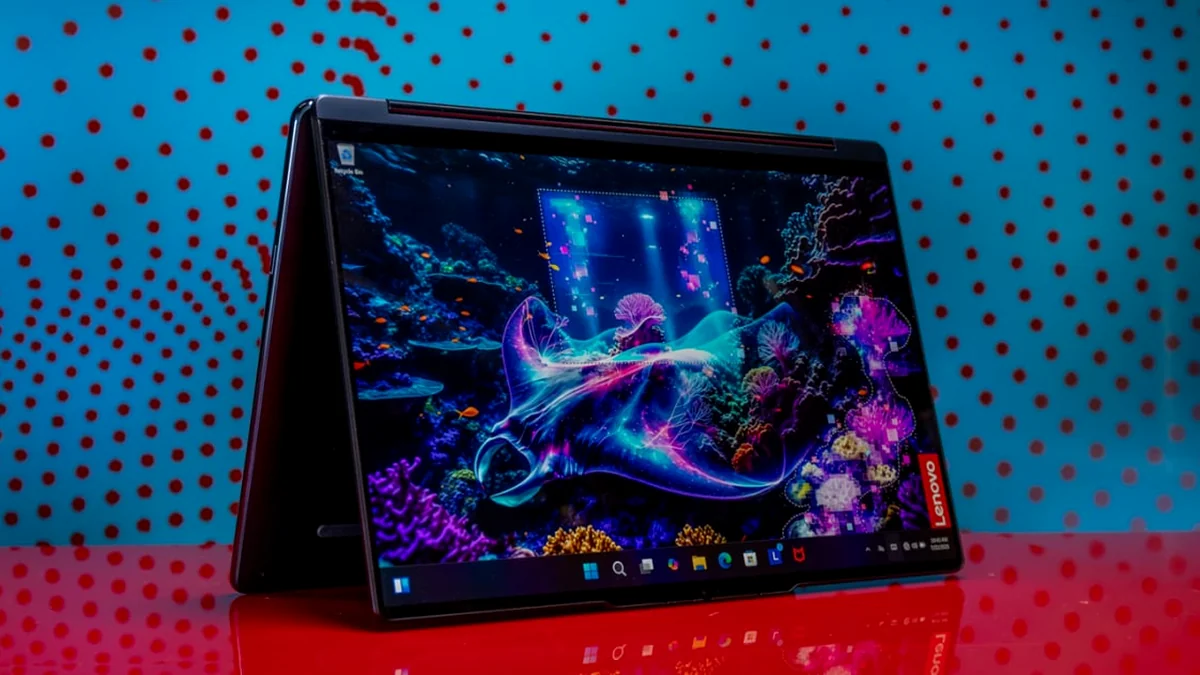

Key Takeaways: Lunar Lake & The Yoga 9i
- Efficiency Reimagined: Intel’s radical Lunar Lake architecture delivers on its promise of efficiency, enabling the Yoga 9i to achieve exceptional battery life, exceeding 20 hours in light usage scenarios.
- Integrated Graphics Power: The on-package Arc 140V iGPU is a surprisingly capable performer, delivering stable, high-quality frame rates for light-to-moderate gaming at FHD+ resolution, redefining expectations for ultrabook graphics.
- The RAM Tax: Because the memory is soldered, the 16GB LPDDR5X configuration is a critical long-term limitation. For anyone serious about utilizing the full potential of future AI models or the integrated GPU, upgrading to the 32GB tier is mandatory, adding a significant and non-negotiable cost.
The Lenovo Yoga 9i Gen 10, the company’s flagship 2025 premium convertible, is more than just a beautiful piece of hardware; it is the definitive test bed for Intel’s radical Lunar Lake architecture. This platform is not merely an iterative update; it represents a complete philosophical shift toward efficiency, necessitated by the rising power demands of on-device AI. Our review, conducted under the rigorous metrics of LoadSyn’s Hardware Engineering Deconstructed mandate, dissects not just the performance figures, but the profound architectural trade-offs inherent in this new era. Specifically, we analyze the exceptional efficiency gains that yield 20+ hours of battery life against the severe consumer constraint imposed by non-upgradable memory decisions. Understanding this tension—efficiency versus future-proofing—is key to defining the true cost of the AI PC era.
The New Engine: Lunar Lake’s Efficiency-First Design
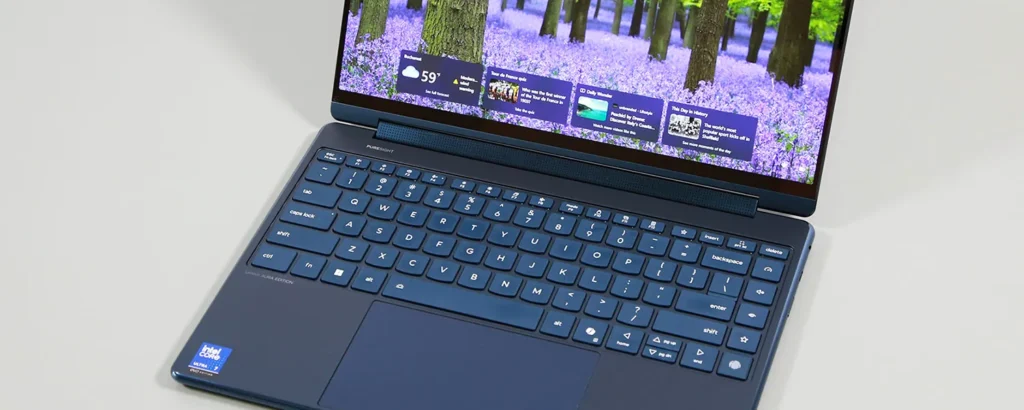
To hit stringent power targets, Intel implemented several radical design choices in Lunar Lake. The most profound is the removal of hyperthreading entirely, a decision driven by the singular focus on efficiency. Furthermore, traditional SO-DIMM slots were eliminated in favor of LPDDR5X memory soldered directly onto the package. This on-package memory configuration minimizes latency and power consumption, rejecting standards like CAMM2 because they were simply too power-hungry for the platform’s goals. The foundation of this efficiency rests on the highly optimized E-cores, which Intel asserts use as little as one-third the power of their Meteor Lake predecessors. These architectural sacrifices, while limiting in some sustained multi-core workloads, are what allow the Yoga 9i to achieve its record battery life while still managing to deliver strong integrated graphics performance via the Arc 140V.
Detailed Specifications
- Processor
- Intel Core Ultra 7 256V (Lunar Lake)
- Integrated Graphics
- Intel Arc 140V (8 Xe Cores)
- Memory (Soldered)
- 16GB LPDDR5X-8533 (up to 32GB available)
- Display
- 14-inch, 2.8K (2880×1800) 120Hz OLED
- Battery
- 75 Wh
- Wireless
- Wi-Fi 7 (Intel BE201), Bluetooth 5.4
The Performance Paradox: Gaming Meets Ultrabook Thermals
Thermal & Gaming Stability Metrics
Key performance indicators measured under sustained load (30 minutes of gaming).
The Lenovo 9 has a processor temperature of 100 degrees Celsius and no mini-LED screen options… Furthermore, some incredible design genius decided it would be a good idea to make it glossy.
The Soldered Future: Why 32GB is Now Mandatory (The $400 RAM Tax)
The most significant architectural compromise of the Lunar Lake platform is the memory subsystem. While the LPDDR5X-8533 memory is lightning fast, its non-upgradable, shared nature creates a severe bottleneck for the 16GB SKU. Both the powerful integrated Arc 140V graphics and the dedicated Neural Processing Unit (NPU) for Copilot+ AI must draw resources from this finite system RAM pool. Today, 16GB is functional, but tomorrow, as AI models grow larger and asset streaming becomes standard, this capacity will rapidly become dangerously insufficient. Consumers are effectively being forced into the significantly more expensive 32GB tier—a configuration priced nearly $400 higher than the 16GB base model—solely to ensure the machine remains viable for its intended purpose (AI and light gaming) for the next three to five years. This is the financial pressure of non-upgradable architecture, and it is a painful reality.
CRITICAL BUYING ADVICE: The 32GB Imperative. Because the LPDDR5X memory is soldered directly to the Lunar Lake package, the 32GB model is a non-negotiable investment for anyone intending to keep the Yoga 9i for more than three years, particularly if they plan on utilizing the full suite of Copilot+ AI features or leveraging the iGPU for light gaming. Do not compromise on the RAM configuration.
Deconstructed Innovation: The Silent Revolution in Thermal Management
Despite the Yoga 9i’s impressive thermal stability under its 28W load, the industry is already anticipating the next generation of heat challenges. The rise of on-device AI, which adds an estimated 10W thermal load from running large language models, demands entirely new cooling solutions for thin chassis. Enter Ventiva’s ion cooling technology. Their ICE9 blower, a revolutionary replacement for traditional fans, uses electrohydrodynamic (EHD) flow to generate silent airflow. This compact, 3mm-high solution is capable of managing up to 40W of thermal power—a significant leap. From an engineering perspective, the most compelling aspect is its integration: it utilizes the standard 4-pin connector and mimics the fan control architecture, meaning it requires no motherboard redesign or software modification. This seamless transition makes it a genuine game-changer for future Lunar Lake and next-gen ultrabooks.

Feature Comparison: Yoga 9i vs. MacBook Pro 14
| Feature | Lenovo Yoga 9i Gen 10 (Lunar Lake) | Apple MacBook Pro 14 (M4) |
|---|---|---|
| Wi-Fi Standard | Wi-Fi 7 (802.11be, up to 40 Gbps) | Wi-Fi 6E (802.11ax, up to 9.6 Gbps) |
| USB-A Port | 1x USB 3.2 Gen 2 (10 Gbps) | None |
| HDMI Port | None | Dedicated HDMI 2.1 |
| Charging Port | Standard USB-C | Proprietary MagSafe |
Pros and Cons: The Ultrabook Compromise
✓ Pros (Efficiency & Power)
- Exceptional battery life (20+ hours) thanks to Lunar Lake efficiency.
- Powerful integrated Arc 140V GPU for capable light gaming.
- Dazzling 2.8K 120Hz OLED display.
- Cutting-edge Wi-Fi 7 and Bluetooth 5.4.
✗ Cons (Compromises & Cost)
- Soldered 16GB RAM is a severe limitation for long-term AI/iGPU use.
- High cost of the mandatory 32GB configuration.
- Lack of dedicated HDMI 2.1 or SD card reader.
- Glossy screen finish creates glare.
Final Verdict
The Lenovo Yoga 9i Gen 10 is a technological marvel that perfectly executes Intel’s Lunar Lake vision of efficiency and integrated power. It delivers a dazzling screen, class-leading battery life, and enough graphics muscle to handle modern titles at acceptable frame rates—all within a stunning convertible chassis. However, this machine serves as a stark warning to the consumer: the AI PC future is non-upgradable. This is, without question, the best premium 2-in-1 on the market today, but that distinction comes with a caveat. You must accept the ‘RAM Tax’ and invest in the 32GB model to secure its longevity. The Yoga 9i is a brilliant machine that demands a painful financial commitment for true future-proofing.