
The New Era of Speed: Unveiling the Corsair MP700 Pro XT
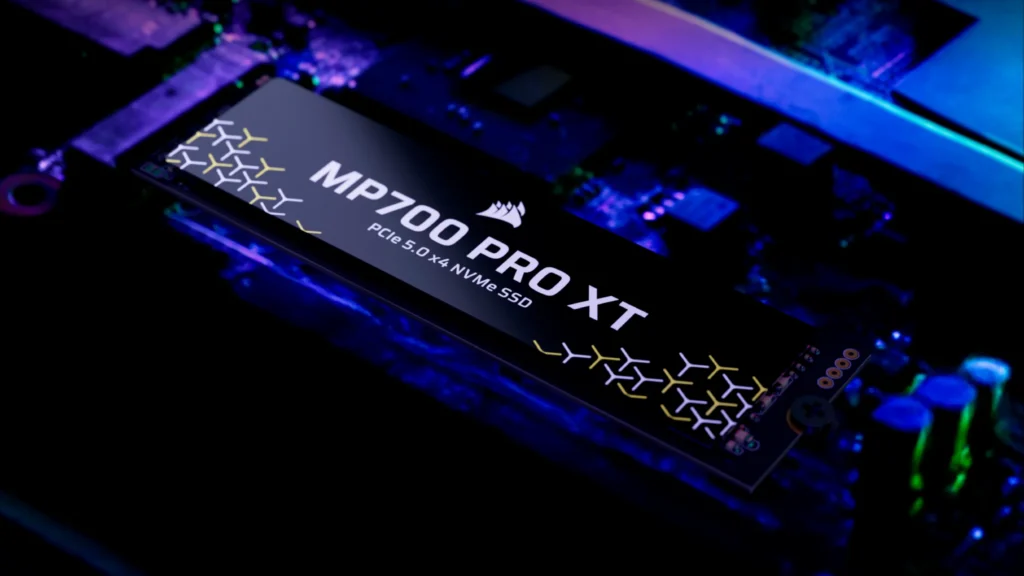
The relentless pursuit of speed in PC hardware has reached a new frontier with PCIe 5.0 SSDs, promising to redefine storage performance for gamers and power users alike. This isn’t just a marginal upgrade; it’s a doubling of the theoretical bandwidth over PCIe 4.0, pushing the limits to an astonishing 15.75 GB/s. For enthusiasts, this means more than just faster file transfers; it underpins technologies like Microsoft DirectStorage, which enables GPUs to directly access game assets, drastically reducing load times and improving in-game responsiveness. Stepping boldly into this high-stakes arena is Corsair’s new flagship, the MP700 Pro XT. With sequential read speeds soaring up to 14,900 MB/s, it edges remarkably close to the theoretical maximum, positioning itself as a formidable contender. This drive isn’t just fast; it’s a direct challenge to established high-end players like the Samsung 9100 Pro and SanDisk WD_Black SN8100, signaling a new benchmark in top-tier storage.
Key Takeaways
- Class-Leading PCIe 5.0 Performance: Achieves near-theoretical maximum sequential read speeds of 14,900 MB/s and up to 14,500 MB/s sequential writes, setting a new benchmark for consumer drives.
- DirectStorage Ready: Fully supports Microsoft DirectStorage, promising significantly faster game loading and smoother asset streaming.
- Phison E28 Controller: Utilizes the advanced Phison E28 controller, initially lauded for its power efficiency, though real-world thermal management proves complex.
- Thermal Management is Critical: Under sustained heavy write loads, the drive will throttle, often requiring more robust cooling than standard motherboard heatsinks can provide. Active airflow or a dedicated, high-performance heatsink is strongly recommended for peak, consistent performance.
- Premium Pricing: Positioned at the high end of the market, reflecting its cutting-edge performance.
- Capacity Limitations (at launch): Available in 1TB, 2TB, and 4TB capacities, with an 8TB model anticipated in 2026.
Unpacking the Performance: Raw Speed & Internal Architecture
| SSD Model | Capacity | Sequential Read (MB/s) | Sequential Write (MB/s) | Random Read (IOPS) | Random Write (IOPS) | DRAM Cache (GB) | Endurance (TBW) | Form Factor |
|---|---|---|---|---|---|---|---|---|
| MP700 Pro XT | 4TB | 14,900 | 14,400 | 2,700,000 | 3,300,000 | 4 | 2,800 | M.2 2280 |
| MP700 Pro XT | 2TB | 14,900 | 14,500 | 2,700,000 | 3,300,000 | 2 | 1,400 | M.2 2280 |
| MP700 Pro XT | 1TB | 14,900 | 14,200 | 1,500,000 | 3,300,000 | 1 | 700 | M.2 2280 |
| MP700 Micro | 4TB | 9,400 | 8,100 | 1,200,000 | 1,400,000 | N/A | 1,400 | M.2 2242 |
| MP700 Micro | 2TB | 10,000 | 8,500 | 1,300,000 | 1,400,000 | N/A | 1,200 | M.2 2242 |
| SSD Model | Sequential Read (MB/s) | Sequential Write (MB/s) | Random Read (IOPS) | Random Write (IOPS) | Available Capacities | Approx. 2TB Price* |
|---|---|---|---|---|---|---|
| Corsair MP700 Pro XT | 14,900 | 14,500 | 2,700,000 | 3,300,000 | 1TB, 2TB, 4TB | $249.99 |
| Samsung 9100 Pro | 14,800 | 13,400 | N/A | N/A | Up to 8TB | ~$900 (8TB) |
| SanDisk WD_Black SN8100 | 14,900 | 14,000 | N/A | N/A | Up to 8TB | ~$1000 (8TB) |
| TeamGroup T-Force Z54E | 14,900 | 14,000 | N/A | N/A | N/A | N/A |
| *Prices are approximate at launch and subject to change. Random IOPS for competitors not explicitly stated in research for direct comparison. | ||||||
At the heart of the MP700 Pro XT’s blistering performance lies the Phison PS5028-E28 Gen5 NVMe 8-channel controller, paired with Kioxia/SanDisk’s advanced BiCS8 218-layer TLC NAND flash. This combination is a testament to cutting-edge engineering, enabling the drive to harness the full potential of PCIe 5.0. The E28 controller, specifically, has been noted for its power efficiency, even outperforming several high-end competitors in laptop battery life tests, suggesting a design that aims to balance raw speed with energy consciousness. However, as we’ll delve into shortly, the reality of sustaining such extreme speeds introduces complex thermal dynamics that challenge even the most efficient designs.
Launched alongside its powerhouse sibling, the Corsair MP700 Micro offers a different proposition for a distinct audience. This compact M.2 2242 form factor drive, powered by Phison’s E31T PCIe 5.0 controller (a DRAM-less HMB design), is purpose-built for ultra-thin laptops, tablets, and mini-PCs. While its sequential speeds of up to 10,000 MB/s read and 8,500 MB/s write don’t match the Pro XT, they are still exceptionally fast for its diminutive size, offering a robust storage upgrade where space and power efficiency are paramount.
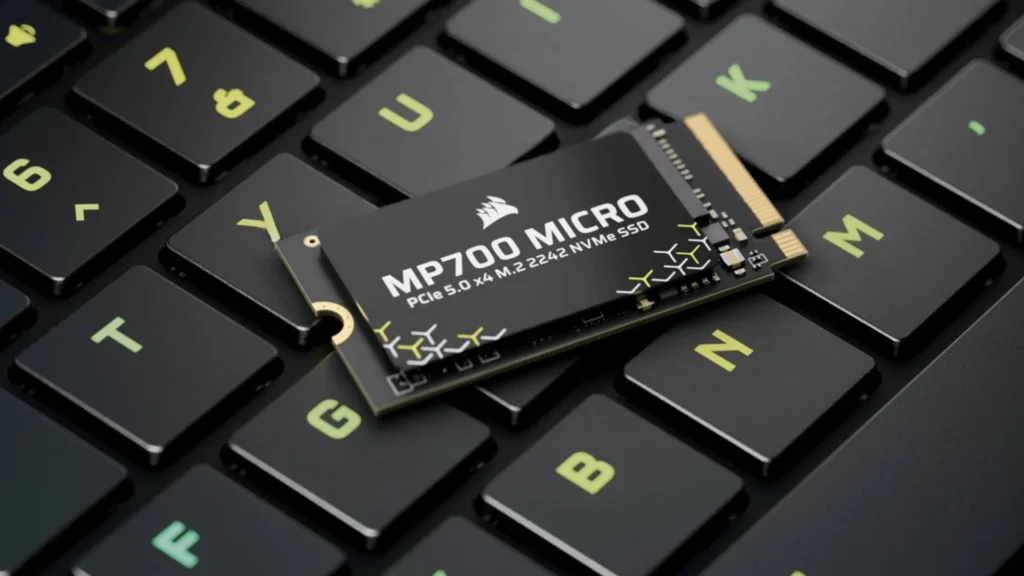
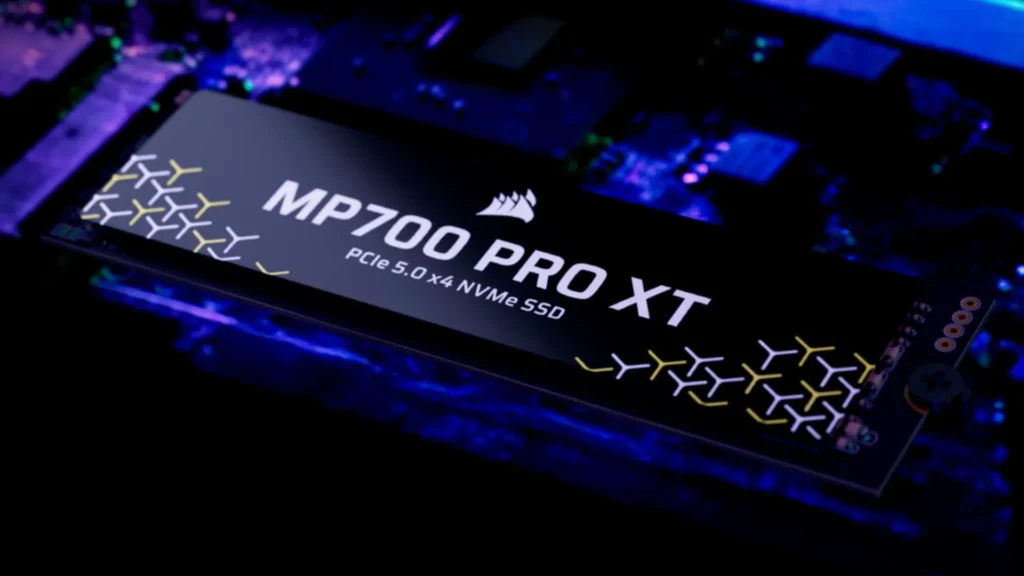
The Heat Barrier: Power Consumption, Thermals, and Sustained Performance
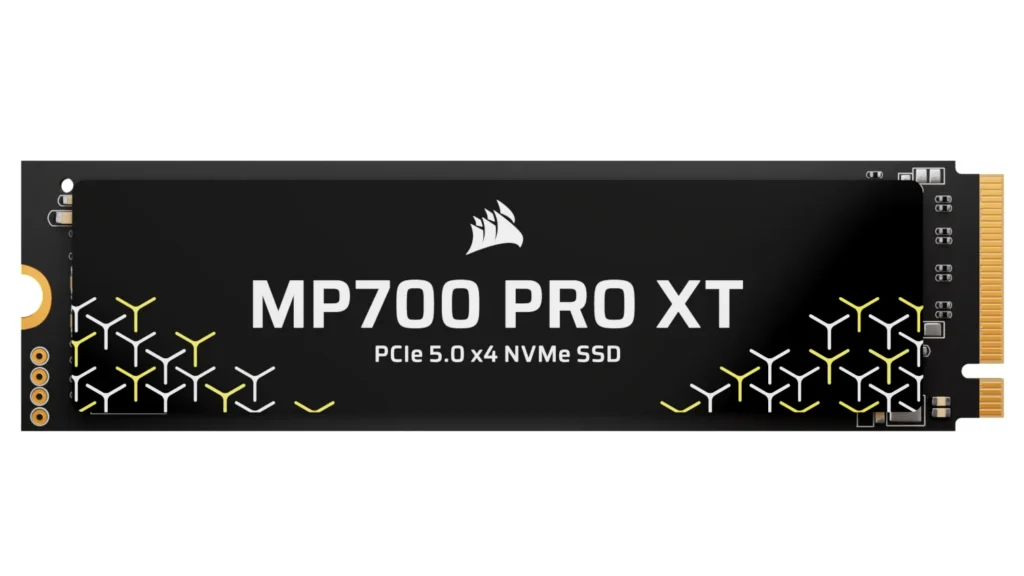
The exhilarating speeds of PCIe 5.0 come with a fundamental challenge that often goes understated: heat. The Phison E28 controller, despite its advanced manufacturing node, exhibits a high power density due to its compact chip area. This isn’t merely about total power consumption; it’s about how that heat is concentrated, creating intense localized hotspots. While some specifications might allude to a controller power draw of around 6.5 watts, our meticulous analysis, echoing findings from sources like Igor’s Lab, reveals a more complex reality.
Under real-world, sustained active mode operation, the entire drive’s power consumption—encompassing the controller, the Kioxia/SanDisk NAND flash, the SK Hynix DRAM cache, and the power conversion losses from the PMICs (Power Management ICs)—can easily sum up to an estimated 9 to 10 watts. This is a significant increase over the isolated controller figure and presents a formidable thermal management task. This elevated heat flux density means that even with a nominally massive heatsink, the localized temperature at the controller can quickly reach firmware limits, leading to performance throttling. It’s akin to modern Ryzen CPUs, where higher hotspot temperatures occur despite similar or lower TDPs, simply because the active components are packed into a smaller, denser area. Effective cooling, therefore, demands not just mass, but superior planarity, higher contact pressure, and low thermal resistance at the thermal interface material (TIM).
Critical Cooling Alert: Your PCIe 5.0 SSD Needs More Than Just a Heatsink
Without adequate cooling, the Corsair MP700 Pro XT WILL throttle under sustained write loads, severely impacting its long-term performance. While many modern motherboards include M.2 heatsinks, these are often designed for lower-power PCIe 4.0 drives and may prove insufficient for the extreme heat generated by the MP700 Pro XT. For users engaging in continuous heavy tasks like large file transfers, video editing, or game streaming, we strongly recommend either a more robust, aftermarket heatsink solution or ensuring direct, active airflow over your M.2 slot to maintain peak speeds.
“For constant write throughputs without throttling, a more massive cooler with better planarity, higher contact pressure and low thermal resistance of the TIM is required, alternatively an active airflow.”
Gaming Implications & The Fandom Pulse: What the Community Thinks
For gamers, the arrival of drives like the MP700 Pro XT, with its explicit support for Microsoft DirectStorage, signals a tantalizing future. DirectStorage promises to revolutionize game loading times and asset streaming by allowing the GPU to access storage directly, bypassing CPU bottlenecks. While the MP700 Pro XT’s incredible sequential speeds are undoubtedly foundational for this technology, it’s crucial to temper expectations. Not all games are optimized to fully saturate PCIe 5.0 bandwidth, meaning that while load times will be dramatically improved, the sheer sustained throughput might not always be fully utilized in typical gaming scenarios.
However, the community’s pulse reveals another critical intersection: the burgeoning interest in Small Form Factor (SFF) builds. The allure of a compact, powerful gaming rig is undeniable, yet high-performance components invariably bring significant thermal challenges. Integrating a PCIe 5.0 SSD that can draw upwards of 10 watts into a cramped SFF chassis, often with limited airflow, can quickly turn a cutting-edge drive into a throttled bottleneck. This echoes a prevalent concern within the fandom, where the trade-off between miniaturization and thermal efficiency remains a constant, heated debate, especially when considering the demands of modern GPUs and now, ultra-fast storage.
“Mera budget tab hil raha hai jabe mai ram mai ake ruk raha hu 😂”
Pricing, Availability, and the Road Ahead
- Initial Capacities & Pricing (USD): The MP700 Pro XT is available in 1TB ($159.99), 2TB ($249.99), and 4TB ($459.99) configurations. While these represent a premium, they are competitive for a bleeding-edge PCIe 5.0 drive at launch.
- Future Capacity: Corsair has indicated plans for additional capacity options in 2026, most likely an 8TB model, following competitors like Samsung and SanDisk who already offer higher capacities.
- Warranty & Software: Both the MP700 Pro XT and MP700 Micro are backed by Corsair’s robust five-year limited warranty, offering peace of mind. Additionally, users gain access to the Corsair SSD Toolbox software for drive management, monitoring, and firmware updates.
- Market Position: Positioned at the pinnacle of consumer SSD performance, the MP700 Pro XT’s pricing reflects its status. However, as with all new technologies, street prices are subject to fluctuation and are expected to become more accessible over time, especially as competition intensifies.
Final Verdict
The Corsair MP700 Pro XT stands as an undeniable technical marvel, pushing the very boundaries of PCIe 5.0 storage performance. Its sequential read speeds are breathtaking, offering a glimpse into the future of ultra-fast data access and gaming experiences powered by DirectStorage. For users whose workloads consist of frequent, intensive burst transfers—think application launches, rapid file access, or short-duration creative tasks—this drive will deliver unparalleled responsiveness.
However, as our deep dive into its thermal dynamics reveals, harnessing the MP700 Pro XT’s full, sustained potential is a nuanced endeavor. This isn’t a plug-and-play upgrade for every system; its high power density necessitates robust thermal management. Without a dedicated, high-performance heatsink and adequate airflow, particularly under prolonged write operations or when the pSLC cache is heavily utilized, throttling is an inevitable reality. For those engaging in continuous, heavy streaming or archiving, where sustained write performance is paramount, a more conservative approach to cooling, or even alternative drives with different cache designs, might be more suitable.
Ultimately, the MP700 Pro XT is for the discerning enthusiast and power user who understands the demands of cutting-edge hardware. Before committing to the premium price tag, meticulously assess your system’s cooling capabilities and your primary use cases. If you’re prepared to optimize your setup to match its performance, the MP700 Pro XT will reward you with an exhilarating, top-tier storage experience.