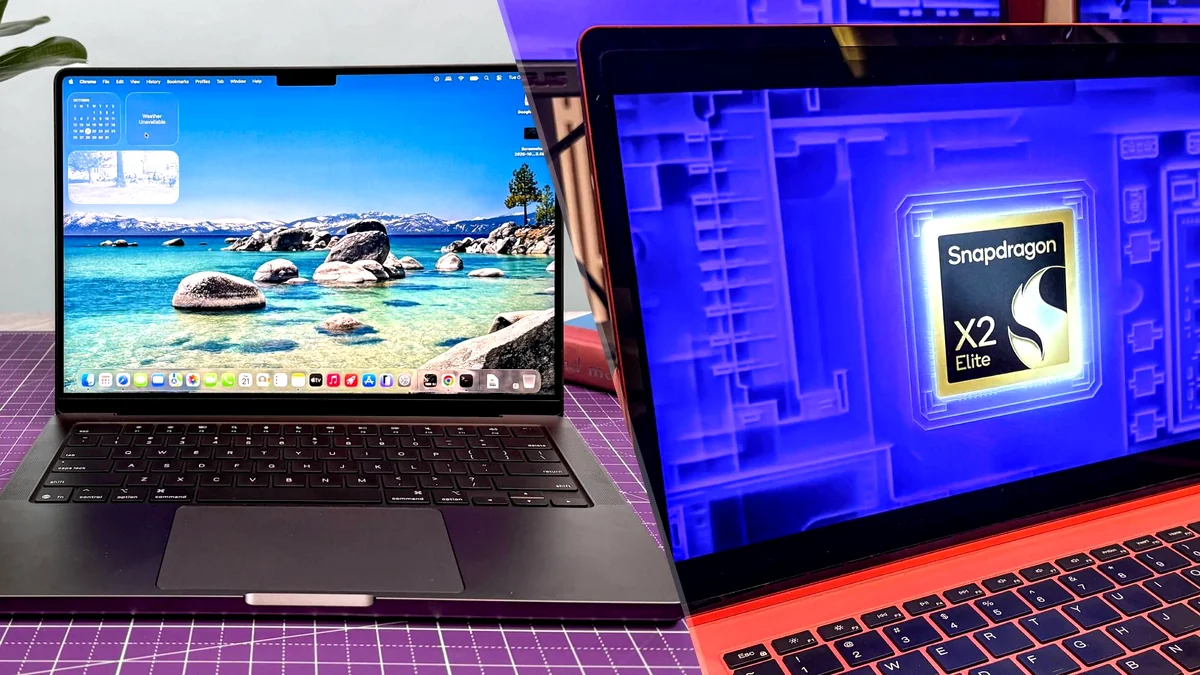

🔑 Key Takeaways: M5 vs. Snapdragon X Elite
- Apple’s M5 chip is a highly focused performance upgrade, delivering up to 1.6x faster graphics and 3.5x faster AI performance than the M4, driven by Neural Accelerators strategically placed in every GPU core.
- The M5 14-inch MacBook Pro retains its M4 physical design, but crucially now offers a 153Gb/s memory bandwidth (up from 120Gb/s) and makes the 4TB SSD configuration option available on the base model.
- The Snapdragon X Elite (SXE) platform remains the clear battery life champion, delivering tested endurance up to 21 hours, but its gaming performance relies heavily on the maturity and stability of Microsoft’s Prism emulator.
- Consumer anxiety centers on Apple’s strategic hardware limitations—specifically the 60Hz screen and 16GB RAM base on the M5 Air—which forces users toward the much higher-priced Pro models for acceptable longevity and future-proofing.
- The ‘AI PC’ trend is the new battleground, with both platforms leveraging NPUs (Neural Processing Units) for on-device tasks, though the practical, daily-use benefits outside of specific creative workflows are still under intense scrutiny.
M5 Deconstructed: The Performance and AI Leap
Apple M5 (Base 14-inch MacBook Pro) Core Specifications
The Strategic Tax: Why the M5 Air is a Trap
The Fandom Pulse reveals widespread anxiety among buyers: while the M5 MacBook Air starts at an attractive $999, it ships with a restrictive 60Hz display and a functionally obsolete 8GB RAM base configuration. For any user seeking true longevity, seamless multitasking, or a modern, consistent user experience, upgrading to 16GB RAM and/or the $1,599 Pro model (which offers 120Hz ProMotion and a superior XDR display) becomes a necessity. This strategic pricing model—where the base model is intentionally crippled by key feature limitations—is the single biggest factor driving consumer frustration and forcing users into the higher-margin Pro ecosystem.
The Snapdragon X Elite: Gaming and Efficiency Reality Check
Windows on Snapdragon, a Platform Ready for your PC Games. Qualcomm has already reviewed and checked out all the top games available on Steam.
Qualcomm’s confidence in the Snapdragon X Elite (SXE) is based on a robust, three-pronged strategy designed to ensure compatibility: native ARM64 ports, hybrid ARM64EC applications for efficiency, and the highly improved x64 emulation layer, Prism. While this approach undeniably promises industry-leading battery life—tested endurance reaching up to 21 hours on some reference models—and future-proof AI NPU integration, our Fandom Pulse analysis highlights a critical gap: driver maturity. Enthusiasts are reporting real-world instability and a distinct lack of optimized drivers (the equivalent of ‘turnip drivers’ in the mobile space) needed to unlock peak performance and consistency in complex gaming titles. The recent collaboration with Epic Games to bring Fortnite natively to Windows on Arm is a major, stabilizing step forward, yet for the competitive gamer demanding 1% Low consistency, the SXE platform is still fundamentally a high-risk, high-reward proposition.
Platform Showdown: M5 MacBook Pro vs. Snapdragon X Elite (Reference Model)
| Criterion | Apple MacBook Pro 14-inch (M5) | Snapdragon X Elite Laptop (Reference) |
|---|---|---|
| Base Price | $1,599 | Starts at ~$1,299 |
| Claimed Max Battery Life | Up to 24 Hours | Up to 21 Hours (Tested) |
| Display Technology | Liquid Retina XDR (Mini-LED, 120Hz ProMotion) | OLED/LCD (Varies, often 60Hz/120Hz) |
| Gaming Compatibility | Native ARM64 (Limited Library) + Rosetta 2 | Native ARM64 + Prism x64 Emulation (DX12/Vulkan ready) |
| AI Performance Claim | 3.5x faster than M4 | Up to 45 TOPS (Varies by SKU) |
| Ports/Connectivity | 3x Thunderbolt 4/5, HDMI, SDXC, MagSafe 3 | USB4, HDMI, Dedicated NPU (Qualcomm AI 100 on some models) |
The Investment Trade-Off
Pros (Why Choose It)
- M5 Pro: Unmatched, proven single- and multi-threaded performance for creative professionals and demanding workloads.
- M5 Pro: Liquid Retina XDR display is superior to most Windows panels, offering 1,000 nits sustained brightness and 120Hz ProMotion consistency.
- SXE: Industry-leading battery life (21+ hours) and exceptional power efficiency, making it the ultimate mobile workstation.
- SXE: Aggressive driver development and Microsoft collaboration promise future gaming stability, especially with Prism’s AVX/AVX2 emulation support.
Cons (The Drawbacks)
- M5 Pro: Significant price premium, especially when upgrading RAM/Storage (the ‘RAM Tax’ is unavoidable for longevity).
- M5 Pro: Base M5 models lack the latest Thunderbolt 5 support (M4 Pro/Max required), limiting future high-speed peripheral integration.
- SXE: Gaming performance is currently inconsistent and reliant on emulation/driver maturity, leading to unpredictable 1% Low frame rates.
- SXE: Early Windows on Arm devices face OS/driver integration hurdles, with some models (like the Dell Pro Max) shipping Linux first due to delays.
Frequently Asked Questions
Is the M5 upgrade worth it if I have an M4 MacBook Pro?
The M5 is primarily an architectural leap focused on AI and graphics (boasting up to 1.6x faster GPU performance and 3.5x faster AI processing). If your daily workflow relies heavily on AI enhancement (e.g., Topaz Video, Generative Fill, or large LLMs) or if you are upgrading from an M3 or older chip, the performance gains are substantial and actionable. If you are a general user on an M4, the incremental CPU performance increases are less critical, and upgrading is not strictly necessary.
What is the ‘AI PC Tax’ the community is complaining about?
The ‘AI PC Tax’ refers directly to the consumer skepticism that new hardware from all major vendors (Intel, AMD, Qualcomm, and Apple) now requires a dedicated NPU (Neural Processing Unit), primarily to enable Microsoft Copilot or similar on-device features. Many users feel they are paying for NPU hardware they won’t fully utilize, especially since Apple Intelligence features are also supported on the previous M3 and M4 chips, making the NPU upgrade feel redundant to many buyers.
Can the Snapdragon X Elite run competitive games like Valorant or Warzone?
While Qualcomm claims compatibility with all top Steam games, performance for non-native titles relies entirely on the x64 Prism emulator. Titles with complex, low-level anti-cheat mechanisms (such as Valorant or Warzone) have historically struggled or outright failed on emulated platforms. Qualcomm is actively collaborating with major anti-cheat providers (like Hyperion and BattleEye) to improve this integration, but until that ecosystem matures, only native ARM64 games (like the newly ported Fortnite) will offer reliable, competitive performance.
Final Verdict: The Investment Decision
The 2025 premium laptop market is defined by a clear fork in the road. The M5 MacBook Pro is the undisputed authority for creative professionals, engineers, and students who demand reliable, sustained performance and a world-class Liquid Retina XDR display. This reliability comes at a cost, however: buyers must be willing to pay the ’60Hz/RAM Tax’ to secure a truly future-proof machine with 16GB+ RAM. For the user whose primary demand is extreme portability and industry-leading battery life, the Snapdragon X Elite is the only choice; its efficiency is truly disruptive and fundamentally changes mobile computing expectations. However, for the competitive gamer, the SXE remains a high-risk gamble. Until the Windows on Arm driver ecosystem matures, and more AAA titles are natively ported to ARM64, the M5 remains the safer, more reliable high-performance investment for consistent frame rates and proven application compatibility.