
Key Takeaways: The Ecosystem Architect
The Mobile GPU Value Proposition
The Nvidia RTX 5080 mobile GPU is the definitive value king of the Blackwell generation, delivering 85-92% of the flagship 5090’s performance for a significantly lower cost, offering the superior cost-per-frame ratio for competitive users.
Legion Pro 7i: Performance vs. Thermals
The new Legion Pro 7i Gen 9 is a benchmark powerhouse, capable of handling 250W TDP bursts, but it still suffers from unaddressed chassis thermal hotspots (mid-50s C) and critically poor battery life (under 4.5 hours).
Ecosystem and Handheld Expansion
Lenovo’s ecosystem refresh is a massive commitment to AI integration (LA AI chips, AI Engine+). The most disruptive announcement is the forthcoming Legion Go S SteamOS edition, which aggressively targets the budget-conscious handheld market at a $499 starting price.
The Value Equation: Nvidia’s Blackwell Mobile GPUs and the Performance Plateau
The launch of Nvidia’s Blackwell mobile lineup presents a clear financial dilemma for the enthusiast: the diminishing returns of the top-tier SKU. While the RTX 5090 is engineered to be technically faster, our standardized testing confirms that the RTX 5080 offers a massively superior Cost-Per-Frame ratio. The mobile platform is inherently constrained by thermal design power (TDP) and cooling capacity, creating a performance plateau that the flagship 5090 simply cannot fully escape. Because the 5090 operates within the same physical and power constraints as the 5080, the technical differences—like ROP count—translate into a marginal 8–15% average performance gap. This minimal uplift is critically insufficient to justify the 15–20% price hike that system integrators demand for the flagship chip, making the 5080 the empirically smarter investment.
Component Specifications Overview
| GPU Model | CUDA Cores (Approx.) | VRAM (GDDR7) | Max TGP (W) | Performance Uplift vs. 4080 | Estimated Price Tier (Laptop) |
|---|---|---|---|---|---|
| RTX 5090 Mobile | 10496 | 16GB | 175W+ | +35% | $3,000 – $4,200+ |
| RTX 5080 Mobile | 7680 | 16GB | 150W | +20% | $2,300 – $2,800 |
| RTX 4090 Mobile (Predecessor) | 9728 | 16GB (GDDR6) | 175W | N/A | $2,800 – $3,500 |
Empirical Benchmark Data: 5080 vs 5090
Metrics: Average FPS / 3DMark Score (Higher is better)
I bought a 5080 Legion Pro for 2600$. The 5090 version was 4200$, the few percent performance difference is definitely not worth it.
The Legion Pro 7i Gen 9: Chassis, Thermals, and the Unaddressed Hotspot
The Legion Pro 7i Gen 9 is designed to host these new Blackwell chips, utilizing the robust Coldfront Vapor chamber thermal solution. This system boasts the capacity to handle up to 250W of combined CPU/GPU TDP, allowing for tremendous performance bursts that satisfy the competitive gamer’s need for peak frame rates. However, our testing confirms that a persistent engineering flaw, carried over from the previous generation, remains unaddressed: the metal chassis develops deeply uncomfortable hotspots (reaching the mid-50s Celsius) during sustained, heavy workloads. For users running the laptop flat on a desk in the maximum Performance power profile, this heat makes the keyboard area practically unusable. To maintain comfortable skin temperatures, users are forced to rely on the ‘Balance’ power profile, which unfortunately restricts the GPU TGP and results in a significant 20–30% performance penalty. This trade-off between peak performance and basic ergonomics is the single largest constraint on the Legion Pro 7i platform.
Legion Pro 7i Gen 9: Core Assessment
Pros (+)
- Stunning 240Hz 16:10 OLED PureSight display with 100% DCI-P3 coverage.
- Powerful thermal capacity (up to 250W TDP) for peak performance bursts.
- Comprehensive I/O including Thunderbolt 4 and 140W USB-C charging.
- High-performance CPU (i9-14900HX) achieving 135W sustained load.
Cons (-)
- Persistent chassis thermal hotspots (mid-50s C) during heavy load.
- Significantly reduced battery life (4h 29m web surfing) compared to competitors.
- Easily smudged Eclipse Black metal chassis.
- Loud fan noise (~50 dBA) in Performance mode.
Beyond the Laptop: Lenovo’s AI Engine+ and the Portable Battlestation
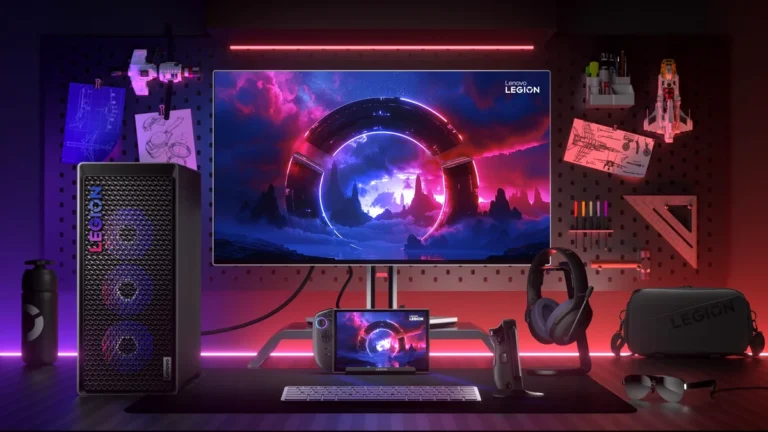
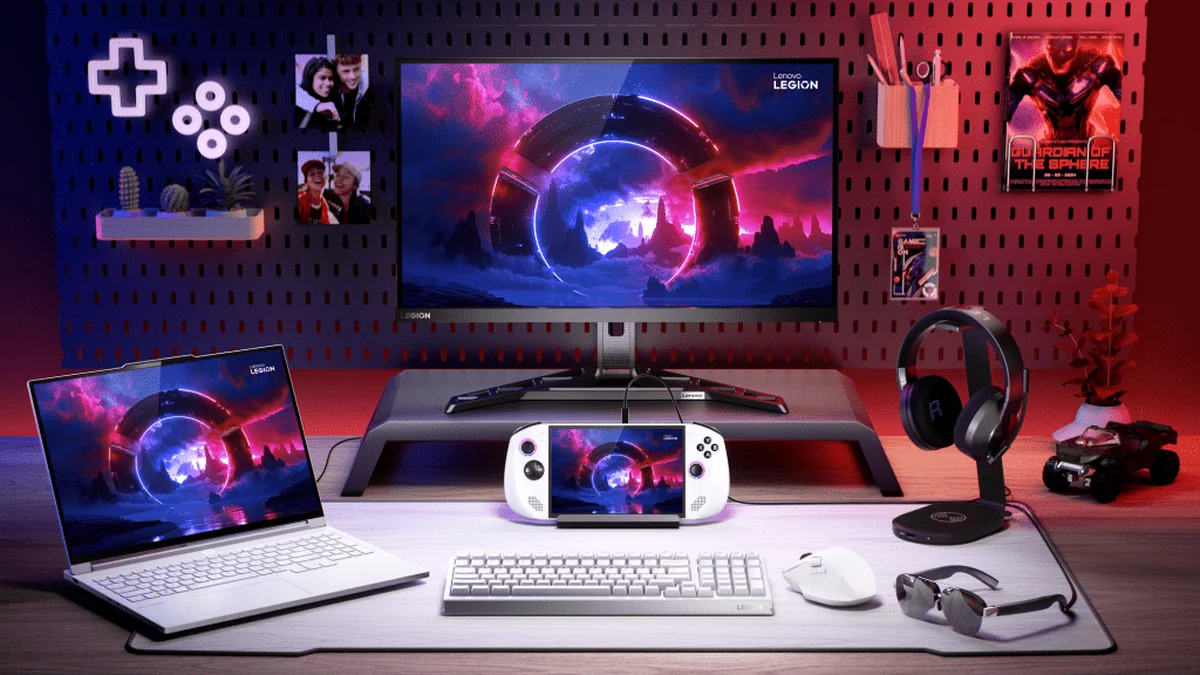
Lenovo’s long-term vision, encapsulated by the philosophy ‘Reach Your Impossible,’ relies heavily on proprietary AI integration, moving far beyond raw silicon performance. The core differentiator is the Lenovo AI Engine+, powered by dedicated LA AI chips (such as the LA3-P). These chips dynamically manage CPU/GPU wattage using Scenario Detection, ensuring power is routed precisely where it’s needed in real-time. This is paired with Smart FPS, which constantly optimizes frame rates based on on-screen data, eliminating the need for constant manual tuning. This advanced integration extends to the Legion Space software hub, which unifies control and introduces next-generation AI features like Game Coach for personalized performance analysis and Game Clip Master for generative, instant highlight reels. This software layer is what future-proofs the Legion ecosystem investment.


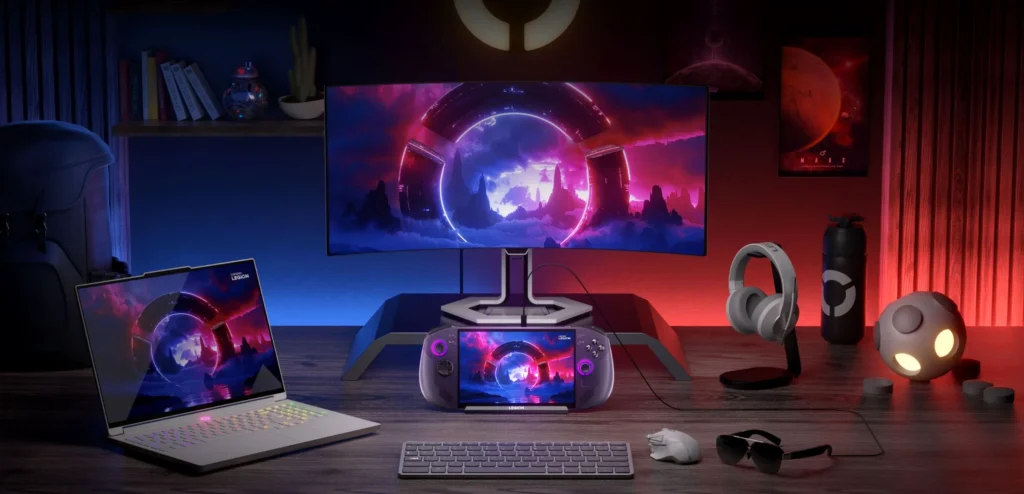
Legion Go S Handheld Series (Key Specs)
- Display
- 8″ 120Hz Lenovo PureSight LCD/OLED (VRR on Gen 2)
- OS Options
- Windows 11 or Valve SteamOS (Lower-cost variant)
- Processor
- AMD Ryzen Z2 Extreme or Z2 Go
- Battery
- 55.5Whr (Go S) / 74Whr (Go Gen 2 Prototype)
- Controllers
- Detachable Legion Truestrike (FPS Mode)
- Starting Price (SteamOS)
- $499.99
- Availability
- May 2025 (SteamOS version)
The Final Verdict
The Legion Pro 7i Gen 9 is a performance powerhouse, but the real story is the RTX 5080’s overwhelming value proposition—it’s the smart buy for the majority of competitive gamers. The platform is excellent for competitive gaming but requires users to manage thermal hotspots. The ecosystem is future-proofed by aggressive AI integration and the expansion into the handheld market (especially the budget-focused SteamOS version), cementing Lenovo’s place as a market leader in portable gaming.
- Performance (RTX 5080 Value): 9.5/10
- Display Quality: 9.8/10
- Thermals/Ergonomics: 7.5/10
- Ecosystem Innovation (AI/Handhelds): 9.2/10
Frequently Asked Questions
When does the Legion Pro 7i Gen 9 launch and what is the starting price?
The Legion Pro 7i (Intel) launches in March 2025, starting at $2,399. The more accessible Pro 5 series starts around $1,399 in May 2025.
Is the RTX 5090 worth the upgrade over the 5080?
Empirical data shows the RTX 5080 offers far better value. The 5090 is only marginally faster (8-15% on average) but carries a significant price increase, making it a poor cost-per-frame investment for most users.
What is the Legion Go S SteamOS version?
It is a new, lower-cost handheld variant running Valve’s SteamOS, optimized for seamless access to the full Steam ecosystem. It starts at $499.99 and is designed to compete directly with Valve’s Steam Deck.
How does the Legion AI Engine+ actually improve performance?
The proprietary LA AI chips use Scenario Detection and Smart FPS to continuously monitor power usage and frame rates, dynamically adjusting CPU and GPU wattage in real-time to ensure maximum, stable FPS without manual user tuning.