
ASRock X870E Taichi OCF: Unlocking AM5’s Extreme Potential
In the realm of high-performance computing, where every megahertz and every nanosecond matters, the ASRock X870E Taichi OCF emerges as a formidable contender for AMD’s AM5 platform. This isn’t merely another motherboard; it is ASRock’s dedicated OC Formula board, meticulously engineered for the discerning few who demand unparalleled precision and performance in extreme overclocking scenarios. Its very name, ‘Taichi,’ embodies the philosophical pursuit of infinite potential, a fitting ethos for a board designed to push hardware to its absolute limits. Leveraging the advancements of the new X870E chipset, the Taichi OCF is purpose-built for professional overclockers and hardware enthusiasts who seek to deconstruct and redefine the boundaries of what’s achievable with AMD Ryzen processors.
Engineering Deconstructed: The Foundational Strength of the Taichi OCF
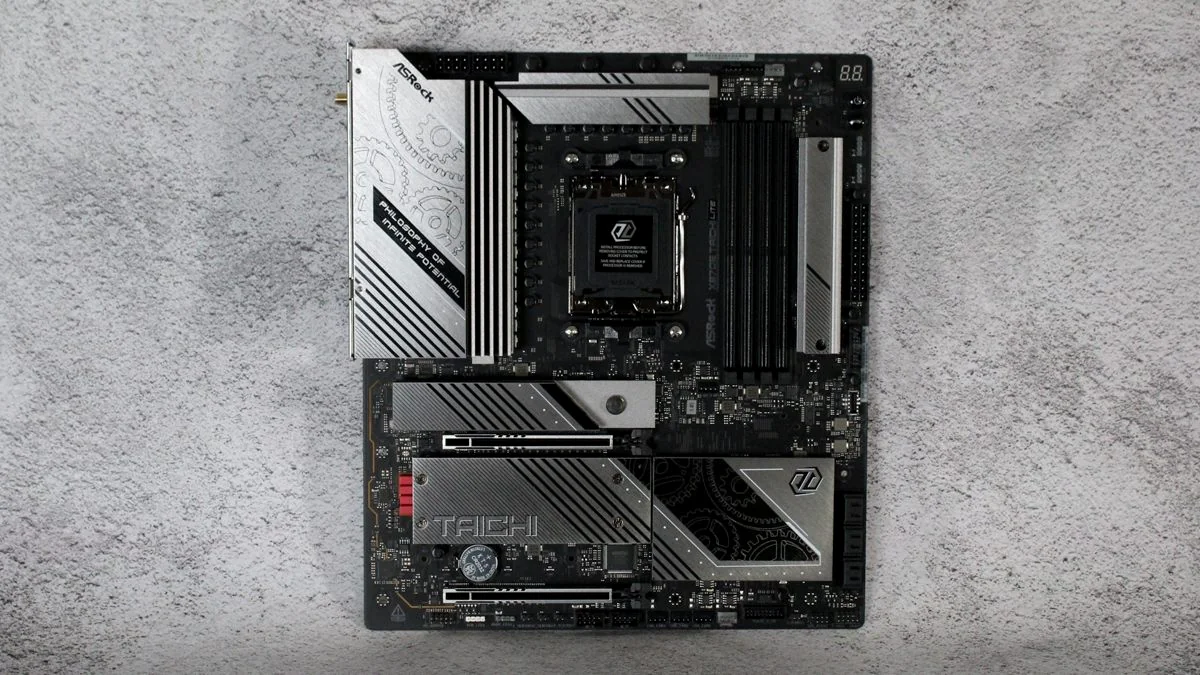
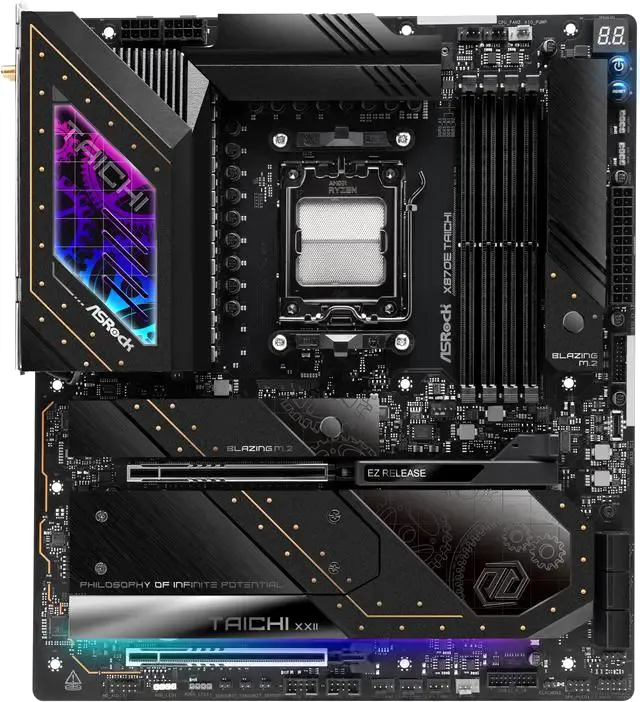
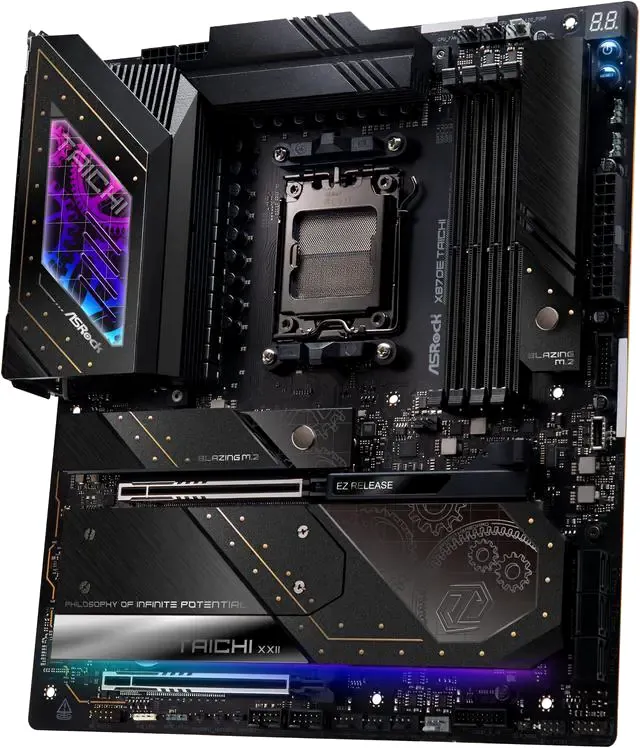
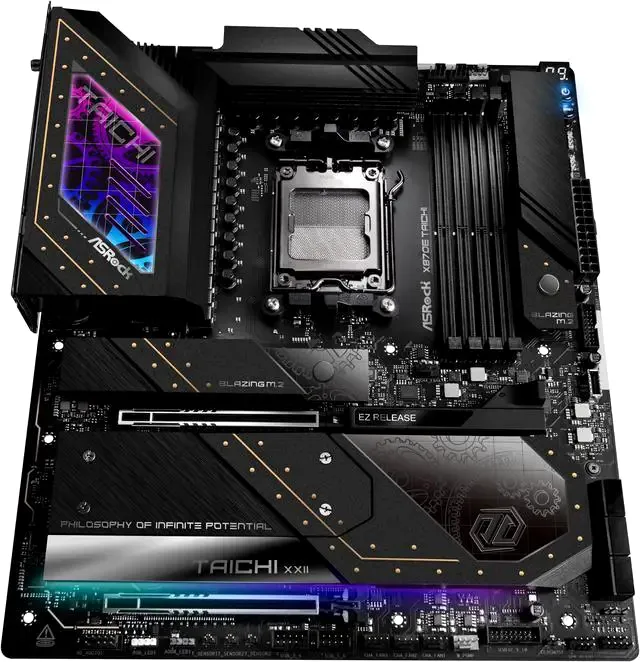
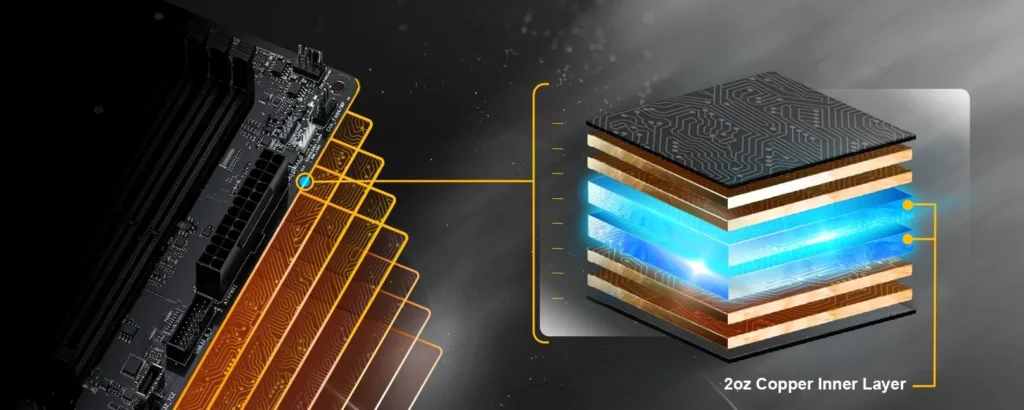
From the moment one observes the Taichi OCF, its high-end pedigree is undeniable. The physical presence alone conveys a sense of industrial-grade functionality, marrying a distinctive black-and-yellow ‘gear/cog’ aesthetic with robust, oversized heatsinks. More than just visual flair, this board is built upon a 10-layer, server-grade low-loss PCB, a critical foundation for maintaining superior signal integrity. This engineering choice is paramount for achieving the extreme frequencies that define its purpose, ensuring that data pathways remain uncompromised. Its Extended-ATX (E-ATX) form factor further underscores its design philosophy, providing ample physical real estate for expansive component layouts and sophisticated cooling solutions, preventing thermal bottlenecks before they even arise.
Unflinching Power Delivery: The 22+2+1 Phase VRM
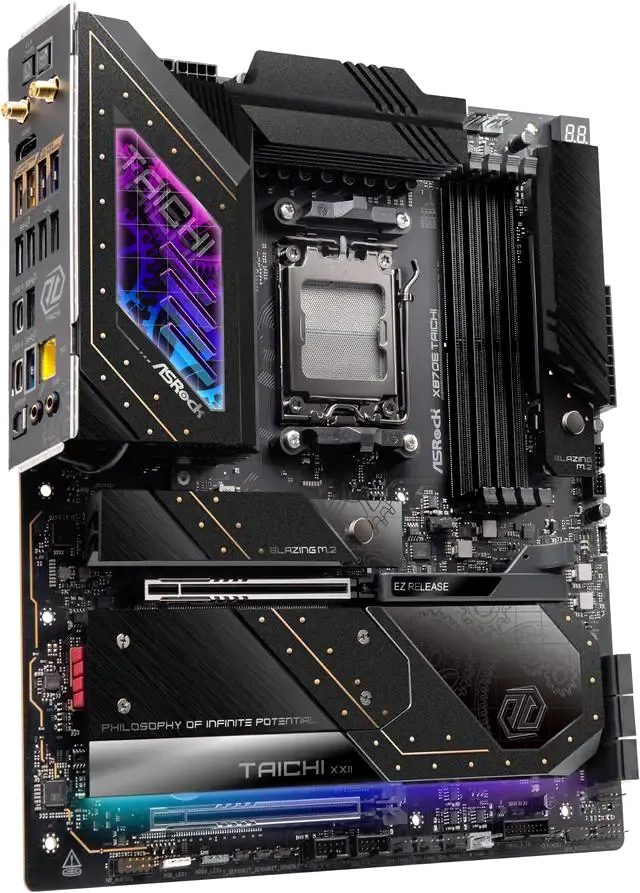
At the very heart of the Taichi OCF’s extreme capabilities lies its formidable power delivery system. This board boasts an impressive 22+2+1 power phase design, meticulously engineered to provide stable, clean power under the most demanding conditions. For the critical Vcore, it is equipped with Renesas RAA229628 PWM controllers driving premium 110A SPS MOSFETs. This configuration alone is capable of delivering an astounding 2,420 Amps to the CPU, ensuring rock-solid stability even when pushing flagship AMD Ryzen CPUs to their absolute limits, including those under liquid nitrogen (LN2) cooling. Complementing this robust design are upgraded 20K Black capacitors, featuring an increased capacitance of 1000uF. These components are not merely about extended lifespan; their higher capacitance facilitates greater charge storage, reducing power output fluctuations and delivering a more stable output current. This minimizes voltage impacts, directly translating to enhanced reliability and consistent performance when overclocking.
Mastering Thermals: Integrated Cooling Solutions
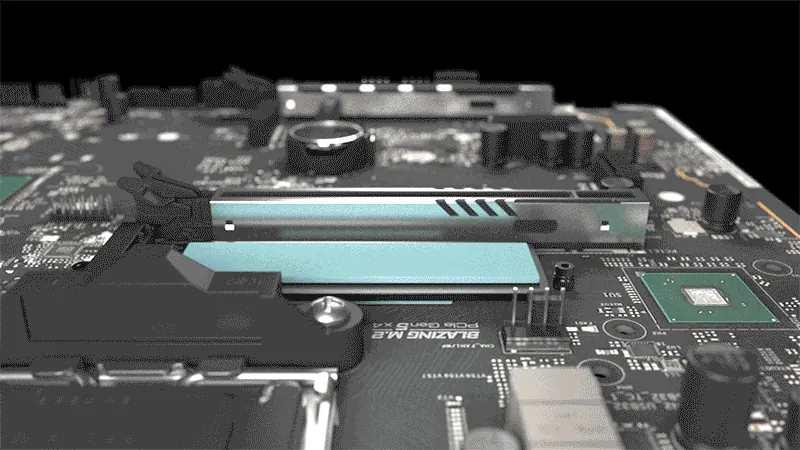
To effectively manage the immense power delivery, ASRock has implemented a sophisticated, multi-faceted cooling design. The composite VRM heatsink is a prime example, integrating an active cooling fan, a generously sized aluminum fin array, and an internal heatpipe. These elements work in concert to maximize heat dissipation from the power stages, ensuring optimal thermal performance during even the most demanding workloads and extreme overclocking sessions. Further enhancing thermal conductivity and energy efficiency, the 10-layer PCB features 2oz copper inner layers, which act as a substantial heat sink. Critically, a full backplate not only provides essential structural rigidity to the E-ATX form factor but also actively contributes to heat dissipation from the rear of the PCB, particularly in critical power and chipset areas. This holistic approach to thermal management is fundamental to achieving and maintaining stability at peak performance.
ASRock X870E Taichi OCF Key Specifications
| Socket | AM5 (LGA 1718) |
| Chipset | AMD X870E |
| Form Factor | ATX |
| VRM Design | 25 Phase (22x Vcore, 110A SPS MOSFETs) |
| Memory Support | 4 x DDR5 DIMMs, up to DDR5-10400+ (OC) |
| PCIe Slots | 2 x PCIe 5.0 x16 (x16 or x8/x8), 1 x PCIe 4.0 x4 |
| M.2 Sockets | 6 (2x PCIe 5.0 x4, 4x PCIe 4.0/3.0) |
| LAN | 1 x 5 GbE (Realtek 8126VB) |
| Wi-Fi / Bluetooth | Wi-Fi 7 (802.11be, 160 MHz) / BT 5.4 |
| USB Ports (Rear) | 2x USB4 Type-C (40Gbps), 7x USB 3.2 Gen 2 (10Gbps) Type-A, 1x USB 3.2 Gen 2 Type-C, 2x USB 2.0 |
| Audio Codec | Realtek ALC4082 + ESS SABRE9219 DAC + WIMA Audio Caps |
The OC Formula: Specialized Tools for Breaking Records
The ‘OCF’ in the ASRock X870E Taichi OCF proudly stands for ‘OC Formula,’ a direct testament to this board’s singular, unwavering focus on breaking performance records. ASRock has meticulously equipped this motherboard with an extensive array of hardware-level tools, designed to provide overclockers with granular control and uncompromising stability. This is crucial when pushing both CPUs and RAM to their absolute limits. The OCF philosophy extends beyond merely integrating high-end components; it’s about the thoughtful, purposeful integration of features that cater directly to the extreme enthusiast, providing the tangible control needed to extract every last ounce of performance.
The OC Toolkit: Hardware-Level Control at Your Fingertips
The OC Toolkit on the ASRock X870E Taichi OCF transforms the motherboard into a physical command center for overclockers. It features dedicated +/- buttons for real-time Base Clock (BCLK) adjustments, enabling minute, on-the-fly tuning at the razor’s edge of stability. Three programmable buttons offer quick access to custom OC profiles, including those meticulously crafted by legendary overclocker Nick Shih, streamlining the process of applying complex settings. Essential Safe Boot and Retry buttons are strategically placed to simplify troubleshooting after an aggressive overclock. Furthermore, specialized LN2 Mode and Slow Mode switches provide crucial functionality for sub-ambient cooling scenarios, ensuring the system behaves predictably. For the ultimate in precision, V-Probe points allow for direct, hardware-level voltage measurement, offering accuracy superior to software readings. Driving this control is the ASRock Hyper BCLK Engine, an external clock generator that enables independent BCLK overclocking, effectively overcoming typical AMD platform limitations and opening new avenues for frequency scaling.
Unparalleled DDR5 Memory Support: Hitting 10400+ MT/s
One of the Taichi OCF’s most impressive engineering feats is its industry-leading DDR5 memory support. Optimized for extreme frequencies, this board boasts support for an incredible DDR5-10400+ (OC) with AMD Ryzen 8000-series APUs, and up to DDR5-8400+ for Ryzen 9000-series processors. This astounding headroom is achieved in part through its two-DIMM-slot design (1 DIMM per channel, or 1DPC). This configuration inherently offers superior signal integrity and stability at higher speeds compared to traditional four-DIMM layouts, which can introduce signal degradation. The board fully supports both AMD EXPO and Intel XMP profiles, allowing users to effortlessly activate pre-tested overclocking settings. Notably, expert reviews consistently praise the OCF for its exceptional ability to handle ‘temperamental’ DDR5 kits that often struggle on less optimized high-end boards, underscoring the robust and finely tuned memory controller implementation that is a hallmark of this design.
Theoretical DDR5 Memory Bandwidth Gains
Connectivity and Expansion: Building a Future-Proof AM5 Powerhouse
Expansive Storage: Six M.2 Slots with PCIe 5.0 Dominance
The Taichi OCF is undeniably a storage powerhouse, featuring an impressive six M.2 sockets to satisfy even the most data-intensive builds. Two of these are cutting-edge PCIe 5.0 x4 (Blazing M.2) slots, directly connected to the CPU and ready to unleash the full potential of today’s and tomorrow’s fastest NVMe SSDs. The remaining four comprise a mix of PCIe 4.0 x4 (Hyper M.2) and PCIe 3.0 x4 slots, offering extensive high-speed storage capacity for a wide range of applications. ASRock’s commitment to user-friendliness is evident in the toolless M.2 SSD installation clips and toolless heatsink designs on key slots, which eliminate the frustration of tiny, easily lost screws. Crucially, many of these slots also benefit from bottom heatsinks, providing comprehensive cooling to prevent thermal throttling. However, users should be aware of a common trade-off on feature-rich boards: lane sharing. Occupying certain M.2 slots (specifically M2_2 or M2_3) can downgrade or even disable the rear USB4 Type-C ports or the PCIE1 slot, a consideration for those planning complex I/O configurations.
PCIe 5.0 x16 Slots with EZ Release: GPU Power and Convenience
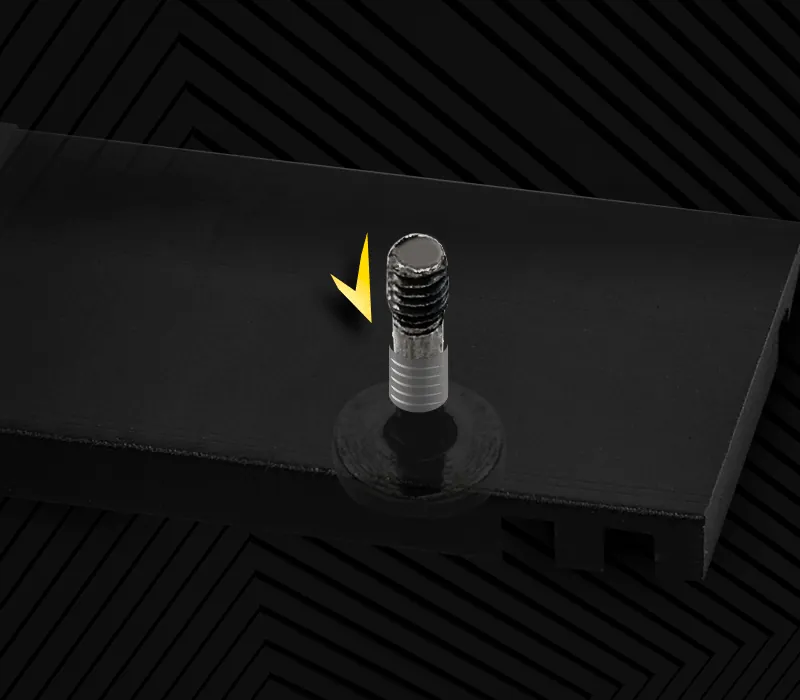
For graphics and other high-bandwidth expansion, the Taichi OCF provides two full-length PCIe 5.0 x16 slots, ensuring maximum bandwidth for the latest and future GPUs. These slots are designed to operate at x16 speed individually, or intelligently reconfigure to x8/x8 when both are populated, catering to multi-GPU setups or other demanding PCIe devices. Both slots are robustly reinforced with ASRock’s proprietary Steel Slot technology, providing enhanced durability crucial for supporting the increasing weight of modern, high-performance graphics cards. A standout quality-of-life feature is the ASRock EZ Release mechanism on the primary PCIe slot, which simplifies the often-fiddly process of installing and removing graphics cards, even the most oversized models, without struggling to reach a difficult latch.
Comprehensive Rear I/O: Dual USB4, Wi-Fi 7, and Flagship Audio
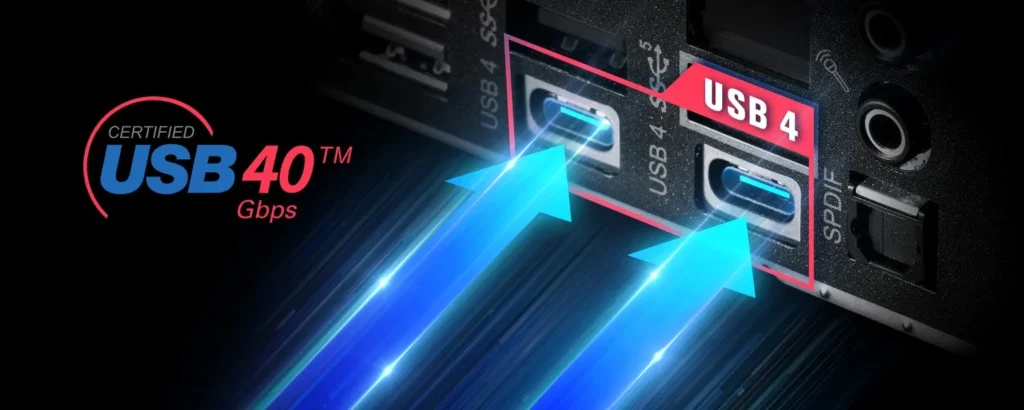
The rear I/O panel of the Taichi OCF is a masterclass in comprehensive connectivity, ensuring a future-proof interface for any high-end system. It prominently features two USB4 Type-C ports, delivering lightning-fast 40Gbps data transfer speeds and DisplayPort Alt Mode capabilities for versatile display output. A generous complement of seven USB 3.2 Gen2 (10Gbps) Type-A ports, one additional USB 3.2 Gen2 Type-C port, and two legacy USB 2.0 ports ensure ample connectivity for all peripherals, from high-speed storage to everyday devices. Networking is handled by a robust 5 GbE LAN (Realtek 8126VB) for blisteringly fast wired connections, complemented by the latest Wi-Fi 7 (AMD RZ717) with 160 MHz channels and Multi-Link Operation (MLO) for ultra-low latency wireless performance. Audio enthusiasts will appreciate the flagship Realtek ALC4082 codec, paired with an ESS SABRE9219 DAC and WIMA Audio Capacitors for pristine, high-fidelity sound, further enhanced by Nahimic Audio software. Uniquely, a PS/2 port is also included, a subtle nod to extreme overclockers who occasionally find USB stability challenging under highly experimental conditions.
ASRock X870E Taichi OCF vs. High-End X870E Competitor
| Feature | ASRock X870E Taichi OCF | Typical High-End X870E |
|---|---|---|
| Dedicated OC Toolkit | Yes (Physical Buttons, V-Probe, External BCLK Gen) | Limited/Software-based |
| Max DDR5 Speed (OC) | DDR5-10400+ | DDR5-8200 – 8600 |
| PCIe 5.0 M.2 Slots | 2 | 1-2 |
| Total M.2 Slots | 6 | 4-5 |
| USB4 Type-C Ports | 2 (Rear) | 2 (Rear) |
| LAN Speed | 5 GbE | 2.5 GbE or 10 GbE |
| Wi-Fi Version | Wi-Fi 7 | Wi-Fi 6E or Wi-Fi 7 |
| Audio DAC | ESS SABRE9219 | Often ALC4080/4082 (no DAC) |
RAMageddon: Navigating the Volatile DDR5 Market
While the ASRock X870E Taichi OCF offers unparalleled DDR5 memory support, the stark reality of building an AM5 system today is heavily influenced by the volatile DDR5 market. What the community is candidly calling ‘RAMageddon’ refers to the unprecedented surge in DDR5 prices, a phenomenon largely driven by insatiable demand from the burgeoning AI and data center segments. This market upheaval has left many PC builders and gamers in a state of ‘purchasing paralysis,’ forcing them to reconsider aspirational upgrades. The financial necessity often dictates sticking with older, more affordable platforms like AM4, even as cutting-edge hardware beckons.
“I bought my Corsair vengeance ddr5 6000MHz for $200 now if you check on Amazon it’s up $504 for a used one…Lord have mercy.”
The narrative surrounding DDR5 pricing often oscillates precariously between hopeful claims of ‘stabilization’ and the grim reality of an ‘exorbitant new normal.’ Many users express deep skepticism about any positive market news, perceiving current prices as artificially inflated by enterprise demand rather than a true reflection of manufacturing costs or genuine consumer needs. This creates a significant emotional conflict for enthusiasts: the urgent desire to upgrade to cutting-edge platforms like AM5 and DDR5, clashing directly with financial strain and a profound distrust in the market forces at play. For a significant portion of the community, ‘stabilized’ simply translates to ‘stabilized at an unaffordable level,’ perpetuating the purchasing paralysis.
The DDR5 Dilemma: Pros & Cons for AM5 Builders
Pros
- Future-Proofing: AM5/DDR5 offers the latest platform for upcoming CPUs and technologies.
- Performance Ceiling: Higher theoretical performance, especially for memory-intensive tasks and games.
- OCF’s Stability: Boards like the Taichi OCF provide exceptional stability for high-speed DDR5.
- Long-Term Value: Investing now avoids potential future price hikes.
Cons
- Exorbitant Cost: DDR5 prices are significantly higher than previous generations.
- Market Volatility: Prices can fluctuate unpredictably, leading to buyer’s remorse.
- Financial Strain: High costs deter many users from upgrading.
- Limited ‘Sweet Spot’: Finding the optimal balance is challenging.
Conclusion: The Taichi OCF in a ‘RAMageddon’ World
The ASRock X870E Taichi OCF stands as a testament to engineering excellence, a motherboard meticulously crafted for the most demanding overclockers and enthusiasts on the AM5 platform. Its robust power delivery, advanced cooling, dedicated OC Toolkit, and unparalleled DDR5 memory support make it a dream board for those seeking to push the absolute limits of their hardware. From its extensive six M.2 storage options, including two PCIe 5.0 slots, to its cutting-edge Wi-Fi 7 and dual USB4 connectivity, it leaves no stone unturned in offering a feature-rich, high-performance foundation that embodies the ‘infinite potential’ of its Taichi namesake.
ASRock X870E Taichi OCF: The Final Tally
Pros
- Purpose-built for extreme overclocking toolkit.
- Industry-leading DDR5-10400+ support.
- Robust 22+2+1 power phase (110A MOSFETs).
- Advanced thermal solutions with active cooling.
- Six M.2 slots (2x PCIe 5.0).
- Next-gen USB4, Wi-Fi 7, and 5GbE.
Cons
- High price point (~$499).
- E-ATX form factor limitations.
- Lane sharing compromises I/O.
- Polarizing black-and-yellow aesthetic.
- Specialized features overkill for average users.
Overall Score
9.4
9.8
9.5
9.6
8.5
Final Verdict
The ASRock X870E Taichi OCF is unequivocally not a motherboard for everyone. It is a highly specialized instrument, meticulously crafted for the elite few who demand the absolute peak of AM5 overclocking potential and are prepared to make a significant investment to achieve it. For these dedicated users, its unparalleled technical prowess and rock-solid stability, particularly with high-speed DDR5 memory, make it an exceptionally compelling choice, even amidst the turbulent ‘RAMageddon’ market. For mainstream users, other Taichi variants or more affordable X870E boards will likely offer a more balanced value proposition. But for those chasing records, pushing the envelope, and requiring a foundation that will not flinch under pressure, the Taichi OCF stands as an exceptional, purpose-built platform.
Frequently Asked Questions
What is the primary difference between the X870E Taichi OCF and the standard X870E Taichi?
The OCF (OC Formula) variant is purpose-built for extreme overclocking, featuring a more robust power delivery, specialized OC Toolkit (physical buttons, V-Probe), and optimized 1 DIMM per channel memory layout for higher DDR5 frequencies.
What AMD CPUs are compatible with the AM5 socket on this motherboard?
The ASRock X870E Taichi OCF supports AMD Ryzen 9000, 8000 (APUs), and 7000 Series Processors for the AM5 socket.
Can I use older DDR4 RAM with the ASRock X870E Taichi OCF?
No, the ASRock X870E Taichi OCF, like all AM5 motherboards, exclusively supports DDR5 memory.
Has the ‘X3D CPU frying’ issue been addressed for this board?
Yes, ASRock has released BIOS updates (AGESA 1.2.0.3g and later) to mitigate these risks. Always ensure you are running the latest stable BIOS version.
What is the maximum supported DDR5 memory speed?
It officially supports up to DDR5-10400+ (OC) with Ryzen 8000-series APUs, and DDR5-8400+ (OC) with Ryzen 9000-series processors.
How many M.2 slots does the X870E Taichi OCF have?
The board features a total of six M.2 slots: two Blazing M.2 slots support PCIe Gen5 x4, while the remaining four support PCIe Gen4 and Gen3 speeds.