

🔑 Key Takeaways
- The B850 chipset is the definitive mid-range chipset for AM5, offering full CPU overclocking capabilities and standardizing PCIe 5.0 support dedicated to NVMe storage.
- The official retail launch has been postponed until Q1 2025. However, existing 600-series motherboards remain viable for new builds, supporting Ryzen 9000 CPUs after a simple BIOS update.
- The central conflict for enthusiasts is the marginal price difference between the B850 and the entry-level X870 chipset, where the latter guarantees crucial features like PCIe 5.0 GPU support and essential quality-of-life tools, such as debug displays, leading to considerable consumer anxiety.
The Mid-Range Vacuum: Why B850 Matters (And Why It’s Delayed)
AMD’s Socket AM5 platform stands on a firm promise of longevity, projecting support for new Ryzen generations through 2027 and beyond. Currently, however, the market suffers from a performance vacuum between the restricted A620 budget boards, which prohibit CPU overclocking and omit PCIe 5.0 entirely, and the high-cost, feature-laden X870 premium chipsets. The B850 chipset was engineered to fill this critical mainstream void, offering enthusiasts the ability to tune their Ryzen 7000 or 9000 CPUs without the X-series price tag. Regrettably, the launch of the B850 has been officially postponed until Q1 2025, mirroring previous AMD chipset release schedules. Fortunately, the urgency of this delay is mitigated by the fact that all existing 600-series motherboards already support the new Ryzen 9000 CPUs, requiring only a straightforward BIOS update to unlock compatibility. This means builders are not forced to wait, but the promise of a superior, purpose-built mid-range option remains elusive.
AMD 800-Series Chipset Segmentation: X870 vs. B850
| Feature | X870E/X870 | B850 | B840 |
|---|---|---|---|
| CPU OC Support | Yes (Full) | Yes (Full) | No (EXPO Only) |
| GPU PCIe Standard | Gen 5.0 (Guaranteed) | Gen 4.0 (Gen 5.0 Optional) | Gen 3.0 |
| NVMe PCIe Standard | Gen 5.0 (Guaranteed) | Gen 5.0 (Standard) | Gen 3.0 |
| USB 4.0 Standard | Standard | Optional | No |
| Wi-Fi 7 Support | Standard | Optional | No |
Engineering Deconstructed: The B850’s Robust VRM and Connectivity
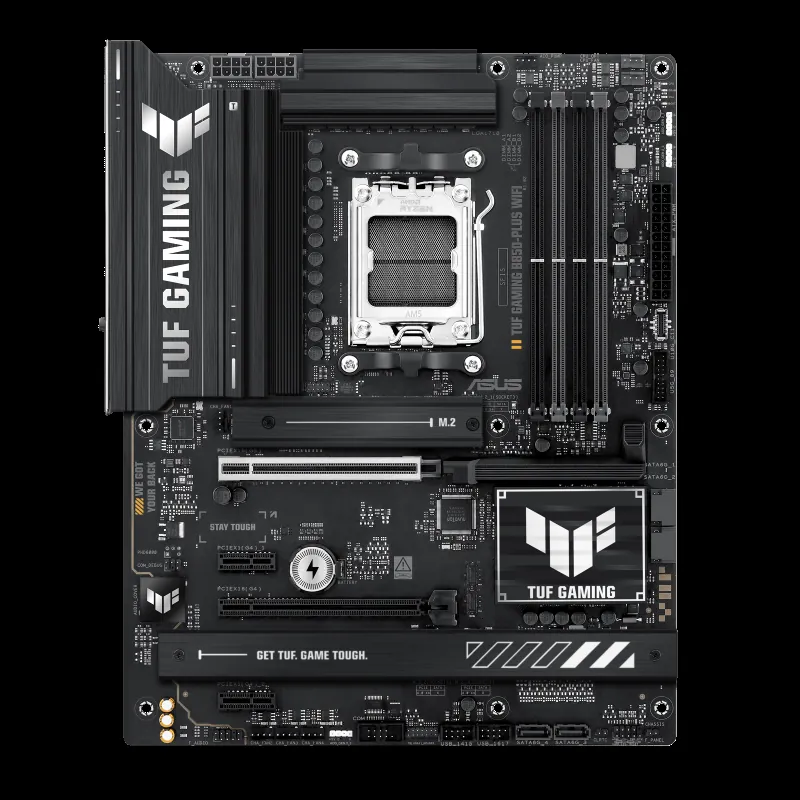
The true metric of a motherboard’s quality, especially in the AM5 ecosystem, is its power delivery subsystem. Initial B850 boards have demonstrated surprisingly robust Voltage Regulator Modules (VRMs), challenging the traditional mid-range stigma. For instance, the ASUS TUF GAMING B850-PLUS WIFI features a formidable 14+2+1 phase design utilizing 80A premium DrMOS stages, while Sapphire’s Pure B850A also employs a solid 12+2+1 configuration. This level of engineering depth is not merely for extreme overclocking; it is a necessity for stability. The Ryzen 9000 series, particularly the higher core count models, demands instantaneous, clean power delivery under load. A robust VRM, cooled by enlarged heatsinks, ensures that the CPU operates within its ideal thermal and electrical parameters, mitigating the risk of performance throttling and extending the longevity of the entire system. Furthermore, the B850 standardizes PCIe 5.0 for NVMe storage, meaning even a mainstream build can utilize the fastest SSDs on the market, offering transfer speeds up to 128 Gbps.
Key Engineering Annotations
- 14+2+1 Phase VRM Heatsink: Enlarged heatsinks covering the high-amperage DrMOS stages, critical for Ryzen 9000 stability.
- PCIe 5.0 x4 M.2 Slot: Dedicated Gen 5 lane for NVMe storage, a key standardized upgrade over B650.
- Integrated Wi-Fi 7 Antenna: Next-generation networking support, often included on B850 boards like the ASUS TUF.
The Quality-of-Life Tax: Why Builders Fear the B850/X870 Overlap
The B850 is fundamentally a price-sensitive product, yet consumer behavior in the AM5 market is increasingly driven by ‘regret avoidance.’ Builders are now prioritizing features once considered luxuries, such as Q-LED diagnostic indicators, two-digit debug displays, and high-end software suites like ASUS AI Advisor or AI Cache Boost. These quality-of-life (QoL) tools are invaluable for troubleshooting the complex stability issues sometimes encountered with high-speed DDR5 memory and new Ryzen CPUs. When the price differential between a feature-rich B850 board and an entry-level X870 board narrows to just $50 or $75, the perceived value of these guaranteed X-series QoL features often outweighs the savings. The anxiety surrounding AM5 stability is real, and builders are willing to pay a premium to ensure they have the diagnostic tools necessary to resolve potential boot or memory training failures.
“I came very close to getting the B850 Tomahawk Max, but it was so close in price to the X870 Tomahawk, that it was a no-brainer to go for the X870. […] after experiencing it, I am never buying a motherboard without one of those [debug displays] again.”
B850 Board Feature Comparison: QoL vs. Cost
| Model | VRM Phase Count | PCIe 5.0 GPU Support | Wi-Fi Standard | Q-LED/Debug Feature | Estimated Price |
|---|---|---|---|---|---|
| ASUS TUF B850-PLUS WIFI | 14+2+1 (80A DrMOS) | Yes (via SafeSlot) | Wi-Fi 7 | Q-LED Indicators | $180 – $220 |
| ROG STRIX B850-A GAMING WIFI | High-End (Unspecified Phases) | Yes (via Q-Release Slim) | Wi-Fi 7 | Q-LED Indicators + Q-Dashboard | $240 – $280 |
| Sapphire Pure B850A WiFi | 12+2+1 | Yes | Wi-Fi 6 | None Specified | $182 (CN Market) |
The Final Call: Should You Wait for the B850?
👍 Pros of Waiting for B850
- Guaranteed CPU Overclocking for Ryzen 9000/7000.
- Standardized PCIe 5.0 NVMe Storage for maximum SSD speed.
- Robust VRM Designs (12-14+ Phases) ensuring long-term stability.
- Future-Proof AM5 Socket longevity (supported through 2027+).
👎 Cons of Waiting for B850
- Q1 2025 Launch Delay means you must wait 4-6 months.
- PCIe 5.0 GPU Support is Optional (often defaulted to Gen 4).
- Price Overlap with entry-level X870 boards can make the X870 a better value proposition.
- High consumer anxiety regarding brand-specific AM5 stability issues.
Final Verdict
For the builder targeting a performance sweet spot with a Ryzen 7 9700X or Ryzen 5 9600X, the B850 chipset is technically the definitive answer. Its combination of full CPU overclocking and standardized PCIe 5.0 NVMe support delivers approximately 90% of the X870’s performance ceiling at a more appealing cost. However, the confirmed Q1 2025 delay dramatically changes the equation. Only two types of builders should consider waiting: those who are currently running a perfectly functional system and can afford to delay their upgrade, or those who absolutely require a specific B850 feature, such as integrated Wi-Fi 7. For the vast majority of users building today, a discounted, reliable B650 board with a proven stability track record is the smarter, immediate choice. The B850’s unfortunate price positioning often forces difficult compromises on essential quality-of-life features, making the slightly more expensive X870 an often superior, anxiety-free investment.
Frequently Asked Questions (FAQ)
Does overclocking my B850 motherboard void my AMD warranty?
Yes. AMD explicitly warns (GD-106) that altering clock frequencies, multipliers, or voltages—even if enabled by AMD software—operates outside of published specifications and immediately voids the applicable AMD product warranty. Users proceed at their own risk.
What is the biggest difference between B850 and the entry-level B840?
The B850 allows full Ryzen CPU overclocking and includes PCIe Gen 5.0 for NVMe storage. The B840, intended as a budget replacement for A620, prohibits CPU overclocking and is restricted primarily to PCIe Gen 3.0 lanes for both GPU and NVMe, making the B850 the minimum requirement for enthusiasts seeking platform flexibility.
Why are some B850 boards advertised with PCIe 5.0 GPU support and others are not?
AMD makes PCIe 5.0 for the GPU slot optional on the B850 chipset. Motherboard vendors must choose to wire the lanes for Gen 5.0, a decision often tied to cost and the complexity of the PCB design (e.g., eight-layer PCB required for reliable Gen 5 signaling).