
Beyond Raw Temps: Why Noise-Normalized Benchmarking is the New Gold Standard for 2025
Key Takeaways
- Noctua reclaims the air-cooling throne with the $150 NH-D15 G2, featuring eight heatpipes and specialized baseplate convexity variants.
- ID-Cooling has disrupted the market, offering surprisingly high-performance SFF and AIO solutions that challenge the value of premium air cooling.
- LoadSyn’s updated testing methodology now utilizes hardware-monitored 157W and 276W AM5 targets to bypass inconsistent motherboard power reporting.
- Noise-normalized data (45 dBA at 15cm) is now the primary metric for evaluating true cooling efficiency across all form factors.
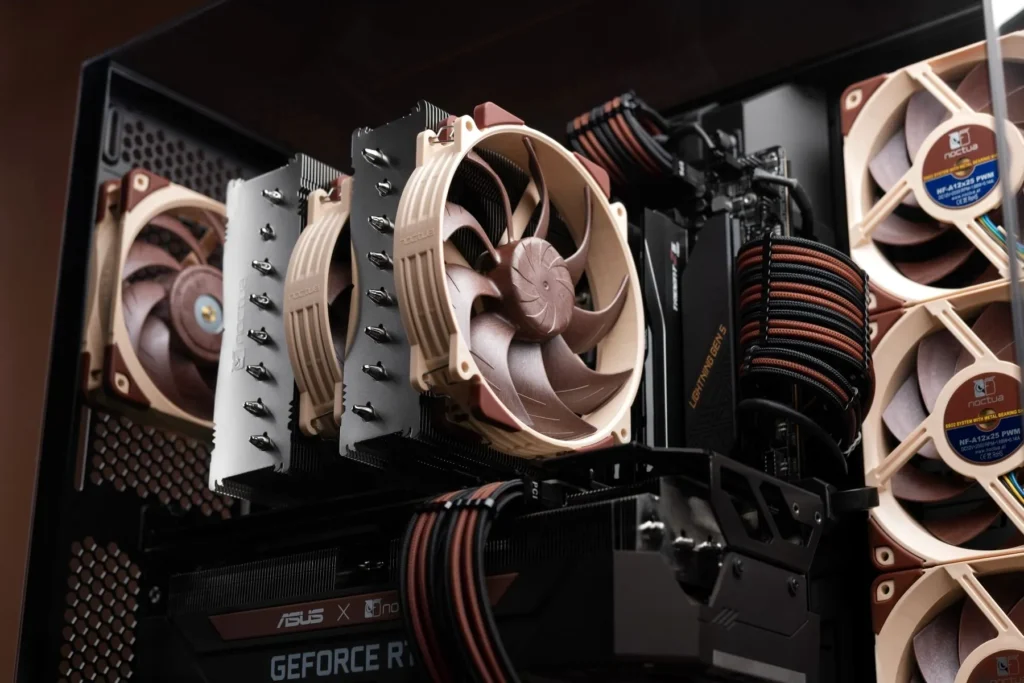
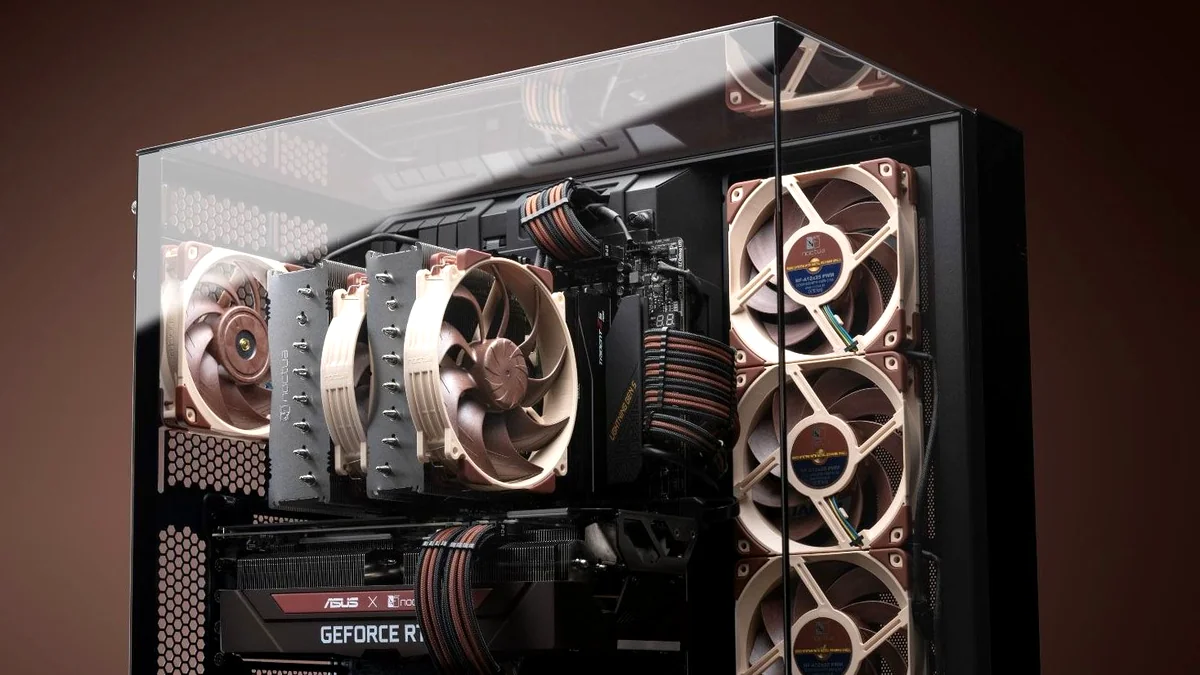
The NH-D15 G2 isn’t just a refresh; it’s a $150 engineering statement designed to push the absolute limits of air cooling. To justify its premium price tag, Noctua increased the heatpipe count from six to eight and tightened the fin spacing from 1.9mm to 1.6mm, yielding a massive 20% increase in total surface area. However, the real technical breakthrough is the introduction of three distinct baseplate convexity variants. Recognizing that CPU integrated heatspreaders (IHS) are rarely perfectly flat, Noctua offers the LBC (Low Base Convexity) for AM4 and lapped chips, the HBC (High Base Convexity) to counter the socket-induced deformation of Intel’s LGA1700 platform, and a Standard version optimized for AM5. This granular approach ensures that the contact layer—the most critical point in the thermal chain—is perfectly tuned for your specific silicon.
Noctua NH-D15 G2 Variant Breakdown
| Variant | Optimization | Convexity |
|---|---|---|
| Standard | AMD AM5 (with offset mounting) and general use | Medium |
| LBC | AMD AM4, lapped CPUs, or exceptionally flat IHS | Low |
| HBC | Intel LGA1700 (specifically for CPUs deformed by high socket pressure) | High |
The Budget Revolution: How ID-Cooling is Rewriting the Value Proposition
Premium Air vs. Performance AIO: The Noise-Normalized Battle
| Cooler Name | Price (USD) | Noise-Normalized Temp (157W) | Fan Type | Warranty |
|---|---|---|---|---|
| Noctua NH-D15 G2 | $149.95 | Top-Tier Air Performance | NF-A14x25r G2 PWM | 6 Years |
| ID-Cooling FX360 PRO | ~$60.00 | Competitive with High-End Air | 120mm PWM Daisy-Chain | 2-3 Years |
| Tryx Panorama 360 | ~$300.00 | Ultra-High Performance | 120mm PWM | 6 Years |
Small Form Factor, Big Heat: Solving the SFF Thermal Throttling Crisis
The 2025 Cooling Dilemma: Air vs. Liquid
Pros
- Unmatched long-term reliability of air cooling (NH-D15 G2) with zero pump failure risk.
- ID-Cooling IS-series provides functional, high-value solutions for ultra-compact cases.
- Premium AIOs offer superior aesthetics and easier management of high-wattage spikes.
Cons
- Flagship air cooling now carries a significant price premium ($150) over budget liquid options.
- All-In-One coolers remain susceptible to pump noise and eventual mechanical failure.
- Compact cases with ‘horrendous’ airflow can render even the best coolers ineffective without proper fan tuning.
Frequently Asked Questions
Yes. Noctua reduced the heatsink depth by 9mm and the front fin stack width by 5mm, ensuring full clearance for the top PCIe x16 slot on the vast majority of modern motherboards.
For the AM5 platform, the Standard variant used in conjunction with Noctua’s optional offset mounting is the recommended choice to target the CCD dies directly.
Thermally, many budget AIOs can match or exceed the dissipation of high-end air. However, the $150 Noctua premium buys you a 6-year warranty, superior acoustic refinement, and the peace of mind that comes with a failure-proof mechanical design.
The Final Verdict
The landscape of CPU cooling has evolved beyond the pursuit of the lowest raw temperature. In our lab, we’ve seen that modern silicon will often push to its thermal limit regardless of the cooler’s capacity. Therefore, the true mark of quality in 2025 is noise-normalized efficiency. If you are a high-end enthusiast who demands absolute reliability and acoustic perfection, the Noctua NH-D15 G2 is the definitive air cooler, provided you select the convexity variant suited to your socket. Conversely, for budget-conscious gamers and SFF builders, ID-Cooling has proven that thermal stability is no longer locked behind a $100+ paywall. Regardless of your choice, always look to noise-normalized data—it is the only empirical way to ensure your cooling solution isn’t just loud, but truly effective.