
Key Takeaways
- The Ryzen 7 9850X3D is officially confirmed, featuring an 8-core/16-thread design with 96MB of L3 cache, boasting a significant 5.6 GHz boost clock (400 MHz higher than the 9800X3D).
- AMD’s 2nd Gen 3D V-Cache uses a revised stacking method (compute die on top) to improve thermal dissipation, potentially enabling stable overclocking for enthusiasts.
- Rumors point to a flagship Ryzen 9 9950X3D2 with cache on both chiplets (up to 192 MB L3), targeting extreme gaming and specialized VM workloads.
- The community sentiment is heavily skewed toward the 7800X3D as the best value, making the decision for the 9850X3D a pragmatic cost calculation rather than a performance necessity for most gamers.
Section I: The Zen 5 X3D Lineup – Confirmed Specs and Flagship Rumors
AMD has officially confirmed the existence of the Ryzen 7 9850X3D, signaling the first major refresh to the Zen 5 X3D lineup. This move is critical because the standard Ryzen 9000 series offered only marginal gains over the excellent 7000 series. The 9850X3D is poised to reclaim the gaming performance crown, leveraging a significant clock speed increase paired with the performance-critical 3D V-Cache technology. This is more than just a speed bump; it’s an architectural statement. Here is a breakdown of the confirmed and rumored top-tier models that will define the next generation of high-performance gaming PCs.
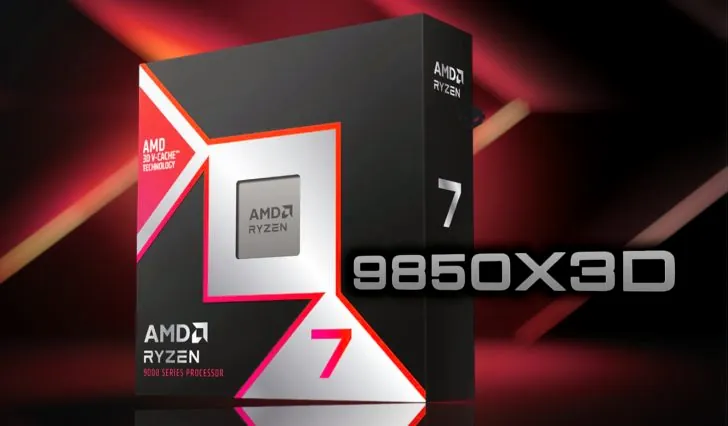
AMD Ryzen 9000X3D Series: Confirmed and Rumored Specifications
| Feature | 9850X3D | 9950X3D2 (Rumored) |
|---|---|---|
| Architecture | Zen 5 (Granite Ridge) | Zen 5 (Dual CCD) |
| Cores/Threads | 8 / 16 | 16 / 32 |
| Total L3 Cache | 96 MB (Single 3D V-Cache CCD) | 192 MB (Dual 3D V-Cache CCD) |
| Base Clock | 4.7 GHz | 4.3 GHz |
| Max Boost Clock | Up to 5.6 GHz (Confirmed) | Up to 5.6 GHz |
| TDP / PPT | 120W | 200W |
The X3D Gaming Hierarchy: 9850X3D vs. Predecessors
| Metric | Ryzen 7 9850X3D | Ryzen 7 9800X3D | Ryzen 7 7800X3D |
|---|---|---|---|
| Architecture | Zen 5 (Refreshed V-Cache) | Zen 5 | Zen 4 |
| Max Boost Clock | 5.6 GHz | 5.2 GHz | 5.0 GHz |
| L3 Cache (Total) | 96 MB | 96 MB | 96 MB |
| Power (TDP) | 120W | 120W | 120W |
| Release Status | Confirmed / Upcoming | Available | Available (Discounted) |
Section II: The 2nd Gen 3D V-Cache Breakthrough
The true performance story of the 9000X3D series isn’t just the 400 MHz clock bump; it’s the fundamental architectural redesign of the 3D V-Cache stack. Previous generations, like the 7950X3D, often suffered from thermal throttling because the stacked cache die acted as an insulating layer above the compute cores. This arrangement forced AMD to operate X3D chips at lower clock speeds, making them inferior for frequency-dependent computational loads compared to their non-X3D counterparts. The Zen 5 X3D series reverses this stacking entirely: the compute die is now placed directly onto the heat spreader, with the cache underneath. This ingenious design change places the cores closer to the cooling solution, resolving the primary thermal bottleneck and unlocking the higher clock potential necessary for sustained peak gaming and computational loads.
⚡ A New Era for X3D Overclocking
The improved thermal path in the 2nd Gen 3D V-Cache design is rumored to introduce something enthusiasts have long waited for: stable overclocking support. By mitigating the thermal constraints that plagued the 7000X3D chips, AMD is giving enthusiasts more flexibility to push the clock speeds beyond stock, further enhancing performance potential.
Section III: The Value Dilemma – Why the 7800X3D Remains King of Pragmatism
While the 9850X3D is technically superior, the decision to upgrade is not purely performance-based; it is fundamentally a financial calculation. The Fandom Pulse, our community sentiment analysis, indicates that users are overwhelmingly content with the Ryzen 7 7800X3D, which still delivers exceptional 1440p and 4K gaming performance and frame-time consistency. Furthermore, the overall cost of the AM5 platform remains a significant barrier for new builders and upgraders. This is driven by the mandatory switch to expensive DDR5 RAM and the necessity of high-end 600-series motherboards to unlock features like PCIe 5.0. For the majority of gamers, the marginal performance gain of the 9850X3D simply does not justify the steep platform ‘tax’ required to switch from a mature, discounted ecosystem like AM4 or to build a new AM5 system from scratch.
“Bottom line is that you’re gonna be happy with either purchase. If the budget is tight then the 7800X3D all day. Put that extra money in a card that’s maybe one tier above what you were thinking about getting.”
Upgrade Decision Matrix: 9850X3D vs. 7800X3D
Pros of Upgrading to 9850X3D
- Superior clock speeds (5.6 GHz) providing the highest raw gaming FPS and competitive 1% Lows.
- Improved thermal design eliminates throttling issues of previous X3D chips, ensuring stable performance under load.
- Potential for stable CPU overclocking for enthusiasts who demand maximum tuning flexibility.
- Longer platform longevity and full feature support on the Zen 5 architecture.
Cons of Upgrading to 9850X3D
- High platform cost (mandatory DDR5 and expensive AM5 motherboards) increases total system price significantly.
- Marginal gaming performance gains at 1440p/4K resolutions where the GPU typically becomes the bottleneck.
- Initial high MSRP, likely placing it significantly above the heavily discounted 7800X3D.
- Uncertain availability and potential delays (rumors suggest early 2026 for some models).
Final Verdict: The Technical Champion vs. The Value King
The Ryzen 7 9850X3D is the new technical champion, designed specifically to address the thermal and frequency limitations of its predecessors. For the elite gamer building a new, no-compromise AM5 system today, the 9850X3D will be the definitive choice for the best 1% Lows and frame-time consistency. The architectural changes finally allow the X3D cache to coexist with high clock speeds. However, for the vast majority of existing AM5 users, or those migrating from AM4, the cost-per-frame benefit of the discounted 7800X3D remains too strong to ignore. The 9850X3D is an engineering triumph, but the 7800X3D is still the unbeatable value king.
✓ Recommended For:
Elite competitive gamers building a brand new, high-end AM5 system who prioritize absolute frame-time consistency and raw FPS above all else.
✗ Recommended Against:
Any gamer currently on a 7800X3D, or budget-conscious builders who would see a greater performance uplift by investing the price difference into a better GPU.
Frequently Asked Questions (FAQ)
When is the expected release date and pricing for the 9850X3D?
While AMD has confirmed the chip’s existence, the official release date remains unconfirmed, with rumors ranging from Q4 2025 to early 2026. Pricing is also unknown, but it is expected to launch at a premium above the 9800X3D’s MSRP of $479, reflecting its clock speed increase and architectural improvements.
What is the significance of the rumored Ryzen 9 9950X3D2?
The 9950X3D2 is rumored to feature 3D V-Cache on both chiplets (a massive 192 MB total L3 cache). This capacity would make it ideal for specific, highly multi-threaded, cache-sensitive professional workloads (like Computational Fluid Dynamics or Finite Element Analysis) as well as advanced gaming setups utilizing dedicated virtual machines, but its high 200W TDP suggests it will be a niche, high-end product.
Does the 9850X3D still suffer from the I/O bottleneck issues noted in the 7000 series?
The I/O die limitations (especially regarding chipset bandwidth) are a known platform-level issue AMD has acknowledged. While the 9000 series improves CPU-level architecture, the constraint where populating multiple NVMe slots halves GPU bandwidth on X870E boards remains a factor until AMD releases a new I/O die, which they are reportedly working on to alleviate these platform constraints.
Sources & Attribution
- AMD Corporate Press Release (CES 2025 announcement details)
- Olrak29 & Moore’s Law is Dead (9850X3D/9950X3D2 leaks and shipping manifests)
- GamersNexus (Thermal and architectural analysis of X3D stacking)
- Hardware Metric (AM4 vs AM5 platform cost and longevity comparison)