The End of the Spinning Disk: Why AI Demands Silicon Scale
The architectural shift in modern data centers is no longer just about speed; it is about the fundamental survival of the data pipeline. As we transition from traditional file storage to massive, AI-grade data lakes and high-velocity vector databases, the legacy of the mechanical spinning disk has hit a wall. Large Language Models (LLMs) and real-time AI inference engines thrive on random I/O access—a requirement that traditional 10K RPM HDDs simply cannot fulfill at scale. In an environment where every millisecond spent waiting for a mechanical arm to seek data is a millisecond lost in model training, the mechanical bottleneck has become an existential threat to progress. We are moving toward a reality where data must stay online and immediately accessible, positioning all-flash architectures as the only viable bedrock for the AI era.
Key Takeaways
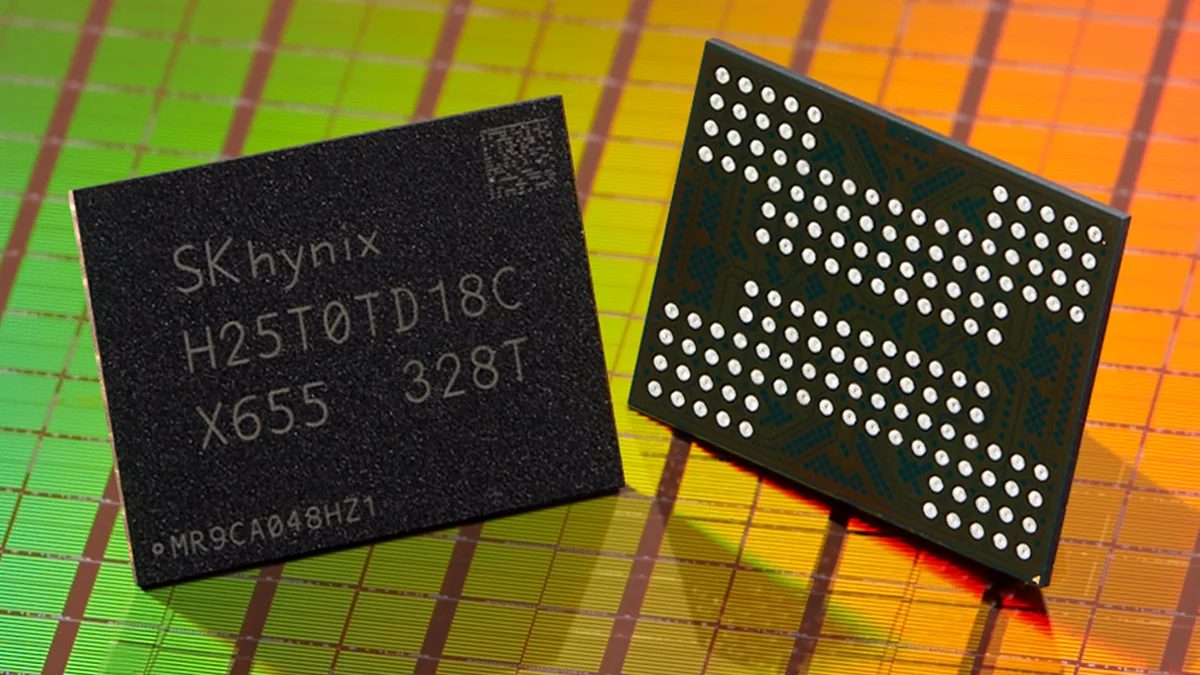
- The industry is rapidly pivoting from Triple-Level Cell (TLC) to Quad-Level Cell (QLC) NAND to meet the density requirements of massive AI datasets.
- A new generation of ‘Ultra-Capacity’ SSDs is emerging, with form factors reaching staggering 245TB to 256TB capacities.
- Transitioning to high-density QLC deployments can result in a 31% reduction in Total Cost of Ownership (TCO) for hyperscale environments, driven by lower power, cooling, and rack space requirements.
The QLC Evolution: Stacking Bits Without Sacrificing Sanity
NAND Hierarchy: SLC vs. TLC vs. QLC
| Attribute | SLC | TLC | QLC |
|---|---|---|---|
| Bits Per Cell | 1 | 3 | 4 |
| Voltage States | 2 | 8 | 16 |
| P/E Cycles (Endurance) | ~100,000 | ~3,000 | ~1,000 |
Pro-Tip: The Read-Dominant Reality
Don’t let the lower P/E cycle count of QLC scare you. In the world of AI and hyperscale cloud, workloads are overwhelmingly read-dominant, often hitting a 90/10 read-to-write ratio. Research indicates that nearly 99% of modern enterprise workloads can comfortably survive on the endurance ratings provided by current QLC technology, as AI ingestion is far more about throughput than constant cell wear.
The 250TB Titans: A Competitive Landscape
Battle of the Hyperscale SSDs (2025-2026)
| Vendor | Model | Max Capacity | Interface | Key Innovation |
|---|---|---|---|---|
| SanDisk | UltraQLC SN670 | 256TB | PCIe Gen 5 | Direct Write QLC (No SLC Cache) |
| Kioxia | LC9 Series | 245.76TB | PCIe Gen 5 | 32-die QLC Stacking / CBA Tech |
| DapuStor | R6060 | 245TB | PCIe Gen 5 | Flexible Data Placement (FDP) Support |
Engineering the Impossible: Controllers and Data Placement
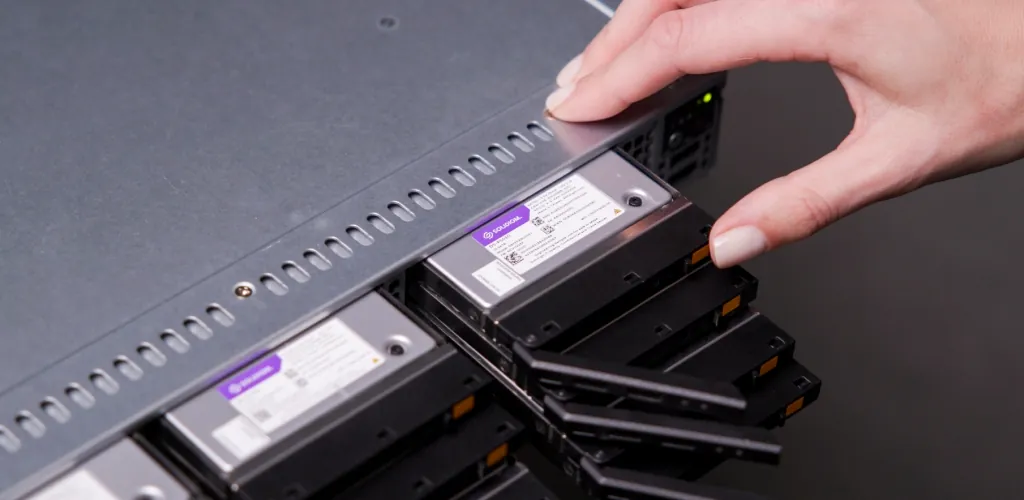
To make QLC viable at 250TB+ capacities, vendors are moving beyond simple NAND stacking and into sophisticated controller logic. DapuStor’s R6060 utilizes Flexible Data Placement (FDP), a protocol that allows the host to intelligently direct data to specific physical locations, drastically reducing write amplification—the silent killer of QLC endurance. Meanwhile, SanDisk’s UltraQLC platform introduces ‘Direct Write QLC’ mode. Unlike consumer drives that rely on a volatile SLC cache that eventually saturates and tanks performance, Direct Write ensures power-loss-safe, consistent throughput directly to the QLC layers. This is critical for AI ingestion, where a steady 10-hour write stream is far more valuable than a 30-second burst.
Frequently Asked Questions
Can I use a 256TB QLC drive in my gaming rig?
No. These drives utilize enterprise-specific U.2 and E3.S form factors. They require specialized power envelopes, cooling, and backplanes found in server racks, and their pricing structures are designed for hyperscale budgets rather than consumer setups.
Is QLC really as fast as TLC for AI?
In sequential read tasks—which describe the bulk of AI data ingestion and model loading—the performance is nearly identical. In these scenarios, the massive density-to-power ratio of QLC makes it the superior metric for large-scale deployments.
The era of the mechanical hard drive in the data center is officially on life support. With 1PB SSD roadmaps now visible on the horizon, the economic and performance arguments for spinning platters have evaporated. For the next generation of AI, the future is clear: it will be all-flash, all-the-time, built on the back of ultra-dense silicon.