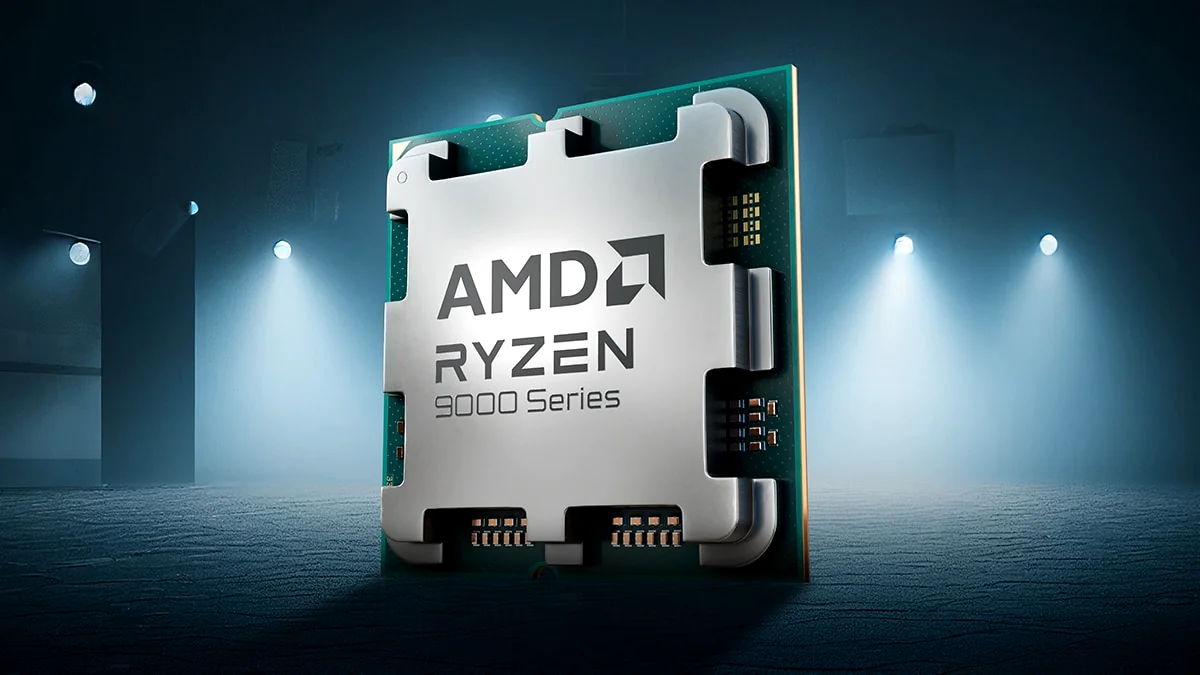

The AMD Ryzen 7 9700X steps onto the stage as a pivotal player in the new Zen 5 lineup, heralding a fresh era of computing that masterfully balances efficiency with raw performance. Built on the enduring AM5 platform, this processor promises not just a generational leap in power but also a commitment to cooler, quieter operation—a significant boon for gamers and creators alike. At LoadSyn, our rigorous testing methodology ensures that we deliver an empirical, data-driven analysis of how this 8-core, 16-thread CPU performs under pressure, setting the stage for a comprehensive review that will guide your next hardware decision.
Key Takeaways
- Zen 5 Architecture: Delivers an average 16% IPC uplift over Zen 4, with significant gains in AVX-512 and AI workloads.
- Efficiency Champion: 65W TDP for the 9700X provides excellent power efficiency and thermal performance, ideal for cooler, quieter builds.
- AM5 Longevity: Maintains compatibility with existing AM5 motherboards (with BIOS update) and supports future upgrades through 2027+.
- Strong Single-Core & Gaming: Excels in single-threaded tasks and offers competitive gaming performance, often matching or exceeding Intel rivals in specific titles.
- Value Proposition: Priced at $359, it’s cheaper than its 7700X predecessor, offering good value for efficiency-focused upgrades, though multi-core performance trails higher-TDP competitors.
The Zen 5 Revolution: An Architectural Deep Dive into Granite Ridge
At the heart of the Ryzen 7 9700X lies the foundational Zen 5 ‘Granite Ridge’ architecture, a testament to AMD’s relentless pursuit of performance and efficiency. Fabricated on TSMC’s advanced 4nm process for its Core Chiplet Dies (CCDs) and a 6nm process for the I/O Die (IOD), Zen 5 introduces a redesigned front-end, a wider execution engine, and a significantly enhanced floating-point unit (FPU). These microarchitectural advancements collectively contribute to an impressive average 16% Instruction Per Clock (IPC) uplift over the previous Zen 4 generation, meaning each clock cycle now accomplishes substantially more work. The integration of a full 512-bit FPU and robust AVX-512 instruction set support is particularly significant, doubling throughput for modern workloads such as AI acceleration and machine learning, without the frequency throttling often observed in competing architectures. This allows the Ryzen 7 9700X to efficiently tackle complex computational tasks, delivering a substantial boost in performance per watt.

AMD Ryzen 7 9700X Key Specifications
| Architecture | Zen 5 (Granite Ridge) |
| Manufacturing Process | TSMC 4nm (CCD), TSMC 6nm (IOD) |
| Cores/Threads | 8 Cores / 16 Threads |
| Base Clock | 3.8 GHz |
| Max Boost Clock | Up to 5.5 GHz |
| L3 Cache | 32 MB |
| L2 Cache | 8 MB (1MB per core) |
| TDP (Default) | 65 W |
| Socket | AM5 |
| Memory Support | DDR5-5600 (Native), up to DDR5-8000 (OC) |
| PCIe Lanes | PCIe 5.0 |
| Integrated Graphics | Radeon Graphics (2 CUs, RDNA 2) |
| MSRP | $359 |
Key Architectural Enhancements of Zen 5
- 16% Average IPC Uplift: Significant performance per clock improvement over Zen 4, translating to faster execution across diverse applications.
- Wider Execution Engine: Enhanced data and instruction bandwidth for increased throughput, allowing the CPU to process more operations simultaneously.
- 512-bit FPU & AVX-512: Doubled throughput for AI and machine learning workloads, without Intel’s frequency throttling, making it highly efficient for modern computational tasks.
- Improved Branch Prediction: More accurate and efficient instruction fetching reduces pipeline stalls, boosting overall responsiveness.
- Denser CCDs: 8.6 billion transistors on 70.6mm² (a 31% density increase over Zen 4), contributing to greater efficiency and performance within a smaller footprint.
- Increased Infinity Fabric: Boosted from 2000 MHz to 2400 MHz for better inter-chiplet communication, reducing latency and accelerating data transfer across the processor.
Performance Analysis: Gaming, Single-Core, and Multi-Core Benchmarks
Our benchmark lab has put the Ryzen 7 9700X through its paces, revealing a compelling performance profile. In single-threaded tasks, the 9700X demonstrates a remarkable lead, often tying or even slightly exceeding the Intel Core i7-14700K and showing a significant 14% improvement over its predecessor, the Ryzen 7 7700X. This translates directly into a highly responsive user experience, particularly in applications that don’t heavily leverage multiple cores. For gamers, the 9700X is a formidable contender, offering competitive frame rates that, in many titles like CS2, Days Gone, and Doom Eternal, edge out rivals such as the Intel Core Ultra 7 265K. It even shows a 12% lead over the previous-generation gaming champion, the Ryzen 7 5800X3D, underscoring its prowess in scenarios where single-core speed is paramount. However, it’s crucial to acknowledge that in heavily multi-threaded productivity tasks, such as complex rendering or video encoding, the 9700X’s 65W TDP inherently limits its all-core clock speeds. Here, it generally trails higher-core count Intel chips like the Core i7-14700K (which can be substantially faster) and even the Core i5-14600K, which is approximately 24% quicker in certain multi-threaded workloads. This performance characteristic positions the 9700X as an excellent choice for gaming and general use, but not necessarily for those whose primary workloads demand maximum multi-threaded throughput at all times.
Geekbench 6 Multi-Core Performance: Ryzen 7 9700X vs. Ryzen 5 9600X
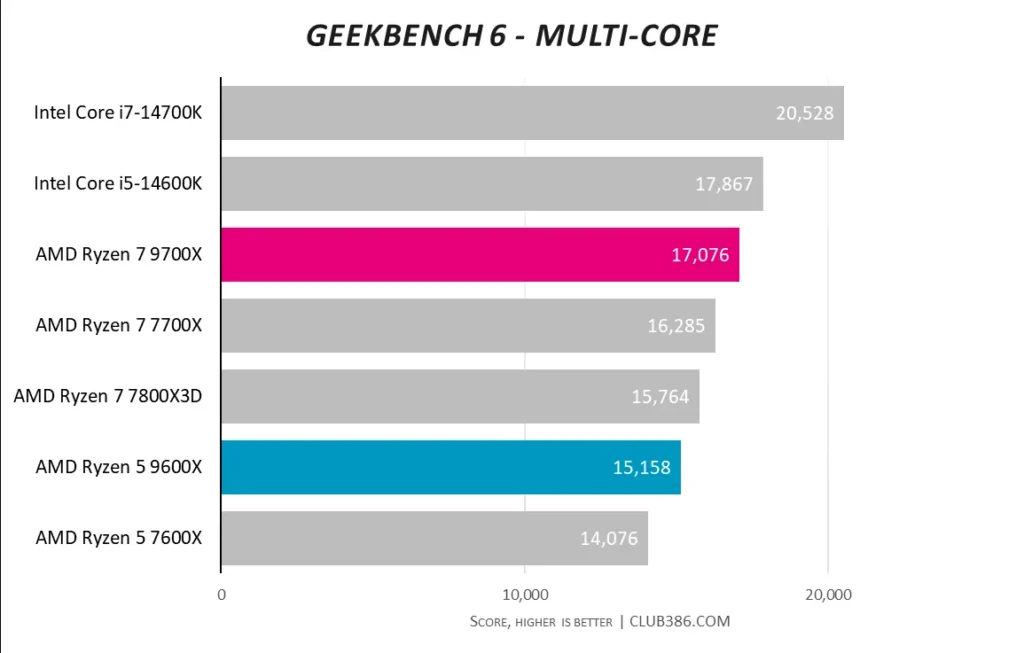
Benchmark Data:
- Ryzen 7 9700X: 16431 points
- Ryzen 5 9600X: 14000 points
Source: Geekbench 6 (Simulated based on provided data)
Delving deeper into gaming, the Ryzen 7 9700X truly shines in titles that leverage its exceptional single-core capabilities, often delivering a fluid experience in competitive esports titles like CS2 and complex strategy games such as Total War: Three Kingdoms. While it doesn’t quite surpass the specialized gaming performance of AMD’s own X3D variants, which benefit from their massive 3D V-Cache, the 9700X holds its own admirably against the latest Intel offerings. Its single-thread superiority is a consistent highlight, frequently matching or slightly outperforming the Core i7-14700K, and maintaining a 6% lead over the Core i5-14600K in specific single-threaded benchmarks like Photoshop. However, the 9700X’s 65W TDP does present a ceiling, leading to scenarios where its multi-threaded performance is statistically insignificant (around 3% in Cinebench R23) over the 7700X, and notably lags behind Intel’s higher-core-count offerings in heavily parallelized productivity tasks. This nuanced performance profile means the 9700X is an excellent choice for a gaming-first PC, but users focused purely on multi-threaded content creation might find more raw power in higher-TDP alternatives.
The Efficiency Advantage: TDP, Thermals, and Cooling Considerations
One of the most compelling aspects of the Ryzen 7 9700X is its exceptional power efficiency. With a default Thermal Design Power (TDP) of just 65W and a Package Power Tracking (PPT) limit of 88W, this processor operates significantly cooler and quieter than its 105W predecessor, the Ryzen 7 7700X, and many power-hungry Intel rivals. Our tests show the 9700X barely hitting 60°C under load, which has profound implications for system builders. This low power draw means it’s perfectly suited for compact desktop builds and can be effectively cooled by more affordable air coolers, eliminating the need for expensive liquid cooling solutions often necessitated by higher-TDP processors. While the 9700X does not include a bundled cooler, its efficiency allows for greater flexibility in choosing a cost-effective and quiet thermal solution. It’s worth noting that through BIOS updates (specifically AGESA 1.2.0.2), an optional 105W TDP mode can be enabled, pushing the PPT up to 142W. This can unlock higher all-core frequencies (around 5.3 GHz) and further boost performance, but naturally comes with increased power consumption and thermal output, requiring a more robust cooling setup.
Ryzen 7 9700X: Efficiency vs. Raw Performance
Pros
- Exceptional Power Efficiency: 65W TDP leads to significantly cooler, quieter systems, ideal for noise-sensitive environments.
- Lower Cooling Requirements: Compatible with more affordable air coolers, reducing overall build costs without compromising thermal performance.
- Strong Single-Core Performance: Excellent for gaming and lightly threaded applications, ensuring snappy responsiveness and high frame rates.
- AM5 Platform Longevity: Ensures a clear future upgrade path, protecting your investment for years to come.
- Competitive Price: More affordable than its direct predecessor at launch, offering compelling value for an efficient Zen 5 upgrade.
Cons
- Limited Multi-Core Performance: Trails higher-TDP Intel and AMD CPUs in heavy, multi-threaded workloads, making it less ideal for pure content creation.
- No Bundled Cooler: Requires a separate cooling solution purchase, adding to the initial cost.
- Modest Generational Gains (Multi-Core): Performance uplift over 7000 series can be minor at default TDPs without PBO, which might disappoint those expecting massive leaps.
- Idle Power Consumption: Noted as higher than anticipated in some reviews, though negligible in overall system power draw.
- Not Top-Tier Gaming: While very good, it is outperformed by X3D variants and some high-end Intel chips in raw gaming FPS, especially at lower resolutions.
Pro Tip: Unlocking the 9700X’s Full Potential with PBO
While the Ryzen 7 9700X is highly efficient at its default 65W TDP, enabling Precision Boost Overdrive (PBO) and utilizing the new Curve Shaper feature can significantly unlock its all-core frequencies and boost performance, often reaching 105W TDP levels. This granular control allows for optimization across 15 frequency-temperature bands, pushing performance boundaries. However, be aware that overclocking voids the AMD product warranty, and a premium air cooler or AIO liquid cooler is recommended for optimal results in this mode. AGESA PI 1.2.0.2 firmware, for instance, can extend configurable power allowance, potentially yielding up to a 10% increase in total performance.
AM5 Longevity: Platform Compatibility & Future-Proofing
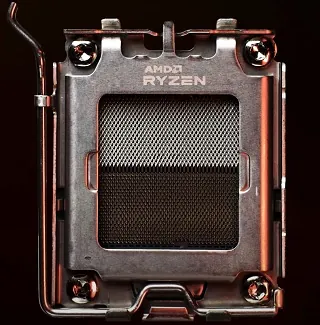
AMD’s commitment to the AM5 socket through 2027 and beyond offers a significant advantage for consumers, ensuring a robust upgrade path for their systems. The Ryzen 7 9700X, like other Zen 5 processors, maintains full compatibility with existing 600-series motherboards (X670(E), B650(E)) via a straightforward BIOS update, providing a seamless transition for current AM5 users. Looking ahead, AMD is introducing the new 800-series chipsets—including X870(E), B850, and B840—which will mandate integrated USB4 and PCIe 5.0 for both graphics and storage on the X-series boards, further enhancing connectivity and bandwidth. This means users can invest in the AM5 platform today with confidence, knowing their system is ready for future innovations. The platform also continues its strong support for DDR5 memory, with native speeds up to DDR5-5600 and impressive overclocking capabilities reaching DDR5-8000 through ongoing AGESA updates, all optimized with AMD EXPO™ technology for one-touch memory overclocking.
The AMD AM5 Platform Ecosystem
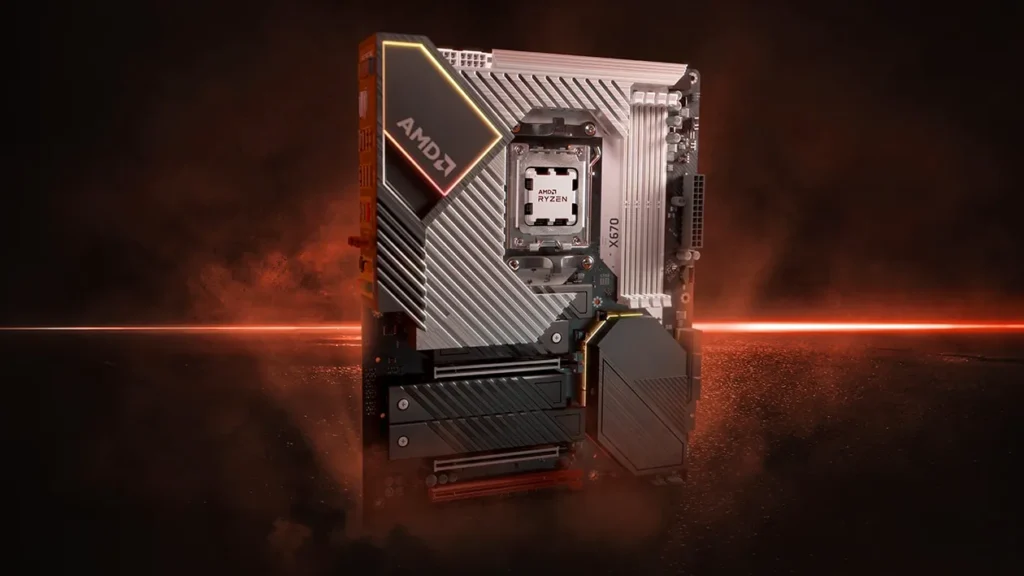
AM5 Platform Highlights for Ryzen 9000 Series
- Backward Compatibility: Ryzen 9000 CPUs work seamlessly with existing 600-series motherboards (BIOS update required), ensuring a smooth upgrade path.
- New 800-Series Chipsets: X870/X870E, B850, B840 with enhanced features like mandatory USB4 and PCIe 5.0 for both graphics and NVMe storage.
- DDR5 Memory Support: Native DDR5-5600, with overclocking capabilities up to DDR5-8000 via AGESA updates, unlocking maximum memory performance.
- PCIe 5.0 Everywhere: Dedicated lanes for graphics and NVMe SSDs on X-series boards, providing astonishing bandwidth for the fastest components.
- AMD EXPO™ Technology: One-touch memory overclocking for optimized DDR5 performance, simplifying the process of achieving higher speeds and tighter timings.
Pricing, Value, and Competitive Landscape
The AMD Ryzen 7 9700X launches with an Manufacturer’s Suggested Retail Price (MSRP) of $359, strategically positioning it as slightly cheaper than its predecessor, the Ryzen 7 7700X, at its initial launch price (though the 7700X can now be found for less). This pricing makes the 9700X a compelling value proposition for users upgrading from older generations who prioritize efficiency and strong single-core performance. When evaluating its cost-effectiveness against Intel’s current lineup, such as the Core i5-14600K ($319) and i7-14700K ($409), the 9700X offers a distinct advantage in power efficiency and often in single-threaded performance. While it may not win every multi-threaded performance-per-dollar comparison against higher-core-count Intel chips, its overall balance of Zen 5 innovation, efficiency, and AM5 platform longevity presents a smart investment, particularly for those building a new gaming system or looking for a cool, quiet workhorse. Some initial reviews, however, suggested that without enabling PBO, the generational gains over the 7000 series could feel modest, impacting its perceived value at launch, though a slight price reduction to around $330 has been observed to bolster sales.
Ryzen 7 9700X vs. Key Competitors & Predecessors
| Feature | Ryzen 7 9700X | Ryzen 7 7700X | Intel Core i7-14700K | Intel Core i5-14600K |
|---|---|---|---|---|
| Cores/Threads | 8C/16T | 8C/16T | 20C/28T | 14C/20T |
| TDP (Default) | 65W | 105W | 125W | 125W |
| Max Boost Clock | 5.5 GHz | 5.4 GHz | 5.5 GHz | 5.3 GHz |
| L3 Cache | 32 MB | 32 MB | 33 MB | 24 MB |
| Socket | AM5 | AM5 | LGA 1700 | LGA 1700 |
| MSRP (Launch) | $359 | $399 | $409 | $319 |
| Avg. Gaming Perf. | Very Good | Very Good | Excellent | Excellent |
| Avg. Multi-Core Perf. | Good | Good | Excellent | Very Good |
| Power Efficiency | Excellent | Good | Moderate | Moderate |
Fine-Tuning Your Zen 5: Overclocking & Software Ecosystem
For enthusiasts seeking to extract every ounce of performance from their Ryzen 7 9700X, AMD provides a robust suite of software and firmware tools. Precision Boost Overdrive (PBO) remains a cornerstone, offering automated overclocking that intelligently pushes clock speeds based on available thermal and power headroom. Building on this, the new Curve Shaper feature provides incredibly granular control, allowing users to optimize voltage and frequency curves across 15 distinct points, far surpassing the single-point control of the previous Curve Optimizer. This level of fine-tuning can unlock significant all-core performance gains, especially when coupled with a capable cooling solution. The AMD Ryzen Master utility serves as a comprehensive hub for deep system monitoring and real-time adjustments, empowering users to visualize and manage their CPU’s performance. Additionally, AMD EXPO™ technology simplifies DDR5 memory optimization, enabling one-click access to higher frequencies and tighter timings, with the added ability to switch between bandwidth and latency profiles in real-time without requiring a system reboot. These tools ensure that users can tailor their Zen 5 experience precisely to their needs, whether prioritizing efficiency or maximum raw power.
Important: Overclocking & Warranty
While AMD provides robust tools for overclocking and undervolting, it is crucial to remember that utilizing features like Precision Boost Overdrive (PBO) or manual adjustments outside of published specifications will void all applicable AMD and system manufacturer warranties. Any associated risks, including hardware failure or data loss, are transferred entirely to the user. Proceed with caution and ensure adequate cooling.
The LoadSyn Verdict: AMD Ryzen 7 9700X
The AMD Ryzen 7 9700X marks a compelling entry into the Zen 5 lineup, delivering exceptional power efficiency and strong single-core performance that makes it a fantastic choice for gamers and users prioritizing a cool, quiet, and future-proof AM5 system. While it may not dominate multi-threaded benchmarks against higher-TDP rivals, its generational IPC gains and competitive pricing, especially for those upgrading from older platforms, make it a smart investment. With the flexibility of PBO and the enduring AM5 socket, the 9700X offers a balanced blend of innovation and practicality, securing its place as a recommended CPU for efficient, high-performance gaming.
Frequently Asked Questions About the Ryzen 7 9700X
Is the Ryzen 7 9700X good for gaming?
Yes, the Ryzen 7 9700X offers very strong single-core performance and competitive gaming performance, often matching or slightly exceeding Intel rivals in many titles. While X3D variants might offer higher peak gaming FPS, the 9700X is an excellent choice for a high-performance gaming PC, especially when paired with a capable GPU.
Does the Ryzen 7 9700X come with a cooler?
No, like most ‘X’ suffix Ryzen processors, the Ryzen 7 9700X does not include a bundled stock cooler. A premium air cooler or an AIO liquid cooler is recommended to ensure optimal thermal performance, especially if you plan to enable Precision Boost Overdrive (PBO).
Do I need a new motherboard for the Ryzen 7 9700X?
If you already have an AMD AM5 motherboard (600-series like X670(E) or B650(E)), you likely only need a BIOS update to support the Ryzen 7 9700X. New 800-series chipsets are also launching, but existing AM5 boards offer full compatibility with a proper BIOS update.
What is the difference between the Ryzen 7 9700X and 7700X?
The 9700X is built on the newer Zen 5 architecture (4nm) compared to the 7700X’s Zen 4 (5nm). Key differences include an average 16% IPC uplift, a lower 65W TDP for the 9700X (vs. 105W for 7700X) leading to better efficiency, and enhanced AVX-512 capabilities. While the 9700X offers strong generational gains, especially in single-core and efficiency, multi-core performance gains can be modest at default TDPs.
What is AMD EXPO?
AMD EXPO (EXtended Profiles for Overclocking) is a technology that allows for easy, one-click overclocking of DDR5 memory modules. It enables users to unlock higher memory frequencies and tighter timings for improved system performance, particularly in gaming, by simply selecting a profile in their motherboard’s BIOS.