
The Ghost in the Machine: Why ‘Sleeper PCs’ Are Gaming’s Hottest Throwback
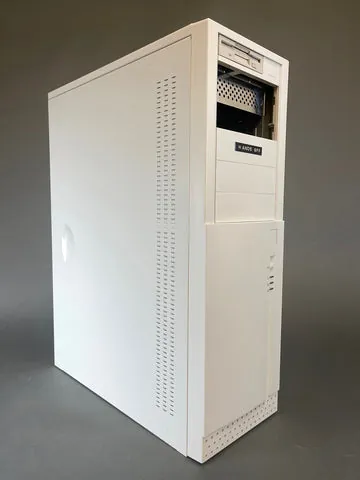
In the ever-evolving landscape of PC gaming, where flashy RGB and aggressive designs often dominate, a fascinating counter-culture has emerged: the ‘sleeper PC.’ This growing trend in PC modding sees enthusiasts meticulously repurpose vintage computer cases—think those unassuming beige towers from the late 80s and early 90s—to house the most powerful, cutting-edge gaming components available today. The allure lies in the extreme contrast: a machine that looks like it belongs in a museum, yet performs like a beast capable of tackling the latest AAA titles at ultra settings. It’s the ultimate wolf in sheep’s clothing, delivering an element of surprise and understated power that captivates both builders and onlookers alike.
More Than Meets the Eye: The Irresistible Pull of Retro Power
The appeal of the sleeper PC transcends mere technical specifications; it taps into a deep well of nostalgia and a powerful DIY spirit. For many, these builds are a direct callback to the golden age of PC gaming, recapturing the authentic aesthetics of the MS-DOS era. There’s an undeniable satisfaction in taking what appears to be an antiquated hunk of junk—an old Dell, Gateway, or Inwin case—and transforming it into a high-performance gaming rig. This blend of past and present offers a unique creative challenge, allowing enthusiasts to craft something truly distinctive that stands out by blending eras, delivering modern performance while evoking cherished memories of computing’s early days. The process of dusting off that vintage shell and infusing it with new life is, for many, profoundly satisfying.
“There is a deep affection for the authentic retro aesthetic, but this is heavily tempered by disappointment when modern cases only mimic the look without including functional legacy features. As one builder put it, ‘I really like it… I just wish the slots were real, otherwise it looks very cheap.’ The strong desire among builders to integrate functional legacy components (like floppy/DVD drives) into modern builds indicates a gap in the market for functionally authentic retro enclosures.”
Engineering Elegance: Crafting a Modern Beast in a Vintage Shell
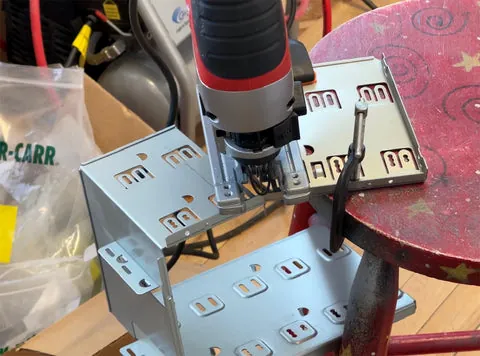
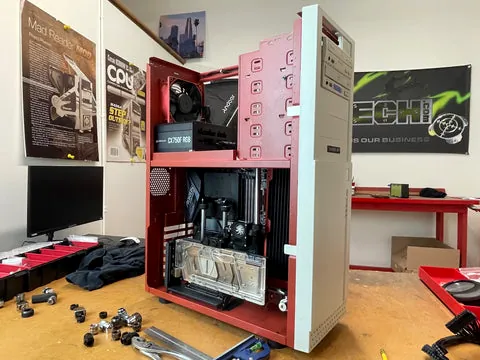
Building a sleeper PC is far from a plug-and-play endeavor; it’s a testament to engineering ingenuity and meticulous craftsmanship. The primary challenge lies in fitting high-performance modern components, which are often significantly larger and require more robust cooling, into cases designed for much less demanding hardware. Take, for instance, Mnpctech’s ultimate water-cooled beige sleeper PC build using an Inwin Q500 Server Tower. This project involved extensive modifications: removing factory HDD and 5.25-inch bay cages to accommodate a massive 480mm crossflow radiator, shortening the sliding motherboard tray, and cutting new exhaust fan locations for 120mm fans where only 80mm or 60mm once existed. Custom water-cooling loops, often featuring stainless steel hardline tubing reminiscent of performance car components, are common to manage the heat from powerful CPUs and GPUs. Builders also frequently fabricate new I/O panels to integrate modern USB-C and audio jacks while maintaining the case’s original aesthetic, showcasing a deep technical skill that goes beyond simple assembly.

The burgeoning popularity of sleeper PCs hasn’t gone unnoticed by manufacturers. Companies like SilverStone are now offering commercial solutions that aim to bridge this gap between nostalgia and modern functionality. Their FLP02 case, for example, sports a late-1980s style beige tower aesthetic but is engineered to support today’s demanding hardware, including large GPUs and 360mm AIO CPU coolers. Crucially, it reintroduces functional legacy features; the iconic ‘Turbo’ button, once used to toggle CPU speeds, now cleverly serves as a fan speed controller, with the red segmented display indicating the selected mode. Hidden beneath a magnetic flap, modern I/O like USB Type-C and 3.0 Type-A ports are discreetly integrated. These products validate the DIY community’s desires, providing an off-the-shelf option for those who crave the retro look without the extensive modding commitment.
The Community Weighs In: Authenticity, Bling, and the Quest for the ‘Real’ Sleeper
Within the passionate sleeper PC community, debates often rage about what truly constitutes an ‘authentic’ sleeper. The core ethos of stealth and subtlety can clash with the irresistible urge to integrate modern conveniences or aesthetic enhancements. Some purists argue that additions like vibrant RGB lighting or internal LCD screens, which display system stats, betray the ‘sleeper’ ideal by drawing attention to the hidden power rather than concealing it. This contrasts sharply with the longing for genuinely functional legacy features, such as working floppy drives or front-mounted optical bays, which represent a deeper, more tactile connection to the past. The community’s response is often a mix of appreciation for the novelty and skepticism towards builds that lean too heavily into modern ‘bling,’ highlighting a constant tension between pure nostalgic form and the functional demands of contemporary hardware.
The Retro-Modern Ecosystem: When Peripherals Join the Time Warp
The retro-modern aesthetic isn’t confined solely to PC towers; it’s a design philosophy that has begun to influence other gaming peripherals, creating a cohesive ecosystem for enthusiasts. A prime example is the Angry Miao AM RGB 65 keyboard. This unique 65% mechanical keyboard pays direct homage to the iconic Game Boy, featuring an exaggerated curve, a pixel art window, and even a USB-C port styled like the classic D-Pad. Beyond its distinctive vintage appearance, it’s packed with premium modern features: an adjustable leaf spring mount for a superior typing feel, custom Icy Silver Pro V2 linear switches, a highly customizable dot matrix LED panel, and versatile connectivity options including Bluetooth 5.1 and 2.4GHz. The AM RGB 65 perfectly embodies the sleeper spirit, blending a deeply nostalgic form with cutting-edge performance, proving that the desire for this unique fusion extends far beyond just the main rig.
The Enduring Appeal: What’s Next for Retro-Tech?
The sleeper PC and the broader retro-modern tech movement are more than fleeting trends; they represent a significant cultural fusion within the PC gaming community. This movement celebrates the rich history of computing while enthusiastically embracing technological progress. It’s a testament to the boundless creativity and passion of modders and designers who continually push the boundaries of hardware integration and aesthetic design. As technology continues its relentless march forward, the desire to connect with the past remains strong. Whether this niche remains primarily a DIY pursuit for dedicated modders or evolves into a more mainstream design philosophy embraced by major manufacturers, one thing is clear: the compelling blend of nostalgic aesthetics with cutting-edge performance is here to stay, ensuring that the ‘ghost in the machine’ will continue to surprise and delight for years to come.
Key Takeaways
- Sleeper PCs combine vintage aesthetics with modern gaming power, offering a unique blend of nostalgia and performance.
- Builders face creative challenges in fitting high-end hardware into old cases, often requiring extensive custom modifications for cooling and I/O.
- The community debates the ‘authenticity’ of sleeper builds, with some favoring functional legacy features over purely cosmetic retro elements or modern ‘bling’ like RGB.
- The retro-modern design philosophy extends beyond PC cases to peripherals, exemplified by products like the Game Boy-inspired Angry Miao AM RGB 65 keyboard.
- This trend reflects a vibrant subculture that celebrates PC gaming history while pushing the boundaries of hardware integration and design.