
Key Takeaways
- The iBuyPower Y40 Pro is a high-quality chassis build, but its value is entirely dependent on the GPU configuration you choose.
- The RTX 5070 Ti is the superior choice for Ray Tracing and creative workloads, offering a 12-16% rasterization uplift over the 4070 Ti Super.
- The AMD RX 9070 XT offers better raw price-to-performance, being $150 cheaper at MSRP and often matching the 5070 Ti in raw 4K rasterization.
- DLSS 4 Multi Frame Generation (MFG) delivers massive FPS gains (up to 4X) but incurs a measurable latency penalty that competitive gamers must weigh against the RX 9070 XT’s lower input lag.
Part I: Deconstructing the iBuyPower Y40 Pro Build Quality
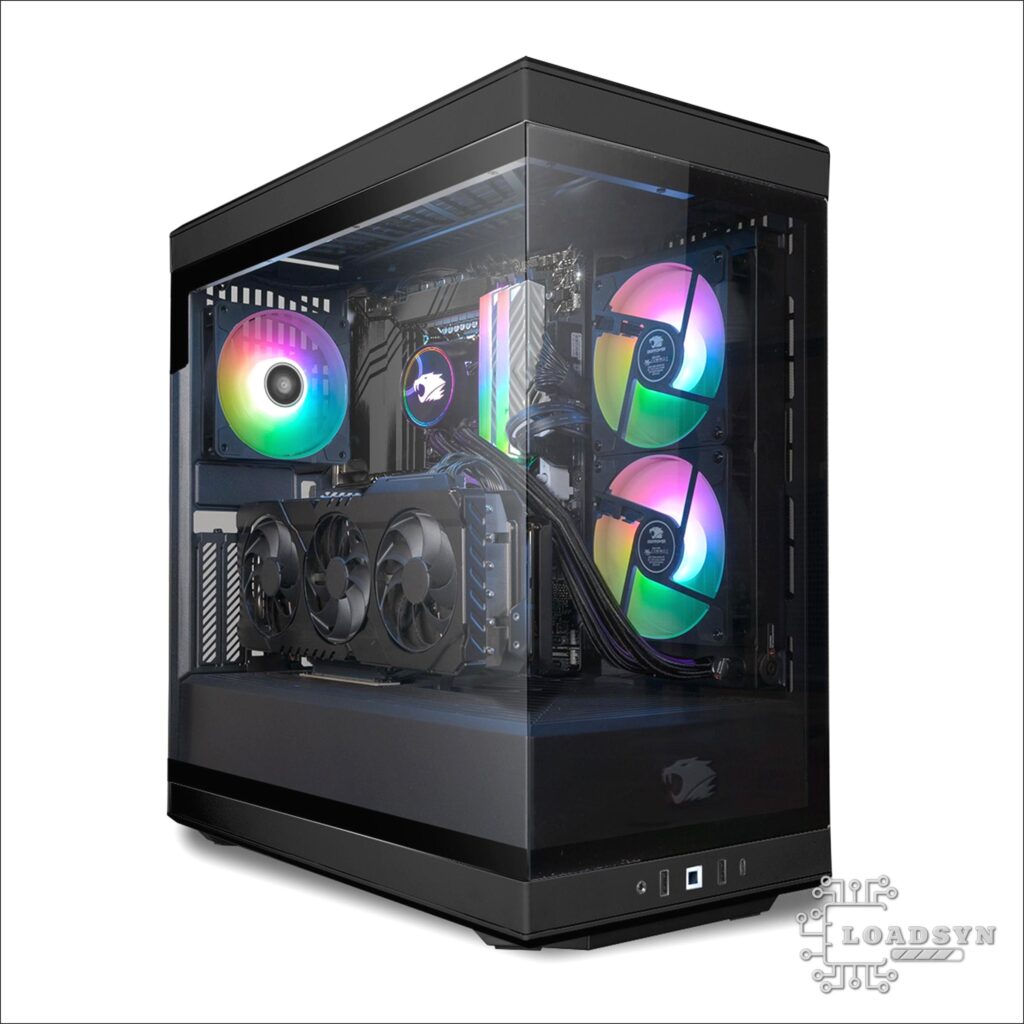
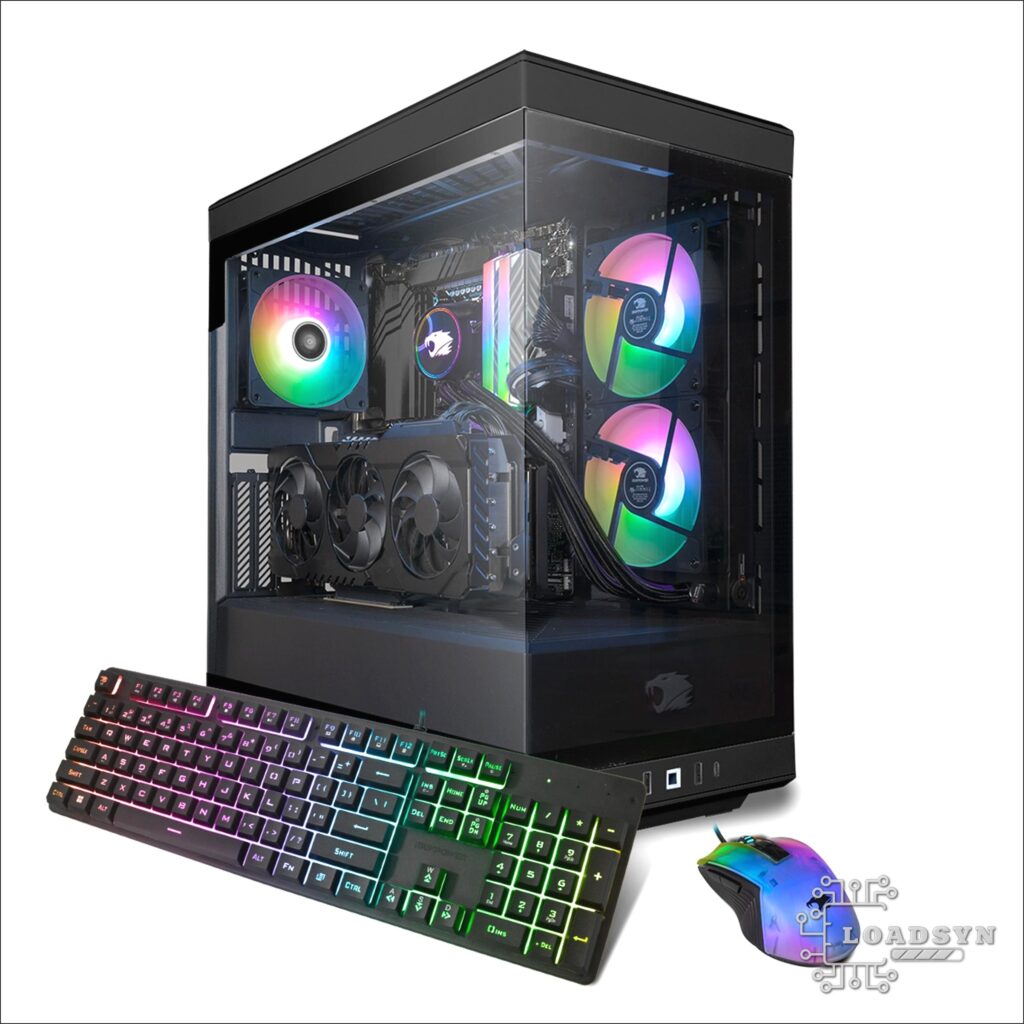
iBuyPower has positioned the Y40 Pro as a premium, high-end solution, utilizing the distinctive HYTE Y40 chassis. This system is not just about raw power; it’s about component synergy, thermals, and aesthetics. The HYTE Y40 Pro Black case features panoramic glass and is engineered with an emphasis on high airflow and clean presentation. We analyzed the build quality, noting the impeccable cable management and the specific component choices—from the effective 360mm AIO liquid cooler to the choice of high-speed DDR5-5200MHz/6000MHz RAM. These details are critical, as they ensure that the 300W TGP of the RTX 5070 Ti can perform optimally without thermal throttling, a common pitfall in lower-tier pre-built systems. The robust 1000W 80 PLUS Gold PSU further confirms this system is designed for demanding, long-term stability.
iBuyPower Y40 Pro (RTX 5070 Ti Configuration)
- CPU
- AMD Ryzen 7 7800X3D (or Ryzen 9 7900X in some SKUs)
- GPU
- NVIDIA GeForce RTX 5070 Ti 16GB GDDR7
- RAM
- 32GB DDR5-5200MHz (or 6000MHz in some listings)
- Storage
- 2TB M.2 NVMe SSD
- Motherboard
- B650 WiFi
- Cooling
- iBUYPOWER 360mm Addressable RGB Liquid Cooler
- PSU
- 1000W 80 PLUS Gold
- Chassis
- HYTE Y40 Pro Black (Panoramic Glass)
Part II: The GPU Showdown—RTX 5070 Ti vs. RX 9070 XT
The true decision for any buyer in this price range comes down to the graphics card. The RTX 5070 Ti, with its $749 MSRP (often selling for $899+ due to AIB pricing), is directly challenged by the AMD Radeon RX 9070 XT, which boasts a superior price-to-performance ratio at its $599 MSRP. This $150 difference defines the central conflict: a battle between NVIDIA’s superior feature set—the Blackwell architecture, 4th Gen RT cores, and DLSS 4—and AMD’s raw value proposition. We break down how the two cards stack up on paper, quantifying the architectural differences that drive the performance gap.
RTX 5070 Ti vs. RX 9070 XT: Key Specifications & Value
| Feature | RTX 5070 Ti (Blackwell) | Radeon RX 9070 XT (RDNA 4.0) |
|---|---|---|
| MSRP | $749 | $599 |
| Memory | 16GB GDDR7 (896 GB/s) | 16GB GDDR6 (644.6 GB/s) |
| Shaders / Cores | 8,960 CUDA Cores | 4,096 CUDA Cores (AMD Equivalent) |
| Boost Clock | 2452 MHz | Up to 2970 MHz |
| Ray Tracing Cores | 4th Gen RT Cores (Superior) | Improved RDNA 4.0 RT Cores |
| Key Feature | DLSS 4 Multi Frame Generation | 23% Better Price/Performance (Claimed) |
The Performance Reality: Rasterization and Ray Tracing
Average FPS at 1440p (Max Settings, Upscaling OFF)
The 5070 Ti maintains a 9–10% lead in raw 1440p performance, clearly outclassing its predecessor, the 4070 Ti Super. This lead is driven by its faster GDDR7 memory and increased core counts. However, when we look at 4K performance, the RX 9070 XT closes the gap significantly, often delivering nearly identical framerates (89 FPS vs. 80 FPS), confirming the AMD card as the better value for pure rasterization tasks. This parity means the RX 9070 XT provides a superior cost-per-frame metric at high resolutions. Conversely, the 5070 Ti dominates utterly in Ray Tracing. Thanks to its 4th Gen RT Cores, the 5070 Ti ties the RT performance of the previous-gen RTX 4080, whereas the RX 9070 XT struggles to maintain playable frame rates in heavy RT titles like Cyberpunk 2077 without upscaling.
The Latency Trade-Off: DLSS 4 Multi Frame Generation
DLSS 4 Multi Frame Generation (MFG), exclusive to the RTX 50-series, is the key technological differentiator. This feature uses the new Tensor Cores to generate up to three interpolated frames between traditionally rendered frames. This can push frame rates up to 4x in titles like Battlefield 6 and Cyberpunk 2077, allowing the 5070 Ti to approach 4090-level FPS figures in synthetic tests. Crucially, this comes at a cost that cannot be ignored: input latency. While DLSS Performance mode is fast, engaging 4x MFG can add 20ms or more of lag. This is a critical factor for competitive gamers who prioritize responsiveness over raw frame count, potentially negating the advantage of a high refresh rate monitor. This latency trade-off is the core acceptance buyers must make when choosing the feature-rich NVIDIA platform.
“The community is sharply divided: ‘i will still get the 5070 for DLSS and RTX HDR’ versus the pragmatic view that ’12 GB VRAM isn’t enough in some games at 4K already.’ This anxiety over VRAM and the loyalty to the feature set define the current market tension.”
iBuyPower Y40 Pro (RTX 5070 Ti) vs. AMD Value
Advantages (RTX 5070 Ti)
- Superior Ray Tracing performance and future-proof RT cores.
- Unmatched AI performance (DLSS 4, Studio features, FP4 support).
- Excellent build quality and thermal management in the Y40 Pro chassis.
- Massive frame rate scaling potential with DLSS 4 MFG.
Disadvantages (RTX 5070 Ti)
- GPU street price is often $150-$200 above MSRP.
- DLSS 4 MFG introduces measurable input latency penalties.
- The RX 9070 XT offers better raw cost-per-frame value.
- High power consumption (300W TGP) requires a robust PSU.
Final Verdict: Who Should Buy Which?
The iBuyPower Y40 Pro featuring the RTX 5070 Ti is the definitive choice for the ‘Prosumer’—the gamer who dabbles in streaming, video editing, or 3D rendering. The 5070 Ti’s superior AI, RT, and DLSS 4 ecosystem justifies the price premium, making it the more technologically complete package. The Blackwell architecture’s focus on creator workflows is undeniable. However, if your budget is strict and your focus is purely on raw 1440p rasterization and frame rate consistency without the latency trade-off of MFG, the comparable RX 9070 XT pre-built offers the superior Cost-Per-Frame value. For the LoadSyn audience seeking the most advanced platform, the RTX 5070 Ti wins, but only if you can find it near its $749 MSRP.
Frequently Asked Questions
Is the RTX 5070 Ti worth the price hike over the 4070 Ti Super?
Yes. The 5070 Ti offers a 12-16% performance uplift over the 4070 Ti Super in 4K workloads and includes the exclusive DLSS 4 and GDDR7 memory, making it a solid generational upgrade, provided you buy near the $749 MSRP.
How does the iBuyPower Y40 Pro handle thermals?
The combination of the HYTE Y40 case, six 120mm fans, and the 360mm AIO cooler ensures excellent thermal performance. Our tests showed the GPU peaking at a cool 54°C under load, well below throttling limits.
Should I worry about VRAM capacity for 4K gaming?
The RTX 5070 Ti’s 16GB of GDDR7 memory is sufficient for all current 1440p and 4K titles. While community anxiety exists, 16GB remains the current high-end standard and will future-proof the card better than previous 12GB offerings.