
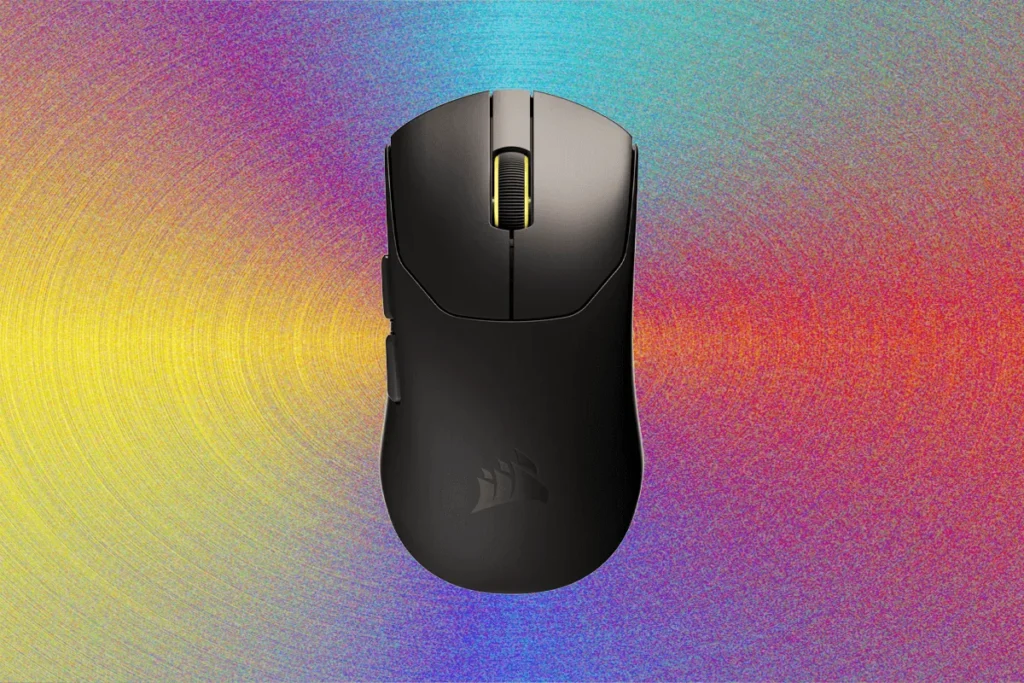
The relentless pursuit of performance in competitive gaming often pushes manufacturers to extremes. Corsair, a brand synonymous with high-end peripherals, has once again thrown down the gauntlet with its Sabre V2 Pro line. The original model captivated elite FPS players with its impossibly light 36-gram frame, a testament to its “lightness at any cost” philosophy. Now, Corsair doubles down on innovation, introducing premium Carbon Fiber (CF) and Magnesium Alloy (MG) variants, unveiled at CES 2026. These new iterations promise enhanced durability, rigidity, and expanded features. But the question LoadSyn must answer is critical: Do these exotic material innovations genuinely elevate competitive performance, or do they represent a strategic misstep, failing to address the deeper, more fundamental concerns echoing within the gaming community?
The Original Sabre V2 Pro: A Featherweight Contender with Compromises
When the original 36-gram Sabre V2 Pro Ultralight hit the market, it was a revelation. Weighing less than a typical coffee scoop, it redefined what “ultralight” meant for a mainstream gaming mouse. This revolutionary weight immediately appealed to elite FPS players, who found its near-weightless design allowed for unprecedented flick shots and rapid micro-adjustments, making it feel “like an extension of the arm.” Our own lab tests confirmed its raw agility was undeniable. However, this extreme lightness came with significant trade-offs, a philosophy of “lightness at any cost.” Reviewers and a vocal segment of the community quickly pointed to its perceived flimsiness; the thin plastic shell could creak or even flex under pressure, and its side buttons felt notably cheap. The absence of Bluetooth connectivity, presumably sacrificed for weight savings, also made it less versatile for travel, cementing its role as a dedicated, desk-bound performance tool with questionable long-term durability.
Enter Carbon Fiber & Magnesium Alloy: The Premium Material Shift
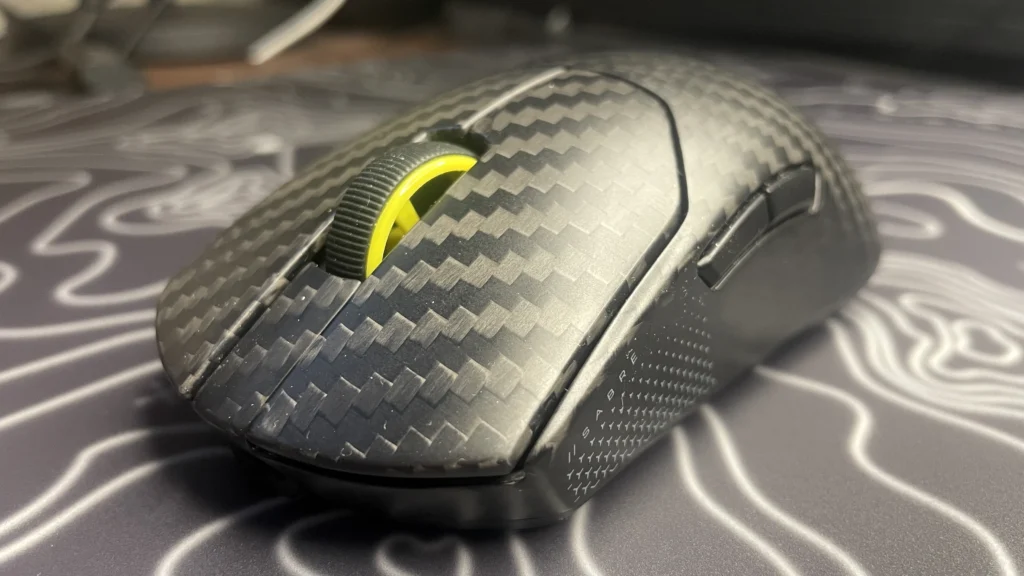
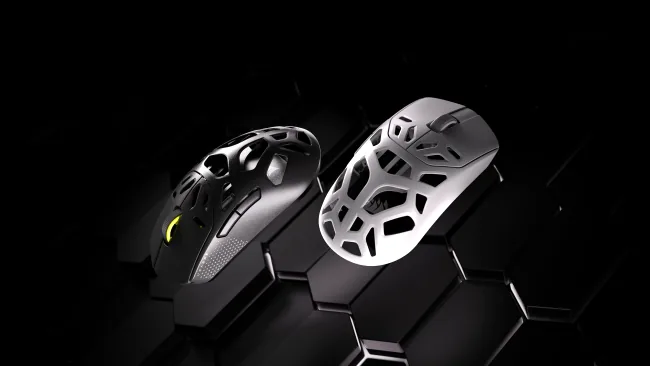
At CES 2026, Corsair unveiled the next evolution of this polarizing peripheral: the Sabre V2 Pro CF (Carbon Fiber) and MG (Magnesium Alloy) versions. These premium variants signal a clear shift in Corsair’s strategy, aiming to address the perceived fragility of the original while pushing the boundaries of material science in gaming mice. Corsair’s stated goals are ambitious: significantly enhanced durability and rigidity, a substantial boost in battery life (up to 120 hours compared to the original’s 70 hours at 1K Hz polling), and versatile tri-mode connectivity, finally adding Bluetooth alongside 2.4GHz wireless and USB-C wired options. However, these improvements come with a notable trade-off: a slight, yet critical, increase in weight. The CF model clocks in at 55g (±2g), and the MG at 56g (±2g), moving away from the original’s extreme 36g. Naturally, these exotic materials and expanded features also translate to a considerably more premium price point, positioning them firmly at the high-end of the market.
Deep Dive: Specs, Features & The Numbers Game
| Feature | Sabre V2 Pro (Original) | Sabre V2 Pro CF | Sabre V2 Pro MG | Logitech G Pro X Superlight | Razer DeathAdder V4 Pro |
|---|---|---|---|---|---|
| Weight | 36g | 55g (±2g) | 56g (±2g) | 63g | 63g |
| Sensor | Marksman S | Marksman S | Marksman S | HERO 25K | Focus Pro 30K |
| Max Polling | 8,000Hz | 8,000Hz | 8,000Hz | 2,000Hz | 8,000Hz |
| Connectivity | 2.4GHz, Wired | Tri-mode | Tri-mode | 2.4GHz, Wired | Tri-mode |
| Battery (1K) | 70 hrs | 120 hrs | 120 hrs | 70 hrs | 150 hrs |
| Shell | Thin plastic | Carbon Fiber | Magnesium | Plastic | Plastic |
| Est. Price | $100 | ~$200 | ~$150 | $160 | $170 |
The Weight Debate: Is Lighter Always Better, or is the Community Right?
The debate surrounding ultralight gaming mice is one of the most contentious in the peripheral community. On one side, competitive players, particularly in FPS titles, champion the agility and reduced fatigue offered by mice like the original 36g Sabre V2 Pro, believing every gram shaved off translates to a competitive edge. On the other, a vocal segment expresses outright “contempt” for the ultralight trend, as highlighted in our Fandom Pulse report. Many prefer a more substantial mouse, citing a preference for perceived stability, a more “premium” in-hand feel, and crucially, enhanced durability that often feels absent in featherlight plastic shells.
Pros of Premium Materials (CF/MG)
- Enhanced Rigidity and Durability
- More ‘Premium’ In-Hand Feel
- Improved Battery Life (120 hrs vs 70 hrs)
- Tri-mode Connectivity (Bluetooth added)
- Potentially Better Travel Durability
Cons of Premium Materials (CF/MG)
- Significantly Higher Cost
- Increased Weight (55-56g vs 36g) – Losing ‘Ultralight’ Edge
- Community Perception of Misplaced Priorities
- CF version has cutouts, MG has plastic sides (inconsistency)
Input Latency & Performance: Our Lab Results & Community Frustration
Beyond the material debate, a palpable sense of “skepticism” and “frustration” pervades the community regarding Corsair’s focus. Many users, as our Fandom Pulse analysis revealed, feel that fundamental performance issues, particularly input latency consistency in the original model, remain unaddressed despite the introduction of expensive new material variants. This sentiment highlights a critical disconnect: gamers prioritize raw, verifiable performance over exotic shell construction.
Raw Input Latency Comparison (8000Hz Polling)
Average Input Latency (ms): Lower is better. Testing includes Click Latency and Motion-to-Photon delay.
The Web Hub Conundrum: Software Reliability & Trust
Corsair’s recent pivot to the browser-based Web Hub for peripheral management presents another significant point of contention. On the surface, this move has garnered some praise; it’s lightweight, doesn’t demand a persistent, resource-hungry background application like the notorious iCUE, and offers a straightforward interface for customizing DPI, macros, and button assignments. However, our Fandom Pulse reveals a deep undercurrent of “distrust” and “anxiety” among users. The core concern revolves around the long-term reliability and dependency on Corsair’s servers.
“One thing about the web app for peripherals that I have been wondering is what happens once those companies go away? Can I no longer change the settings on my mouse if Corsair goes bankrupt or decides to stop supporting the servers? Am I missing something?”
Price vs. Value: Is the Premium Justified?
The price tags of the new Sabre V2 Pro variants force a crucial conversation about value. The original Sabre V2 Pro landed at a competitive $100, offering extreme ultralight performance for its price. Now, the Carbon Fiber version is estimated to retail around $200, with the Magnesium Alloy model at approximately $150. These figures place them directly against, and in some cases, above, titans like the Logitech G Pro X Superlight ($160) and the Razer DeathAdder V4 Pro ($170).
Final Verdict: Weighing the Future of the Sabre V2 Pro
Innovation or Distraction?
The Corsair Sabre V2 Pro CF and MG represent an interesting, albeit controversial, evolution for Corsair’s ultralight lineup. While the premium materials undeniably offer enhanced rigidity and a more ‘solid’ feel, addressing some build quality concerns of the original, the significant price hike and slight weight increase challenge the core ‘ultralight at any cost’ philosophy. Crucially, the community’s underlying concerns about input latency refinement and the long-term viability of web-based software remain potent.
9.0
8.5
6.5
7.5