
Beyond the Marketing Mirage: Why Peak Sequential Speeds are Failing the Modern Gamer
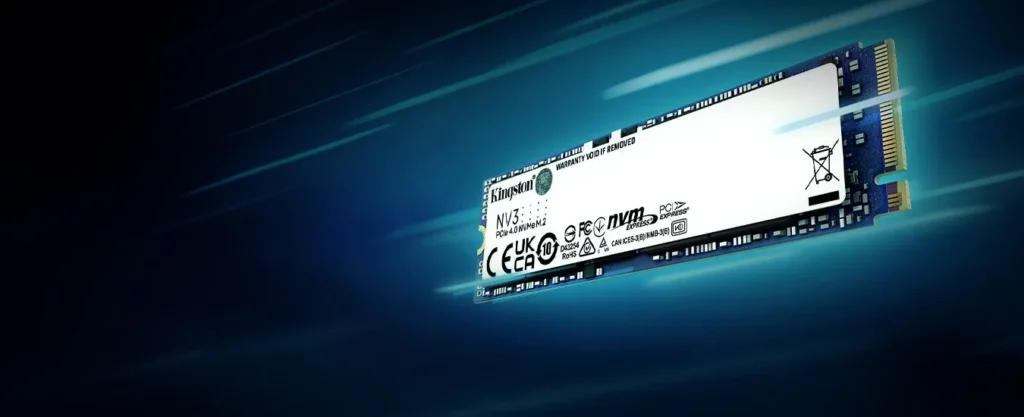
The storage landscape is currently defined by a widening chasm between theoretical benchmarks and tangible user experience. While the industry is aggressively pivoting toward the PCIe 5.0 frontier—and even detailing the PAM4-signaling future of PCIe 6.0—the pragmatic reality for gamers remains firmly rooted in the Gen 4 ecosystem. As an engineer who has spent years dissecting die-shots, I can tell you that the ‘speed’ you see on the box is often a poor proxy for how a drive actually feels. High-capacity, value-oriented drives like the Kingston NV3 and Lexar NQ780 are dominating the 2025 market not because they break records, but because they provide the exact thermal and architectural balance required for modern gaming workloads.
Key Takeaways
- Sequential speed is a marketing trap: These numbers only apply to rare, massive file transfers, not gaming.
- Random 4K performance is the true bottleneck: This dictates actual game load times and asset streaming fluidity.
- PCIe 4.0 is the optimal choice: It offers the best capacity-to-price ratio for 2025 and 2026 builds.
The Anatomy of a ‘Budget King’: Dissecting the Lexar NQ780 and the QLC NAND Trade-off
| Specification | Lexar NQ780 (Budget) | Samsung 980 PRO (Performance) |
|---|---|---|
| Controller | Innogrit IG5236 (2020 Vintage) | Samsung Elpis (In-House) |
| NAND Type | 144-Layer QLC | 3-bit MLC (TLC) |
| Sequential Read | Up to 7,400 MB/s | Up to 7,000 MB/s |
| Sequential Write | Up to 6,000 MB/s | Up to 5,000 MB/s |
| Random 4K Delta | Significant latency in sustained IO | Industry-leading low latency |
| Primary Use Case | High-capacity game storage | Professional content creation & OS drive |
Technical Nuance: Do not let the Lexar NQ780’s 7,400 MB/s sequential read speed deceive you. By pairing an aging 2020-era Innogrit controller with high-density QLC NAND, this drive sacrifices the Random 4K performance required for rapid asset fetching. In titles like Final Fantasy XIV, which rely on frequent, small-block data calls, this drive will feel noticeably slower than a ‘slower’ 5,000 MB/s TLC-based drive. It is a classic example of a large data pipe limited by a slow internal pump.
Architectural Synergies: From CPU Reorder Buffers to the PCIe 6.0 Horizon
To understand the diminishing returns of storage bandwidth, we must look at the CPU’s internal silicon. Modern processors utilize Out-of-Order (OoO) execution, relying on the Reorder Buffer (ROB) to manage speculative instructions and the Load Store Queue (LSQ) to handle memory disambiguation. When a game requests data from an NVMe drive, these hardware structures are the gatekeepers. If the storage latency is high, the ROB fills up with stalled instructions, starving the execution units regardless of how many gigabytes per second the interface supports. As we look toward PCIe 6.0, the transition to PAM4 signaling and Flow Control Units (FLITs) isn’t just about speed—it’s about making data movement more predictable and reducing the ‘pressure’ on these CPU-side queues to improve overall system deterministic behavior.
| PCIe Generation | Transfer Rate (GT/s) | x16 Bidirectional Bandwidth | Signaling Method |
|---|---|---|---|
| PCIe 4.0 | 16 GT/s | 64 GB/s | NRZ (Non-Return-to-Zero) |
| PCIe 5.0 | 32 GT/s | 128 GB/s | NRZ (Non-Return-to-Zero) |
| PCIe 6.0 | 64 GT/s | 256 GB/s | PAM4 (Pulse Amplitude Modulation) |
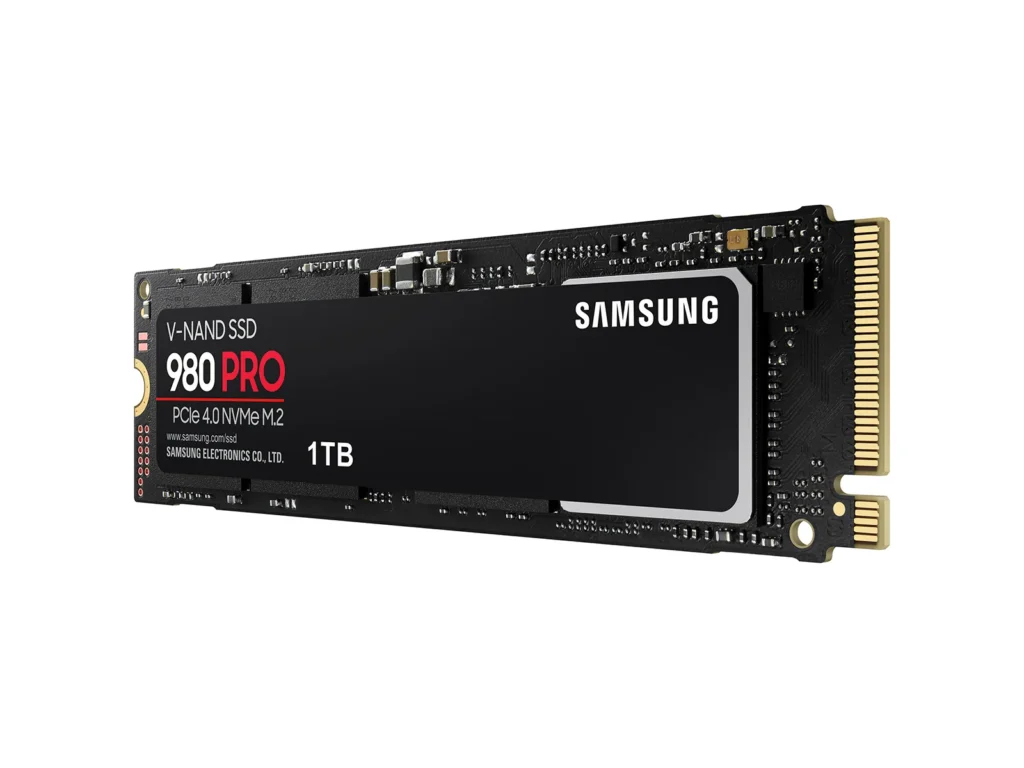

The Samsung 980 PRO represents the ‘Pro’ tier of the Gen 4 era, featuring a nickel-coated controller and a heat spreader label for superior thermal dissipation. Unlike budget QLC drives, the 980 PRO’s firmware is optimized via the Samsung Magician suite to maintain consistent IOPS under heavy thermal loads, preventing the aggressive throttling seen in unshielded alternatives.
Frequently Asked Questions
Does PCIe 5.0 help with LLVM compilation?
Yes, significantly. Software development involves thousands of small file reads and writes where Gen 5’s lower latency and higher throughput can shave minutes off complex builds.
Is 4TB QLC better than 2TB TLC for a pure gaming drive?
For 90% of gamers, yes. With modern games exceeding 150GB, the capacity of a drive like the Kingston NV3 is more valuable than the marginal loading speed gains of a smaller TLC drive.
Will my PS5 benefit from a 7400MB/s drive if it’s capped at 6300MB/s?
Yes, because a drive rated for 7400MB/s is often running well below its thermal limit at 6300MB/s, leading to cooler operation and better long-term reliability.
Final Verdict
The conclusion is a victory for pragmatism. While PCIe 5.0 is an engineering triumph and PCIe 6.0 promises a revolution in AI-scale compute fabric, the average gamer is best served by the mature PCIe 4.0 market. Investing in a high-capacity 4TB drive like the Lexar PLAY or Kingston NV3 provides a tangible quality-of-life upgrade that raw bandwidth benchmarks simply cannot match. In the current hardware landscape, the smartest play is to maximize your storage volume today and leave the expensive, heat-heavy bleeding edge to the researchers and content creators.