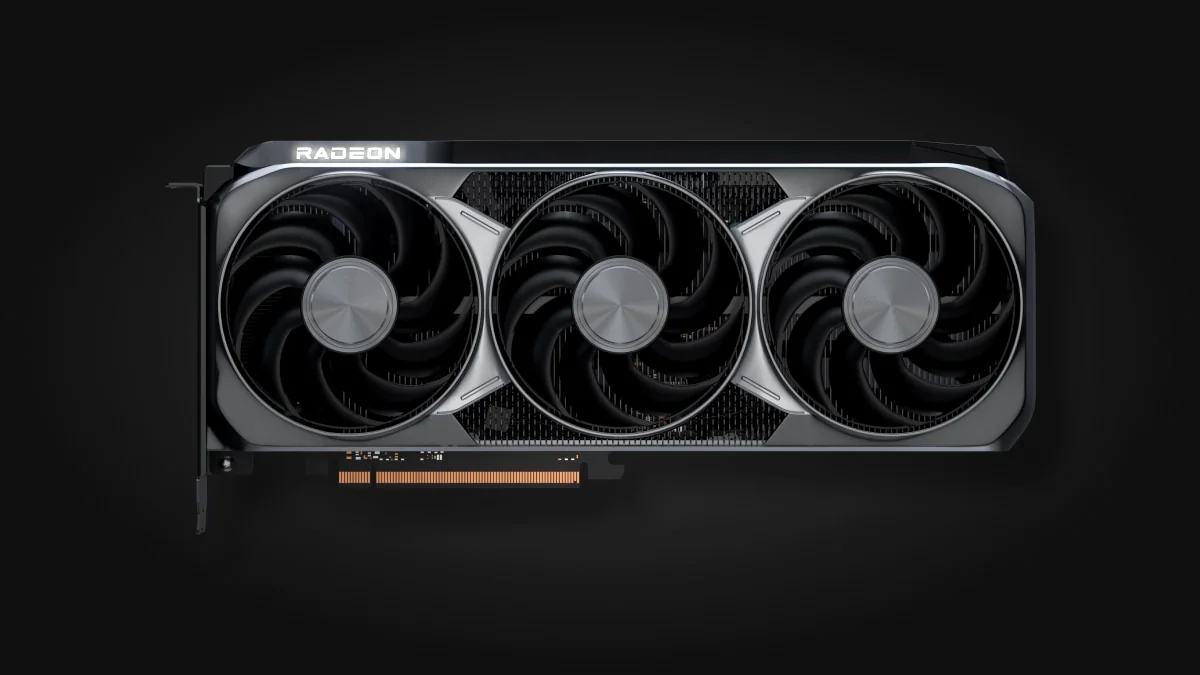

Key Takeaways: RX 9070 XT
- The Radeon RX 9070 XT, priced aggressively at a $599 Suggested E-tail Price (SEP), immediately establishes itself as the new 4K value champion, consistently outperforming the competing RTX 5070 in native rasterization workloads.
- FidelityFX Super Resolution 4 (FSR 4) is the defining technology of this generation. Leveraging advanced ML, it delivers vastly superior image quality compared to FSR 3.1 while providing massive frame rate boosts (e.g., transforming a native 80 FPS experience into a competitive 130+ FPS experience using Quality mode).
- High-risk vBIOS flashing (such as converting a base 9070 model to a 9070 XT) is technically possible but carries severe hardware bricking and warranty risks. Given the robust performance uplift provided by FSR 4, these dangerous modifications are largely obsolete for achieving competitive frame rates.
- The underlying RDNA 4 architecture introduces significant generational improvements, including 3rd Gen Ray Tracing cores (2x throughput) and 2nd Gen AI accelerators, contributing to an overall generational performance uplift of up to 40%.
The launch of the AMD Radeon RX 9070 XT on February 28, 2025, marked a decisive strategic move by AMD to dominate the critical mid-to-high-end GPU market segment, specifically targeting the $500 to $600 price point. This card is not merely an incremental hardware update; it is AMD’s most concerted effort yet to redefine high-end 4K gaming through architectural leaps and ecosystem optimization. AMD’s messaging is clear: achieving competitive frame rates and next-level visuals no longer relies solely on brute-force hardware. Instead, the focus has shifted entirely to leveraging the RDNA 4 architecture’s specialized features and the revolutionary performance scaling provided by FSR 4. This approach ensures that the 9070 XT delivers a premium experience without demanding the premium price tag of top-tier flagships.
RDNA 4 Architecture and Core Specifications Deconstructed
AMD Radeon RX 9070 XT & RX 9070 Reference Specifications
- GPU/Architecture
- Navi 48 / RDNA 4
- Compute Units
- 64 XT, 56 9070
- Stream Processors
- 4096 XT, 3584 9070
- VRAM
- 16GB GDDR6 20 Gbps
- Memory Interface
- 256-bit
- Game Clock
- 2.4 GHz XT, 2.1 GHz 9070
- Boost Clock
- Up to 3.0 GHz XT, Up to 2.5 GHz 9070
- TBP
- 304W XT, 220W 9070
- SEP
- $599 XT, $549 9070
RX 9070 XT vs. NVIDIA RTX 5070: Head-to-Head
| Feature | Radeon RX 9070 XT | GeForce RTX 5070 |
|---|---|---|
| MSRP | $599 | $549 |
| Architecture | RDNA 4.0 (Navi 48) | Blackwell 2.0 |
| VRAM / Bus Width | 16 GB GDDR6 / 256-bit | 12 GB GDDR7 / 192-bit |
| FP32 Performance (TFLOPS) | 48.66 TFLOPS | ~45.2 TFLOPS |
| TDP / Power Efficiency | 304W / 16.17 (Efficiency Score) | 250W / 21.11 (Efficiency Score) |
| Ray Tracing Gen | 3rd Gen RT Cores | 4th Gen RT Cores |
| Ecosystem Advantage | FSR 4 (ML Upscaling) | DLSS 3.5 (Superior Denoising) |
The 4K Performance Baseline: Native Rasterization and RT Gains
RX 9070 XT 4K Gaming FPS (Native Settings)
Source: AMD Performance Labs (Feb 2025, Driver 25.3.1)
The raw data confirms the RX 9070 XT is a formidable native 4K card, but the true measure of RDNA 4 lies in its ray tracing capabilities. The introduction of 3rd Gen Ray Tracing cores provides a generational leap, specifically offering over 2x the ray tracing throughput per compute unit compared to RDNA 3. This advancement is transformative. While older AMD cards struggled to maintain smooth performance with RT enabled, the 9070 XT now consistently delivers frame rates well above the crucial 60 FPS threshold in optimized titles. This enhanced playability directly validates the confidence we see in the community, which is actively pushing back against the old narrative that AMD “sucks at Ray Tracing.” Although Nvidia still holds a tangible advantage in specialized denoiser solutions, particularly visible in complex path-traced scenes like those in Cyberpunk 2077, the 9070 XT makes high-fidelity RT gaming genuinely competitive and enjoyable.
FSR 4: Why ML Upscaling Ends the Need for Hardware Mods
The real game-changer accompanying the RX 9070 XT is AMD FidelityFX Super Resolution 4 (FSR 4). This is not a simple algorithmic update; it is a breakthrough ML-based upscaling technology trained using high-quality game data on AMD Instinct Accelerators. This shift to machine learning fundamentally addresses the key visual flaws that plagued previous FSR versions. FSR 4 successfully eliminates ghosting on moving objects, reduces flickering on thin geometry, and substantially improves temporal stability, which was a notorious weakness of FSR 3.1. While initial benchmarks show FSR 4 running approximately 5% slower than FSR 3 due to the complexity of the advanced algorithm, the resulting image quality is vastly superior—achieving clarity and detail equal to or better than native rendering in Quality mode. Crucially, FSR 4 is exclusive to the RX 9000 Series at launch, cementing its status as a core component of the RDNA 4 ecosystem.
FSR 4 Performance Scaling (Cyberpunk 2077, 1440p Max Settings)
Source: NoobFeed Senior Editor Katmin Testing (Forced FSR 4 via Optic Scaler)
The Overclocking Community: Undervolting vs. The Risky vBIOS Flash
The enthusiast community has rapidly identified the optimal safe path for extracting maximum performance from the RX 9070 series: undervolting (UV). This technique, typically involving a modest reduction of -50mV to -100mV, is highly effective, allowing the GPU to operate within its thermal and power limits more efficiently, resulting in higher sustained boost clocks and superior stability. In stark contrast stands the extreme, high-risk vBIOS flashing technique. While technically possible—allowing users to flash a non-XT card (like the 9070) with an XT BIOS to access higher power limits (e.g., 220W to 304W)—this requires specialized tools like a CH341A hardware programmer and strict adherence to matching display output configurations between the old and new BIOS. This highly technical and dangerous process offers marginal gains compared to the massive, safe boost provided by FSR 4 combined with simple undervolting.
vBIOS Flashing: Risk vs. Reward
Pros (Potential Gains)
- Access to higher power limits (e.g., 220W to 304W or 317W+).
- Potential for 10-15% ‘free’ performance gain on non-XT models.
- Changes are persistent and system-independent.
Cons (Significant Risks)
- Immediate voidance of manufacturer warranty.
- High risk of ‘bricking’ the GPU, requiring a hardware programmer to fix.
- Increased power draw (400-600W transient spikes) demanding ATX 3.0/3.1 PSUs.
- Requires matching display outputs (HDMI/DP) between the old and new BIOS.
CRITICAL SAFETY WARNING: WARRANTY & BRICKING RISK
LoadSyn strongly advises against unauthorized vBIOS flashing. This process voids your warranty immediately and carries a significant risk of rendering your graphics card permanently inoperable (bricking). Performance gains achieved through FSR 4 and safe undervolting are sufficient for the vast majority of users.
AIB Ecosystem Deep Dive: Cooling and Power Innovations
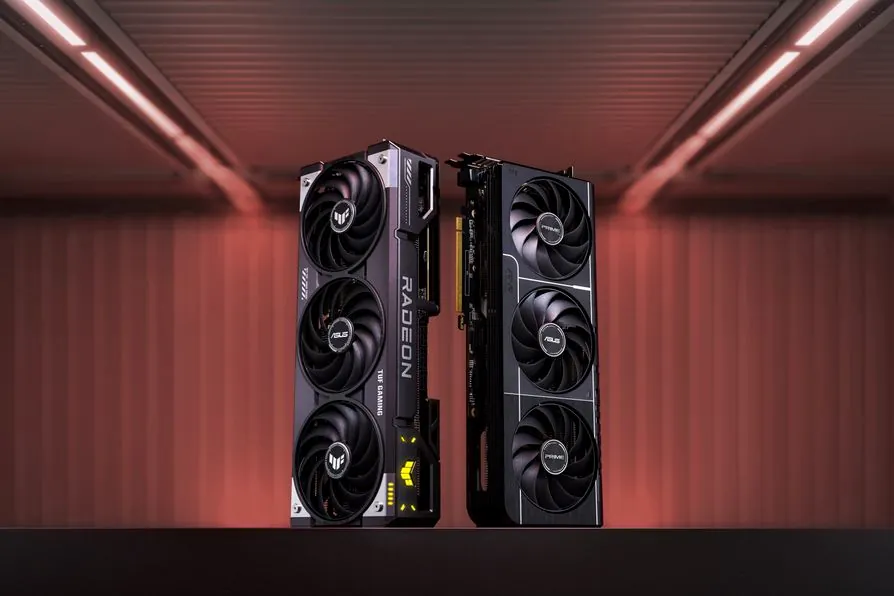
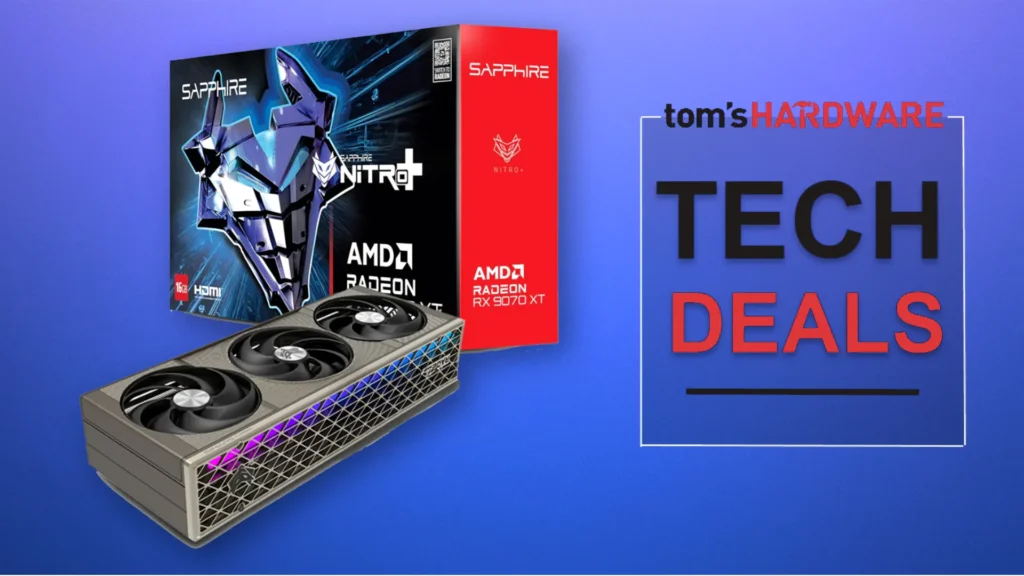
Key AIB Design Innovations
- ASUS Thermal Tech: ASUS has introduced a significant longevity enhancement by replacing standard thermal paste with an electrically non-conductive phase-change thermal pad. This material is solid at room temperature but liquifies under load, offering vastly superior stability and lifespan compared to conventional pastes.
- Sapphire Nitro+: Continuing its tradition of high-end cooling, the Nitro+ utilizes a massive triple-slot cooler, featuring a unique flow-through fan design (the third fan exhausts air through the backplate) and includes a mandatory physical Dual BIOS switch for safe overclocking experimentation.
- XFX Swift: The Swift model is built with a robust 3.5-slot profile and features double ball bearing fans for extended durability. It also employs PTM7950 as its thermal interface material, known for excellent low-temperature performance and consistency.
- Power Connectors: In a move that will please builders, most high-end XT models rely on traditional 3x 8-pin PCIe connectors, safely avoiding the problematic 12VPWR standard used by some competing high-end Nvidia cards.
Final Verdict: Recommendation Score 9.2/10
The Radeon RX 9070 XT is not just a competitive mid-range card; it’s a defining moment for AMD’s software ecosystem. By focusing on superior native rasterization and leveraging the groundbreaking image quality and performance of ML-powered FSR 4, AMD has delivered a card that provides a compelling 4K experience for $599. While community enthusiasts will always push the hardware limits, the necessity for risky vBIOS modifications has been dramatically reduced. FSR 4 gives users the 40-50 FPS boost they need safely and reliably. The 9070 XT offers the best value proposition in its segment, backed by robust AIB designs and a powerful software roadmap that finally makes AMD competitive in the upscaling and RT landscape.
Frequently Asked Questions (FAQ)
Is the RX 9070 XT faster than the RX 7900 XTX?
No. The RX 9070 XT is positioned against the RTX 5070 Ti/4080 Super and is not intended to compete for the top spot. Early performance indications suggest the older 7900 XTX is expected to remain AMD’s overall flagship.
Does the RX 9070 XT use the 12VHPWR connector?
No. The RX 9070 XT universally employs standard 8-pin power connectors (typically two or three depending on the AIB model), avoiding the controversial 12VHPWR standard used by some competing Nvidia cards.
What is the best way to safely optimize the RX 9070 XT?
The safest and most effective optimization is undervolting (UV) the GPU core, typically in the -50mV to -100mV range, combined with VRAM overclocking (up to 2700-2800MHz). This boosts performance without voiding the warranty or risking hardware damage.