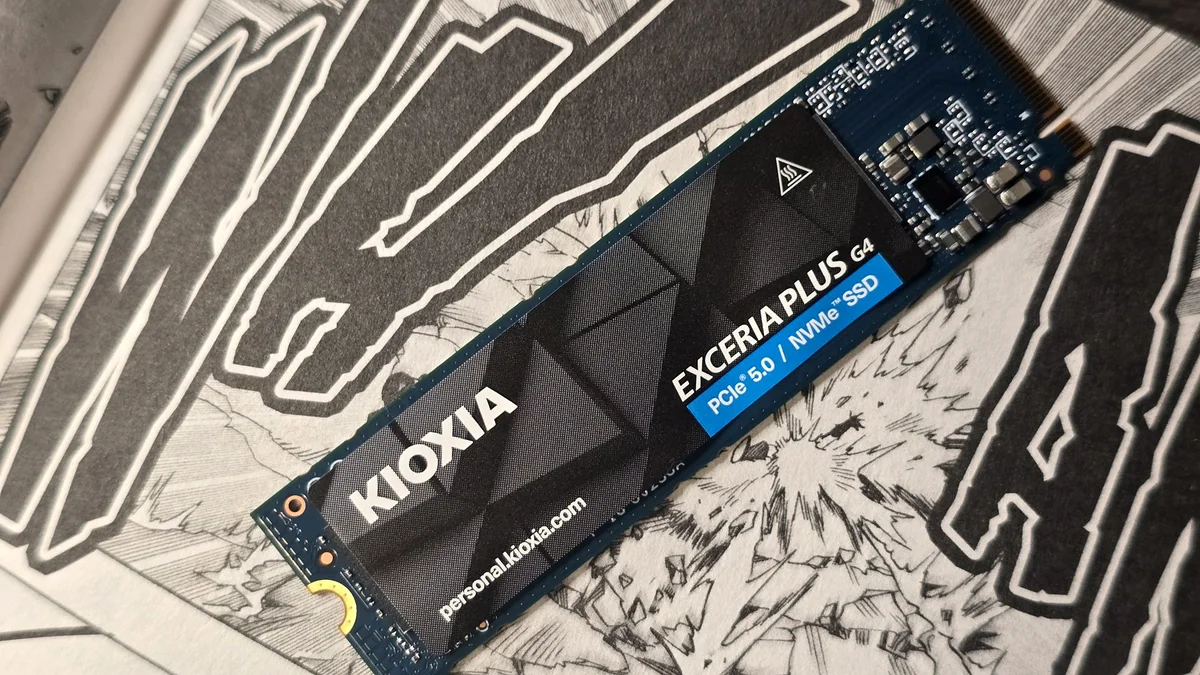
- Mainstream Maturity: The Exceria Plus G4 marks the shift toward efficient PCIe 5.0, utilizing the new 7nm Phison E31T controller to achieve an 80% power efficiency gain over the G3 series.
- Tiered Performance: While both models hit 10,000 MB/s reads, the 2TB model offers 8,200 MB/s write speeds, while the 1TB model delivers 7,900 MB/s.
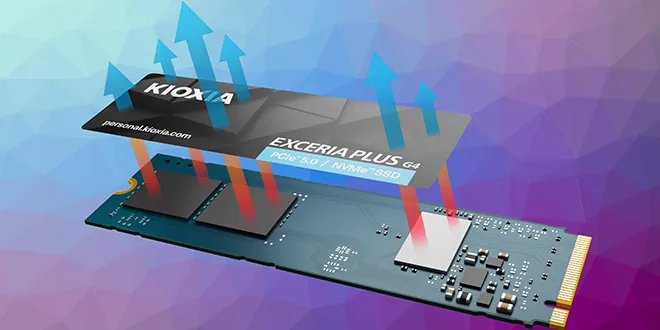
- Thermal Solution: By combining BiCS8 NAND with a 7nm process, Kioxia has created a Gen 5 drive that runs cool enough for laptops and the PS5 without requiring a massive, bulky heatsink.
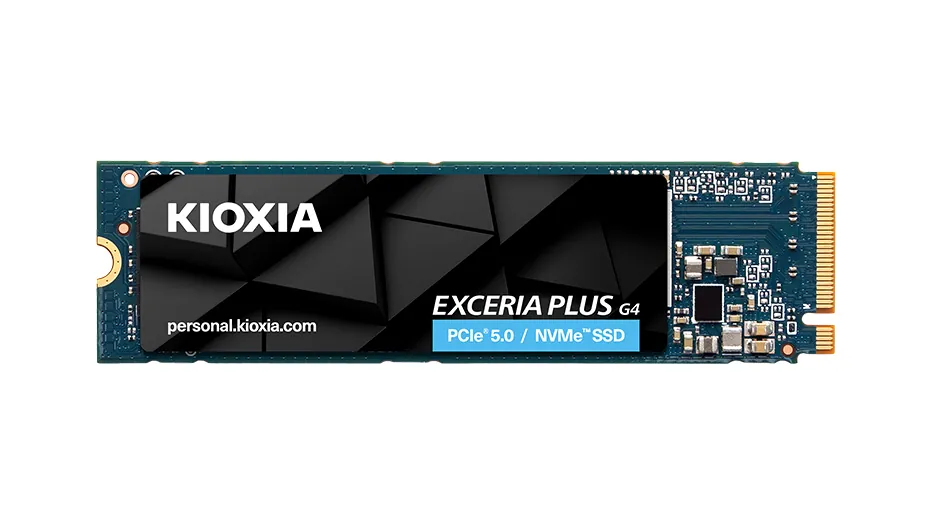
For over a year, PCIe 5.0 SSDs were defined by two things: blistering speed and crippling heat. Drives using the flagship Phison E26 controller required massive, often actively-cooled heatsinks, making them unusable in thin laptops, most SFF builds, and even the PlayStation 5. The Kioxia Exceria Plus G4 changes that narrative entirely. By leveraging the new, highly efficient Phison E31T controller and Kioxia’s own 218-Layer BiCS8 TLC NAND, the G4 delivers Gen 5 speeds (up to 10 GB/s) while maintaining thermal profiles comparable to a high-end Gen 4 drive. This is not the fastest SSD on the market, but it is arguably the most important mainstream PCIe 5.0 release yet, prioritizing compatibility and efficiency over raw, unsustainable peak throughput.
The Thermal Breakthrough
The Kioxia G4 is one of the first Gen 5 drives verified to run safely in thermally constrained environments. Testing shows peak temperatures under heavy load rarely exceed 60°C, staying well below the throttling point. This validates its use in modern gaming laptops and the PS5 expansion slot where bulky heatsinks are prohibited.
Engineering Deconstructed: The Phison E31T and BiCS8 NAND Synergy
The technical heart of the Exceria Plus G4 is the Phison PS5031-E31T, a triple-core ARM 32-bit Cortex-R5 controller fabricated on TSMC’s advanced 7nm process. This 7nm efficiency is the primary driver behind the G4’s staggering 80% improvement in performance-per-watt over the previous G3 generation. To keep costs and heat in check, Kioxia utilizes a DRAM-less design paired with a 64MB Host Memory Buffer (HMB) configuration. This controller works in tandem with Kioxia’s 218-layer BiCS8 TLC NAND, which provides the high-density throughput required to hit 10 GB/s without the thermal runaway seen in earlier 12nm-based Gen 5 controllers.
Full Technical Specifications: 1TB vs. 2TB Comparison
| Kioxia Exceria Plus G4 Performance Matrix | ||
|---|---|---|
| Feature | 1TB (LVD10Z001TG8) | 2TB (LVD10Z002TG8) |
| Sequential Read Speed | 10,000 MB/s | 10,000 MB/s |
| Sequential Write Speed | 7,900 MB/s | 8,200 MB/s |
| Random Read (IOPS) | 1,300,000 | 1,300,000 |
| Random Write (IOPS) | 1,400,000 | 1,400,000 |
| Endurance (TBW) | 600 TBW | 1,200 TBW |
| Warranty / MTTF | 5-Year / 1.5M Hours | 5-Year / 1.5M Hours |
Market Context: G4 vs. The Competition
| Drive Model | Controller | Max Read Speed | Launch Price (2TB) |
|---|---|---|---|
| Kioxia Exceria Plus G4 | Phison E31T (7nm) | 10,000 MB/s | $225 |
| Corsair MP700 Elite | Phison E31T (7nm) | 10,000 MB/s | $180 |
| Samsung 990 Pro (Gen 4) | Samsung Pascal | 7,450 MB/s | $170 |
Performance Analysis: Benchmarks and Consistency
Beyond official specs, third-party validation from PassMark highlights the G4’s competitive edge. The drive achieved an Average Disk Rating of 60,108, which places it ahead of established Gen 4 leaders like the WD Black SN850X and Samsung 990 Pro in raw synthetic throughput. Responsiveness is equally impressive for a DRAM-less drive, with a 4KQD1 IOPS score of 114 MBytes/Sec. This metric is particularly important for gamers, as it translates to faster UI interactions and snappier OS performance, proving that Kioxia’s HMB implementation effectively mitigates the lack of dedicated DRAM cache.
While the G4 excels in responsiveness, users performing massive data transfers must be aware of its cache behavior. The 2TB model features a very large pSLC cache, potentially up to 440GB, allowing for peak write speeds (up to 8.8 GB/s) for nearly a minute. However, once this cache is saturated, the drive enters a direct-to-TLC mode, where sustained writes drop significantly to around 1.5 GB/s. For typical gaming and client PC workloads, where data transfers are bursty, this saturation is rare, but content creators handling massive files should be mindful of this limitation inherent to DRAM-less designs. This is the fundamental trade-off for achieving such low power consumption.
Gaming and Console Compatibility (PS5 Verified)
Key Compatibility and Gaming Metrics
- PS5 Compatibility: Kioxia officially confirmed compatibility with the PS5, based on testing with system software version 23.02-08.40.00.05-00.00.00.0.1.
- Game Load Times: Achieved a game load time of 5.8 seconds in the Final Fantasy Benchmark, placing it in the Top 10 of all tested SSDs.
- 3DMark Storage Score: The G4 showed a 9% speed boost in gaming traces relative to its PCMark 10 scores, indicating strong optimization for gaming workloads.
- Efficiency Advantage: The low power draw and minimal heat output make it a superior choice for SFF cases or laptops where airflow is limited.

- Excellent power efficiency (80% more efficient than Gen 3).
- First PCIe 5.0 drive safe for laptops and PS5 without a bulky heatsink.
- Strong 1TB performance (7,900 MB/s write) for entry-level Gen 5 builds.
- Utilizes advanced 218-Layer BiCS8 NAND.
- Robust 5-year warranty.
- Pricing is currently higher than the Corsair MP700 Elite ($225 vs $180 for 2TB).
- Sustained write performance drops significantly after pSLC cache saturation.
- No 4TB capacity option available.
Final Verdict
The Kioxia Exceria Plus G4 is a landmark product. It’s not about winning the sequential speed race; it’s about winning the efficiency race. By solving the thermal and power issues that plagued early Gen 5 adoption, the G4 makes 10 GB/s performance accessible and practical for the mainstream market, including laptop and PS5 users. While its DRAM-less design means it loses to the E26 in sustained workstation tasks, its low latency and efficiency make it an excellent, responsible choice for gamers and everyday high-performance users. If you need Gen 5 speed but cannot accommodate a giant heatsink, this is currently the best option available.